
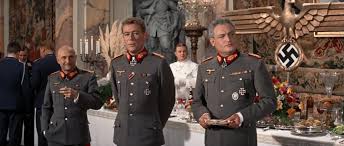
Introduction
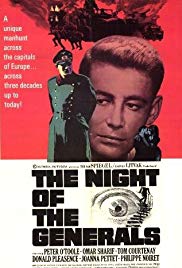
In 1942, a Polish prostitute and German Agent is murdered in Warsaw.
Suspicion falls on three Generals, and Major Grau (Omar Sharif) of German Intelligence seeks justice which ends up taking decades.
Outline
The murder of a prostitute in German-occupied Warsaw in 1942 causes Major Grau of the Abwehr to start an investigation, as she was also a German agent. His evidence soon points to the killer being one of three German generals: General von Seidlitz-Gabler; General Kahlenberge, his chief of staff; or General Tanz. Grau’s investigation is cut short by his summary transfer to Paris at the instigation of these officers.
The case in Warsaw remains closed until all three officers meet in Paris in July 1944. Paris is then a hotbed of intrigue, with senior Wehrmacht officers plotting to assassinate Adolf Hitler. Kahlenberge is deeply involved in the plot, while von Seidlitz-Gabler is aware of its existence but is sitting on the fence, awaiting the outcome. Tanz is unaware of the plot and remains totally loyal to Hitler.
On the night of 19 July 1944, Tanz orders his driver, Kurt Hartmann, to procure a prostitute; Tanz butchers her so as to implicate Hartmann, but offers Hartmann the chance to desert, which he accepts. When Grau, who is now a Lieutenant Colonel, learns of the murder, committed in the same manner as the first, he resumes his investigation and concludes that Tanz is the killer. However, his timing is unfortunate, because the very next day is the 20 July assassination attempt. While Grau is accusing Tanz face to face, word arrives that Hitler has survived, so Tanz kills Grau and labels him as one of the plot conspirators to cover his tracks.
Jumping to 1965, the murder of a prostitute in Hamburg draws the attention of Interpol Inspector Morand, who owes a debt of gratitude to Grau for not revealing his connection to the French Resistance during the war. Almost certain there is a connection to Grau’s 1942 case, Morand reopens the cold case, soon finding a link to the 1944 murder as well.
Morand begins to tie up the loose ends: he finds no criminal activity from Kahlenberge or Seidlitz-Gabler, but learns of one man who knew which man is the real killer. Morand confronts Tanz, recently released after serving 20 years as a war criminal, at a reunion dinner for Tanz’s former panzer division. When Morand produces Hartmann as his witness, Tanz goes into a vacant room and shoots himself.
Film Inspiration
The film is based on the 1962 novel ‘The Night of the Generals by Hans Hellmut Kirst and an incident written by James Hadley Chase.
Trivia & Goofs
- Christopher Plummer (Field Marshal Rommel) received a Rolls-Royce from producer Sam Spiegel as payment for his role.
- This movie was one of the last to run into heavy censorship trouble before the abolition of the Production Code Administration and its replacement with the voluntary ratings system (G through X) by the Motion Picture Association of America (MPAA) in 1968. According to former PCA Director Geoffrey Shurlock, this movie was troublesome due to its depictions of sexual behaviour, which the producers tried to get away with by using silhouettes and shadows.
- Gore Vidal originally wanted Sir Dirk Bogarde for the role of Major Grau, but producer Sam Spiegel objected.
- Donald Pleasence, Nigel Stock, and Gordon Jackson played German soldiers in this movie, which was shot just a few years after The Great Escape (1963), in which the same three played British prisoners plotting to escape from a German P.O.W. camp.
- The same year that this movie was released, Charles Gray and Donald Pleasence appeared in the James Bond movie You Only Live Twice (1967). In it, Pleasence played Ernst Stavro Blofeld, a role that Gray played in Diamonds Are Forever (1971).
- The Polish army contributed approximately two hundred troops to play German soldiers, and they also provided their own weapons, tanks, and vehicles. Not all of them were period-correct, however.
- Producer Sam Spiegel chose Anatole Litvak as the director for this movie because Litvak owned the rights to the novel.
- The car in which Corporal Hartmann (Sir Tom Courtenay) drives General Tanz (Peter O’Toole) around Paris is a 1936 Hispano-Suiza K6. French-built Hispano Suizas were always right-hand drive.
- While shooting on-location in Warsaw, Poland in the winter, Omar Sharif took a break and walked into a small café to warm up, still wearing his uniform costume. This raised a panic reaction from the café’s patrons, and he was refused service, despite his attempts at explaining he was an American actor making a movie, and that the war had been over for almost twenty-two years by then.
- Marlon Brando turned down a leading role.
- This was the first time a major U.S. production company was allowed to film in Communist Poland. Permission was granted after the script was re-written to have General Tanz (Peter O’Toole) changed after the war from an East German General to a neo-Nazi leader in West Germany.
Production & Filming Details
- Director: Anatole Litvak.
- Producer: Sam Spiegel.
- Writers: Joseph Kessel and Paul Dehn (screenplay).
- Music: Maurice Jarre.
- Cinematography: Henri Decaë.
- Editor: Alan Osbiston.
- Production: Horizon Pictures and Filmsonor.
- Distribution: Columbia Pictures.
- Release Date: 29 January 1967 (UK).
- Running time: 145 minutes.
- Country: UK, France, and US
- Language: English.
YouTube Link

 Military Gogglebox
Leave a comment