
Introduction

An RAF squadron is assigned to knock out a German rocket fuel factory in Norway. The factory supplies fuel for the Nazi effort to launch rockets on England during D-Day.
Outline
After the Norwegian resistance leader Royal Norwegian Navy Lieutenant Erik Bergman travels to Great Britain to report the location of a German V-2 rocket fuel plant, the Royal Air Force’s No. 633 Squadron is assigned to destroy it. The squadron is led by Wing Commander Roy Grant, an ex-Eagle Squadron pilot (an American serving in the RAF before the US entered the war).
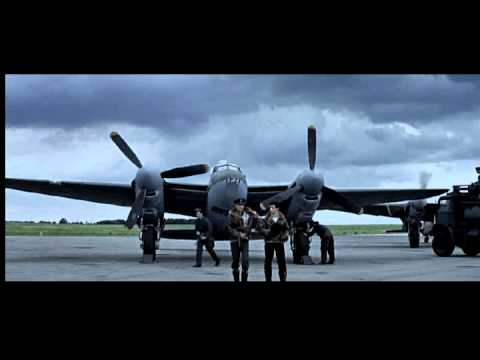
The plant is in a seemingly impregnable location beneath an overhanging cliff at the end of a long, narrow fjord lined with numerous anti-aircraft guns. The only way to destroy the plant is by bombing the cliff until it collapses and buries the facility, a job for 633 Squadron’s fast and manoeuvrable de Havilland Mosquitos. The squadron trains in Scotland, where there are narrow glens similar to the fjord. There, Grant is introduced to Bergman’s sister, Hilde. They are attracted to each other, despite Grant’s aversion to wartime relationships.
The Norwegian resistance is tasked with destroying the anti-aircraft defences of the facility immediately before the scheduled attack. When unexpected German reinforcements arrive, Bergman returns to Norway to try to gather more forces. However, he is captured while transporting desperately needed weapons, taken to Gestapo headquarters and tortured for information. Since Bergman knows too much, he must be silenced before he breaks. Grant and newly married Pilot Officer Bissell are sent in with a single Mosquito to bomb the Gestapo building. Though they are successful, their shot-up Mosquito fighter-bomber crashes on its return, and Bissell is wounded and becomes blind. A tearful Hilde thanks Grant for ending her brother’s suffering.
Still worried, Air Vice-Marshal Davis decides to move up the attack to the next day. However, the resistance fighters are ambushed and killed, leaving the defences still intact. Although Grant is given the option of aborting, he decides to press on. The factory is destroyed at the cost of the entire squadron, though a few crews are able to ditch in the fjord. Grant crash-lands but a local man helps Grant’s navigator, Flight Lieutenant Hoppy Hopkinson, pull the wounded wing commander from the burning wreckage. Back in Britain, Davis tells a fellow officer who is aghast at the losses, “You can’t kill a squadron.”
Film Inspiration
The plot, which involves the exploits of a fictional World War II British fighter-bomber squadron, was based on a novel of the same name by former Royal Air Force officer Frederick E. Smith, published in 1956, which itself drew on several real RAF operations.
Trivia & Goofs
- Cliff Robertson, an accomplished pilot, wanted to buy one of the Mosquitoes after filming had finished, as he was so impressed with the type. He was not permitted to do this but he later bought a Spitfire Mk IX which he owned until the late 1990s.
- Four of the De Havilland Mosquitos seen in this film were airworthy and three could taxi on the ground. The same crash at Abindon Airfield, U.K., shot from a different angle, was used with matte painting (by Tom Howard’s special effects team) to look like it was crashing in Norway, when in fact no shooting was done in Norway. For scenes set in Norway, the mountains of Scotland were pressed into service.
- The German “fighters” were actually four-seat Messerschmitt 108 “Taifuns,” painted to look like ME-109 fighters.
- Director Walter Grauman was a bomber pilot during World War II.
- One of the Mosquitoes seen in the film (number TA639) is on show in the permanent collection of World War II aircraft at the RAF Museum at Cosford in Shropshire, UK.
- This was the first aviation movie to be filmed in colour.
Production & Filming Details
- Director: Walter Gtauman.
- Producers: Cecil F. Ford & Lewis J. Rachmil.
- Writers: Frederick E. Smith (novel, James Clavell, and Howard Koch.
- Music: Ron Goodwin.
- Cinematography: Edward Scaife.
- Release Date: 04 June 1964 (UK).
- Running time: 102 minutes.
- Country: UK.
- Language: English.
YouTube Link


 Military Gogglebox
Leave a comment