
Introduction
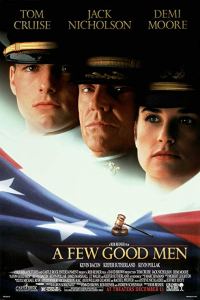
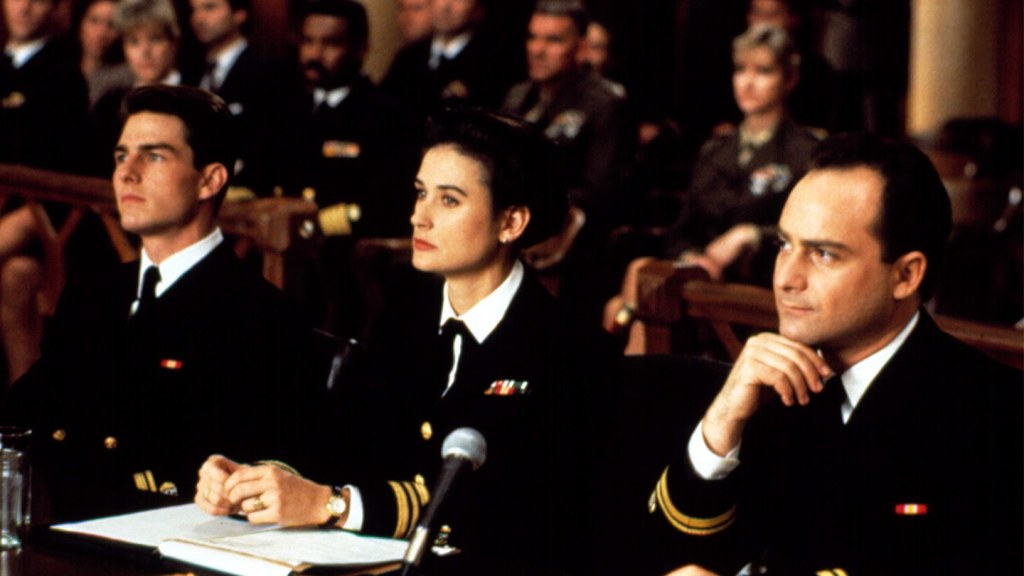
A Few Good Men is a 1992 American legal drama film directed by Rob Reiner and starring Tom Cruise, Jack Nicholson, and Demi Moore, with Kevin Bacon, Kevin Pollak, Cuba Gooding Jr., Wolfgang Bodison, James Marshall, J. T. Walsh, and Kiefer Sutherland in supporting roles. It was adapted for the screen by Aaron Sorkin from his play of the same name but includes contributions by William Goldman. The film revolves around the court-martial of two U.S. Marines charged with the murder of a fellow Marine and the tribulations of their lawyers as they prepare a case to defend their clients.
Outline
U.S. Marines Lance Corporal Harold Dawson and Private First Class Louden Downey are facing a general court-martial, accused of murdering fellow Marine Private First Class William Santiago at the Guantanamo Bay Naval Base in Cuba. Santiago had poor relations with his fellow Marines, compared unfavourably to them, and broke the chain of command in an attempt to get transferred out of Guantanamo. Base Commander Colonel Nathan Jessup (Jack Nicholson) and his officers argue about the best course of action: while Jessup’s executive officer, Lieutenant Colonel Matthew Markinson (J.T. Walsh), advocates that Santiago be transferred, Jessup dismisses the option and instead orders Santiago’s commanding officer, Lieutenant Jonathan James Kendrick (Kiefer Sutherland), to ‘train’ Santiago to become a better Marine.
While it is believed that Santiago’s death was retribution for him naming Dawson in a fenceline shooting, Naval investigator and lawyer Lieutenant Commander JoAnne Galloway (Demi Moore) largely suspects Dawson and Downey carried out a “code red” order: a violent extrajudicial punishment. Galloway wants to defend them, but the case is given to Lieutenant (Junior Grade) Daniel Kaffee (Tom Cruise) – an inexperienced and unenthusiastic lawyer with a penchant for plea bargains. The two instantly embark on a conflict, with Galloway becoming unsettled with Kaffee’s apparent laziness whilst Kaffee resents Galloway’s interference. Dawson shows outright contempt for Kaffee, refusing to salute or acknowledge him as an officer. When Kaffee negotiates a plea bargain with the prosecutor, Dawson and Downey refuse to go along, insisting that Kendrick had indeed given them the “code red” order and that they never intended Santiago to die. When Kaffee and Galloway question Jessup, he claims Santiago was set to be transferred.
Galloway convinces Kaffee to take the case to court. The defence manages to establish the existence of “code red” orders at Guantanamo, and that Dawson specifically had learned not to disobey any order after Kendrick denied him a promotion for helping out a Marine that was apparently given a “code red”. However, they suffer two major setbacks: Downey, under cross-examination, reveals he was not actually present when Dawson received the supposed “code red” order, and Markinson, ashamed that he failed to protect a Marine under his command, tells Kaffee that Jessup never ordered the transfer, but commits suicide rather than testifying.
Without Markinson’s testimony, Kaffee believes the case lost. He later returns home in a drunken stupor, lamenting that he fought the case instead of taking a deal. Galloway encourages Kaffee to call Jessup as a witness, despite the risk of being court-martialed for smearing a high-ranking officer. Jessup spars evenly with Kaffee’s questioning, but is unnerved when Kaffee points out a contradiction in his testimony: Jessup stated his Marines never disobey orders and that Santiago was to be transferred for his own safety, but, having ordered his men to leave Santiago alone, then Santiago was in no danger. Irate at being caught in a lie and disgusted by what he sees as Kaffee’s impudence towards the Marines, Jessup extols the military’s importance, and his own, to national security. When asked point-blank if he ordered the “code red”, Jessup bellows with contempt that he did and is promptly arrested.
Dawson and Downey are cleared of the murder charge, but found guilty of “conduct unbecoming” and ordered to be dishonourably discharged. Dawson accepts the verdict, but Downey does not understand what they did wrong. Dawson explains that they had failed to defend those too weak to fight for themselves, like Santiago. As the two are leaving, Kaffee tells Dawson that he does not need to wear a patch on his arm to have honor. Dawson sheds his previous contempt for Kaffee, acknowledges him as an officer, and renders a salute. The film ends with Kaffee and Ross exchanging kudos before Ross departs to arrest Kendrick.
Trivia & Goofs
- Jack Nicholson repeated his famous courtroom monologue as Colonel Jessep off-camera several times so Rob Reiner could film the reactions of other actors and actresses from various angles. Nicholson’s memorable on-camera performance was filmed last, but according to Reiner and the other cast members, Nicholson gave it his all every take as if he was on camera. Nicholson said he was “quite spent” by the time he finished.
- The original play was inspired by an actual Code Red at Guantanamo Bay. Lance Corporal David Cox and nine other enlisted men tied up a fellow Marine and severely beat him for snitching to the Naval Criminal Investigative Service. Cox was acquitted and later honourably discharged. In 1994, David Cox mysteriously vanished, and his bullet-riddled body was found three months later. His murder remains unsolved.
- Tom Cruise’s Jack Nicholson impersonation (when his character is quoting Colonel Jessep) was not scripted. Demi Moore’s and Kevin Pollak’s reactions are genuine.
- The Defence Department refused to endorse the film. This meant that the filmmakers couldn’t utilise any military installations during filming. Most of it was shot on a Culver City soundstage.
- The word “sir” is used 164 times during the movie. That’s an average of once every 50 seconds.
Production & Filming Details
- Director: Rob Reiner.
- Producers: Rob Reiner, David Brown, and Andrew Scheinman.
- Writers: Aaron Sorkin.
- Music: Marc Shaiman.
- Cinematography: Robert Richardson.
- Editor: Robert Leighton.
- Production: Castle Rock Entertainment.
- Distributor: Columbia Pictures.
- Release Date: 11 December 1992 (US), 01 January 1993 (UK).
- Running time: 138 minutes.
- Country: US.
- Language: English.
YouTube Link

 Military Gogglebox
Leave a comment