
Introduction
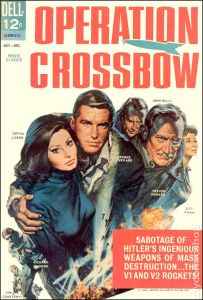
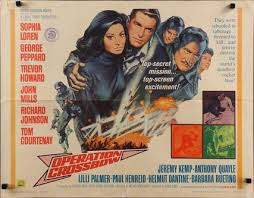
Operation Crossbow, later re-released as The Great Spy Mission, was a 1965 British spy thriller and Second World War Metrocolor film about Operation Crossbow (1943−1945) in Panavision. It was directed by Michael Anderson and written by Emeric Pressburger, under the pseudonym “Richard Imrie”, Derry Quinn and Ray Rigby from a story from Duilio Coletti and Vittoriano Petrilli.
The film is a highly fictionalised account of the real-life Operation Crossbow, made with a large cast of the time’s popular film stars, but it does touch on the main aspects of the operation. The scenes alternate between Nazi German developments of the V-1 flying bomb and V-2 rocket, with a German cast speaking their own language, and British Intelligence and its agents who are attempting to defend against the threats.
Outline
From 1943, Nazi Germany started working on terror weapons, the V-1 flying bomb and V-2 rocket while British Intelligence learns about a new secret weapon. Technical problems with the V-1 lead the Germans to create a manned version to ascertain the flight problems of the rocket but all the test pilots are killed flying it. Aviator Hanna Reitsch (Barbara Rütting) successfully flies and lands the V-1 prototype, discovering the problem (mechanical shifting of the rocket’s weight and change of speed) and how to solve it, which leads to the mass production of the V-1.
Winston Churchill (Patrick Wymark) is concerned about rumours of a German flying bomb and orders Duncan Sandys, his son-in-law (Richard Johnson), one of his ministers, to investigate. Sandys is convinced by intelligence and photo-reconnaissance reports that the weapons exist, but sceptical scientific advisor Professor Lindemann (Trevor Howard) dismisses the reports as extremely fanciful (ultimately he is proved wrong when V-1s start falling on London a year later in June 1944). Bomber Command launches a raid on Peenemünde on 17/18 August 1943 to destroy the factory producing them.
The Germans move their factory underground in Southern Germany for protection and rush ahead with the development and production of the larger, more deadly V-2. The head of British intelligence (John Mills) learns that engineers are actively being recruited across occupied Europe for the new weapon and decides to infiltrate the factory. He finds three qualified volunteers, one an American, all experienced engineers who speak fluent German and Dutch. They are hastily trained and sent to Germany via the Netherlands. Amongst the volunteers interviewed but not selected is a British officer named Bamford (Anthony Quayle), who is actually a German undercover agent.
Just after the Allied agents are parachuted into occupied Europe, British Intelligence learns that one of them, Robert Henshaw (Tom Courtenay), has been given the cover identity of a Dutch sailor wanted by the police for murder. He is arrested but agrees to becoming an engineer to act as an informer for the Germans. However, he is recognised by Bamford, who has returned to Germany as a security officer. Refusing to reveal his mission, he is tortured by the Gestapo and then shot when he refuses to co-operate.
A further complication occurs when Nora (Sophia Loren), the wife of the man whom USAAF Lieutenant John Curtis (George Peppard) is impersonating, comes to visit her husband to obtain custody of their children. Although innocent, the wife can compromise the mission. Curtis assures Nora that she will be allowed to rejoin her children, but, to maintain the mission’s secrecy, after Curtis leaves, the German contact, Frieda (Lilli Palmer) who runs the hotel where Curtis is staying, kills Nora.
Curtis and Phil Bradley (Jeremy Kemp) manage to infiltrate the underground factory. Bradley is only able to work as a porter/cleaner, but Curtis manages to work his way into the heart of the project, where he is assigned to fix the problem of engine vibration that is holding up the V-2’s development.
The two agents send back information and learn that the Royal Air Force is mounting a nighttime bombing raid on the facility, but the protective doors on the ceiling, that cover the ready-to-launch large A9/A10 “New York Rocket”, must be opened to expose the plant and provide a landmark for the bombers. The controls are in the powerhouse; while Bradley is captured at the threshold, Curtis is able to shoot his way inside and seal himself in. The Germans try to stop him by using Bradley as bargaining chip, but as the bombers close in, Bradley reveals to Curtis the lever which opens the main launch door and is shot by Bamford. As the Germans frantically try to start the missile, Curtis opens the main launch door and holds his position until the bombers arrive. The raid succeeds in obliterating the factory.
Production & Filming Details
- Director: Michael Anderson.
- Producer: Carlo Ponti.
- Screenplay: Emeric Pressburger, Derry Quinn and Ray Rigby.
- Story: Duilio Coletti and Vittoriano Petrilli.
- Music: Ron Goodwin.
- Cinematography: Erwin Hillier.
- Editor: Ernest Walter.
- Production: MGM-British Studios.
- Distributor: MGM.
- Release Date: March 1965 (UK).
- Running Time: 115 minutes.
- Country: UK.
- Language: English and German.
YouTube Link


 Military Gogglebox
Leave a comment