

Introduction
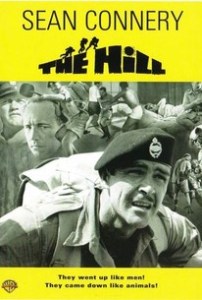
The Hill is a 1965 film directed by Sidney Lumet, set in a British army prison in North Africa in the Second World War.
It stars Sean Connery, Harry Andrews, Ian Bannen, Ossie Davis, Ian Hendry, Alfred Lynch, Roy Kinnear and Michael Redgrave.
Outline
In a British Army “glasshouse” (military prison) in the Libyan Desert, prisoners convicted of service offences such as insubordination, being drunk while on duty, going absent without leave (AWOL) or petty theft etc. are subjected to repetitive drill routines as a punishment in the blazing desert heat.
The arrival of five new prisoners slowly leads to a clash with the camp authorities. One new NCO guard who has also just arrived employs excessive punishments, which include forcing the five newcomers to repeatedly climb a man-made hill in the centre of the camp. When one dies, a power struggle erupts between brutal Staff Sergeant Williams (Ian Hendry), humane Staff Sergeant Harris (Ian Bannen), Regimental Sergeant Major (RSM) Wilson (Harry Andrews) and the camp’s Medical Officer (Michael Redgrave) as they struggle to run the camp in conflicting styles.
Roberts (Sean Connery) is a former Squadron Sergeant Major (SSM) from the Royal Tank Regiment, convicted of assaulting his commanding officer – which he explains to his fellow inmates was because he was ordered to lead his men in a senseless suicidal attack. Roberts openly scorns Williams’s brutality and serves as challenge to his authority. The RSM is a career soldier, powerful within the prison in which he is working, but realistic, “No one’s going to pin a medal on us”. However, he sees his duty to be as important as any other – that of breaking down failed soldiers, then building them back up again, in his words, “Into men!”
Staff Sergeant Williams is new to the prison, and his ambition is matched only by his cruel treatment of the prisoners; he seeks to use their suffering as means for promotion. When Roberts is accused of cowardice, he asks Staff Sergeant Williams, “And what are you supposed to be – a brave man in a permanent base job?” The RSM also questions Staff Sergeant Williams motives for getting out of London, as in another scene, he slyly mentions the fact that the Germans were bombing the UK (including the civilian prison Williams worked at) just as Williams was volunteering for prison duty in Africa. Staff Sergeant Williams openly admits that he is trying to impress the RSM by showing that he has got what it takes to do the job, and attempts to undermine the RSM with a late night drinking contest.
Staff Sergeant Harris is the conscience of the prison who sympathises with the men, too closely, according to the RSM. The officers, both the CO (Norman Bird) and the Medical Officer, take their duties casually and, as Roberts points out, “everyone is doing time here, even the screws” (prison officers).
In the finale, the camp’s Medical Officer and Staff Sergeant Harris decide to report the abuses at the camp. Sadistic Staff Sergeant Williams goes to administer one final, perhaps fatal, beating to Sergeant Major Roberts, when two prisoners intervene and appear to attack and very severely beat Williams. Roberts pleads with them to stop, knowing that if the prisoners beat up a prison officer, then any case they may have had against them is hopelessly lost, they are still prisoners, and the prison staff have a much stronger hand to inflict whatever cruelty they now wish to.
Production & Filming Details
- Director: Sidney Lumet.
- Producer: Kenneth Hyman
- Writer: R.S. Allen (play) and Ray Rigby (screenplay).
- Cinematography: Oswald Morris.
- Editor: Thelma Connell.
- Production: Seven Arts Productions.
- Distributor: MGM.
- Release Date: May 1965 (Cannes Film Festival).
- Running Time: 123 minutes.
- Country: UK.
- Language: English.
YouTube Link


 Military Gogglebox
Leave a comment