
Introduction
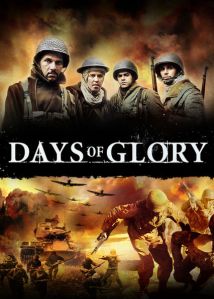
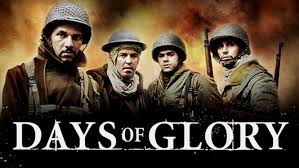
Days of Glory (French: Indigènes – “Natives”; Arabic: بلديون) is a 2006 French film directed by Rachid Bouchareb. The cast includes Sami Bouajila, Jamel Debbouze, Samy Naceri, Roschdy Zem, Mélanie Laurent and Bernard Blancan.
Outline
In French North Africa in 1943 large numbers of men from France’s overseas possessions have been recruited into the French First Army of the Free French Forces to fight alongside the other Allies against Nazi Germany and liberate France from occupation. The army consists of two main elements: pieds-noirs, that is people of mostly European descent, and indigènes, those of mostly African descent. The “indigènes” in turn consist of three main groups: Algerians, Moroccans (known as goumiers), and troops from Sub-Sahara Africa.
Saïd, an impoverished goat herder, joins the 7th RTA (Régiment de Tirailleurs Algériens). With him are other Algerians including Messaoud, who wants to marry and settle in France, and the literate Corporal Abdelkader, who seeks equality with settlers for the indigenous people of his country. There are also two Moroccan brothers Yassir and Larbi, Yassir’s aim being booty so that Larbi can afford to marry.
Soon the men, dressed in mostly lend-lease American uniforms meet Sergeant Martinez, a battle-hardened pied-noir, who trains them before leading them on their first engagement against the Germans in Italy. Their mission is to capture a heavily-defended mountain, but it soon becomes clear that their white commanding officer is using them as cannon fodder to identify artillery targets. The colonial troops eventually succeed, at the cost of high casualties. When asked by a French war correspondent about his thoughts on the losses, the white colonel replies, “today was a great victory for the Free French Forces”.
The troops of the 7th RTA next embark for Operation Dragoon, to liberate the south of France.[4] While aboard ship, a white cook refuses to give tomatoes to black soldiers. Abdelkader calls for equality, but mutiny is averted when Martinez and the company captain promise that everyone will be treated the same.
On arrival at Marseille, the colonial troops are greeted as heroes. Messaoud meets and courts Irène, a French woman, promising when the regiment leaves that he will write and one day return. She says she’ll wait for him and they will marry. However, due to censorship of soldiers’ mail, Irène never learns Messaoud’s fate.
Saïd becomes Martinez’s orderly, for which the other soldiers call him “girlie” and imply he’s gay. Eventually he snaps and holds a knife to Messaoud’s throat. Abdelkader calms the situation, but Saïd makes it clear that in this segregated world the French authorities will not give their colonial soldiers anything. Having seen among Martinez’s possessions a family photograph, while drinking with the sergeant Saïd mentions that the two of them are similar in both having an Arab mother. The NCO attacks him and threatens to kill him if he reveals this secret.
The colonial troops discover that, while they are not granted leave, white members of the Free French Forces are allowed trips home. Eventually the men are told they will be going home, but it’s a ruse; instead, they are billeted behind the lines and given a ballet performance. Bored and disillusioned, most leave the tent and hold a meeting outside decrying the injustice. Martinez challenges the group, led by Abdelkader, and a fight starts.
Early next morning, French military police bring Messaoud to a temporary stockade where Abdelkader is also being held. Messaoud says he was arrested for trying to go back to Marseille and find Irène. Abdelkader is brought before the white colonel who tells him that he needs him to go on a special mission: to take ammunition to American troops fighting in the Lorraine Campaign and also be the first French troops to liberate Alsace. The white officer promises that Abdelkader and the other colonial soldiers will get the rewards and recognition that success in this operation will bring. Later, the white company captain tells the corporal that the colonel will keep his word.
As they cross the German lines, most of the men are killed by a booby trap, including Yassir’s brother, and Martinez is severely injured. The survivors mostly want to go back, but Abdelkader rallies them to push on. Eventually the corporal, Saïd, Messaoud, Yassir and the wounded Martinez reach an Alsatian village. Over the next few days the soldiers ingratiate themselves into the area and Saïd befriends a milkmaid. When a unit of Germans arrives into the village, a battle breaks out. Messaoud is badly hurt by a Panzerschreck rocket and then shot by a German rifleman. Saïd attempts to evacuate Martinez, but they are both shot by the Panzerschreck, killing Saïd and further wounding Martinez, who is quickly finished off. Abdelkader and Yassir attempt to flee, but Yassir is shot in the back by a German. However, just as the corporal is cornered, more colonial troops arrive and drive the Germans out of the village.
As columns of Free French forces begin to move through the area, Abdelkader sees the colonel passing in his jeep, but the white commanding officer ignores him and he is pulled away by a staff officer who asks him where his unit is. When Abdelkader says they are all dead, he is simply assigned to another white NCO. As he walks out of the village, he passes a film cameraman filming only white troops standing by the liberated villagers.
The movie then moves to the present day. An elderly Abdelkader goes to a war cemetery in Alsace to visit the graves of his comrades: Martinez, Saïd, Yassir and Messaoud. He then returns to his small rundown flat in modern-day France. The film concludes with the caption that from 1959 pensions for servicemen from France’s overseas possessions living in France enjoyed no increases after the date their country of origin became independent.
Trivia
- The film deals with the contribution of North African soldiers to the Free French Forces during the Second World War and, controversially, with the discrimination against them.
- The film’s release contributed to a partial recognition of the pension rights of soldiers from former French possessions by the French government.
- Cast members Jamel Debbouze, Samy Naceri, Roschdy Zem, Sami Bouajila and Bernard Blancan all won the Prix d’interprétation masculine at the 2006 Cannes Film Festival for their performances, and the film won the François Chalais Prize.
- It was also nominated for the Academy Award for Best Foreign Language Film.
Production & Filming Details
- Director(s): Rachid Bouchareb.
- Producer(s): Jean Brehat, Jaques-Henri Bronckart, Caroline Cochaux, Jamel Debbouze, Genevieve Lemal, Alexandre Lippens, Muriel Merlin, and Mehdi Sayah.
- Writer(s): Rachid Bouchareb and Olivier Lorelle.
- Music: Armnd Amar and Khalad.
- Cinematography: Patrick Blossier.
- Editor(s): Yannick Kergoat.
- Distributor(s): The Weinstein Company, IFC Films, UK Film Council, Metrodome Entertainment, Sky Movies, and BBC4.
- Release Date: 25 May 2006 (Cannes Film Festival).
- Running Time: 128 minutes.
- Country: France, Morocco. Belgium, and Algeria.
- Language: French and Arabic.


 Military Gogglebox
Leave a comment