
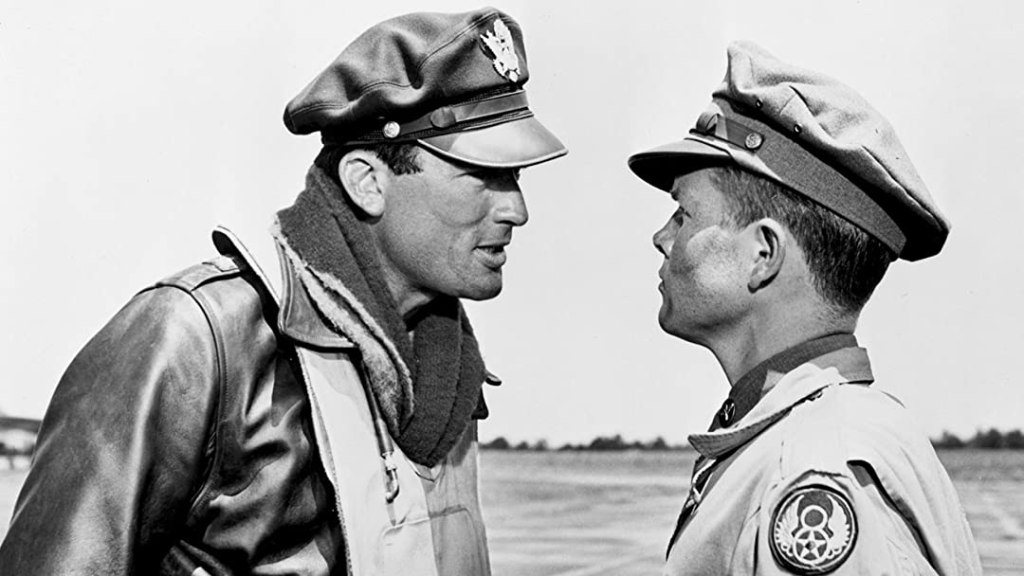
Introduction
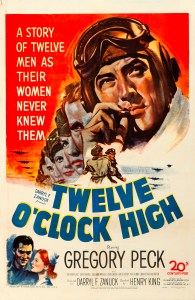
A 2007 special edition of the original 1949 film.
Twelve O’Clock High is a 1949 American war film about aircrews in the United States Army’s Eighth Air Force, who flew daylight bombing missions against Nazi Germany and occupied France during the early days of American involvement in World War II, including a thinly disguised version of the notorious Black Thursday strike against Schweinfurt.
The film was adapted by Sy Bartlett, Henry King (uncredited) and Beirne Lay Jr. from the 1948 novel 12 O’Clock High, also by Bartlett and Lay.
It was directed by King and stars Gregory Peck, Hugh Marlowe, Gary Merrill, Millard Mitchell and Dean Jagger.
Outline
In 1949, former U.S. Army Air Forces officer Harvey Stovall spots a familiar Toby Jug in the window of a London antique shop and learns that it came from Archbury, an airfield where Stovall served during World War II. Convinced that it is the same jug which used to stand on the mantle of the airfield’s officers’ club, he buys it and journeys to the derelict airfield.
Stovall remembers the events of 1942, when the 918th Bomb Group at Archbury had gained a reputation as the ‘hard luck group’. After a particularly disastrous mission, group commander Colonel Keith Davenport appears exhausted and demoralised. His defeatist attitude spreads to other senior leaders of the group, including his Air Exec, Lieutenant Colonel Ben Gately. Ordered to fly another mission the next day, at a dangerously low altitude, Davenport protests to his friend, Brigadier General Frank Savage, the Assistant Chief of Staff for Operations at VIII Bomber Command. Later, Savage reluctantly shares with Major General Pritchard, the commanding general of VIII Bomber Command, his belief that Davenport has become too emotionally close to his men and may no longer be fit to command. That night, Pritchard and Savage visit the group headquarters to investigate the cause of the mission’s heavy losses. Pritchard realises that Savage is right: Davenport has become over-protective and is unwilling to discipline his men even for costly mistakes. Davenport is relieved of command and Savage is asked to take over
Savage takes a harsh approach to restoring the group’s discipline and morale. He begins by reprimanding Lt. Col. Gately, demoting him to aircraft commander and insisting that he henceforth fly every mission. Savage assigns Gately only the most incompetent crewmen, ordering him to paint the name ‘Leper Colony’ on his airplane. Rough-and-ready Major Cobb impresses Savage with his independent spirit and replaces Gately as Air Exec. Savage conducts a series of training missions and waits for an opportunity to restore the group’s pride in its abilities. Upset by the contrast of Savage’s stern leadership with Davenport’s easygoing ways, all of the Squadron’s pilots apply for transfers. Savage asks the Group Adjutant, Major Stovall, to delay processing their applications to buy him some time. An attorney in civilian life, Stovall knows how to use organisational ‘red tape’ to his advantage.
When the Group returns to combat, all the groups are ordered to abort their mission due to heavy weather. Savage, leading the group, ignores the recall order. The 918th successfully bombs the target and is the only group to do so. All of its crews return safely. Though Pritchard is furious, Savage claims that he did not hear the recall due to radio malfunction and instead persuades Pritchard to recommend the group for a Distinguished Unit Citation. Savage also acquires a surrogate son in Lieutenant Jesse Bishop, a Medal of Honour recipient who is Savage’s eyes and ears among the combat aircrews. When the Inspector General arrives to investigate the pilots’ transfer requests, Savage packs his belongings, expecting to be relieved of command and possibly court-martialled. But, led by Bishop, the pilots withdraw their requests. Savage also softens his attitude towards the men as he becomes more closely involved with them. Gately goes on to win Savage’s respect and admiration by demonstrating extraordinary leadership and courage in combat.
With enemy resistance intensifying as the air war advances deeper into Germany, missions become longer and riskier and many of Savage’s best men are shot down or killed. Pritchard tries to get Savage to return to a staff job at VIII Bomber Command but Savage feels that the 918th is not yet ready to stand up without him. Reluctantly, Pritchard leaves him in command. Ordered to return to the same target after a particularly brutal raid on a ball bearing factory, Savage finds himself physically unable to haul himself up into his B-17. The redeemed Ben Gately takes his place as lead pilot and strike commander for the mission. While waiting for the group’s return, Savage becomes catatonic. Only as they return to Archbury does he regain his composure and fall asleep.
The story then returns to 1949, as Stovall pedals away from Archbury.
Special Edition Features
- Full Frame Feature.
- Commentary by World War 11 Film Historian.
- General Frank Armstrong: The Inspiration for General Savage.
- The Legacy of the Eighth Airforce.
- Memories of Twelve O’Clock High (documentary).
Various formats of the film (VHS Tape, Blu-Ray, and DVD) have been released since 2002).
Twelve O’Clock High Series
- Twelve O’Clock High (1949).
- Twelve O’Clock High: Special Edition (2007).
- 12 O’Clock High: Series 01 (1964-1965).
- 12 O’Clock High: Series 02 (1965-1966).
- 12 O’Clock High: Series 03 (1966-1967).
Trivia
- The film was nominated for four Academy Awards and won two: Dean Jagger for Best Actor in a Supporting Role, and Thomas T. Moulton for Best Sound Recording.
- In 1998, Twelve O’Clock High was selected for preservation in the United States National Film Registry by the Library of Congress as being “culturally, historically or aesthetically significant”.
- The term “twelve o’clock high” refers to the practice of calling out the positions of attacking enemy aircraft by reference to an imaginary clock face, with the bomber at the centre.
- The terms “high” (above the bomber), “level” (at the same altitude as the bomber) and “low” (below the bomber) further refine the location of the enemy. Thus “twelve o’clock high” meant the attacker was approaching from directly ahead and above.
- This location was preferred by German fighter pilots because, until the introduction of the Bendix chin turret in the B-17G model, the nose of the B-17 was the most lightly armed and vulnerable part of the bomber.
- Enemy fighter aircraft diving from above were also more difficult targets for the B-17 gunners due to their high closing speeds.
- Bartlett’s wife, actress Ellen Drew, named the story after hearing Bartlett and Lay discuss German fighter tactics, which usually involved head-on attacks from “twelve o’clock high”.
Production & Filming Details
- Director(s): Henry King.
- Producer(s): Darryl F. Zanuck.
- Writer(s): Henry King (uncredited), Sy Bartlett, and Beirne Lay Jr.
- Music: Alfred Newman.
- Cinematography: Leon Shamroy.
- Editor(s): Barbara McLean.
- Production: Twentieth Century Fox.
- Distributor(s): Twentieth Century Fox Film Corporation.
- Release Date: 21 December 1949 (original film) and 05 June 2007 (special edition).
- Running Time: 132 minutes.
- Country: US.
- Language: English.


 Military Gogglebox
Leave a comment