
Introduction
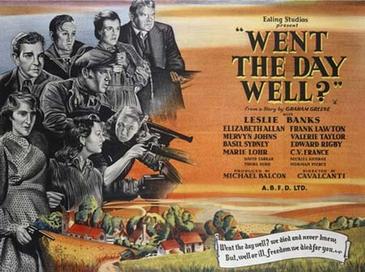
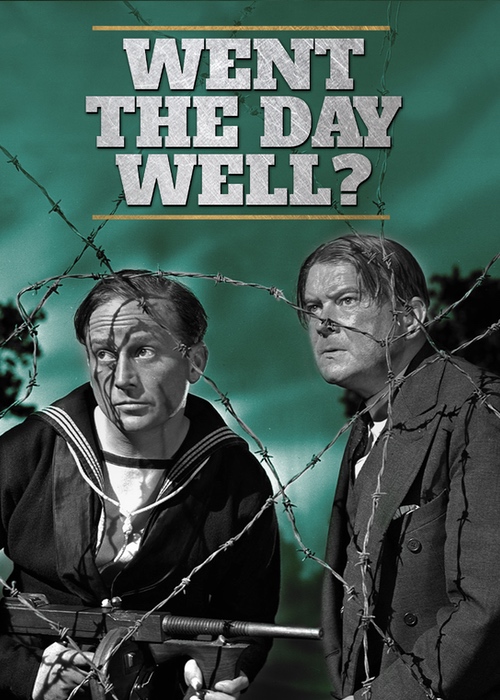
Went the Day Well? is a 1942 British war film adapted from a story by Graham Greene and directed by Alberto Cavalcanti.
It was produced by Michael Balcon of Ealing Studios and served as unofficial propaganda for the war effort.
It tells of how an English village is taken over by German paratroopers. It reflects the greatest potential nightmare of many Britons of the time, although the threat of German invasion had largely receded by that point.
Outline
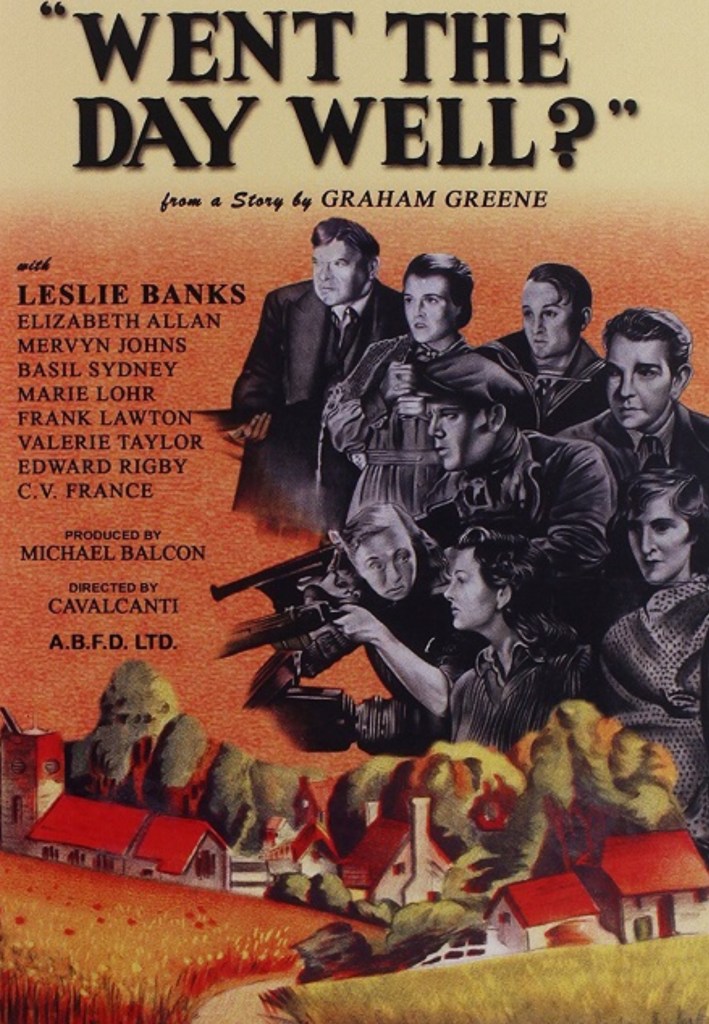
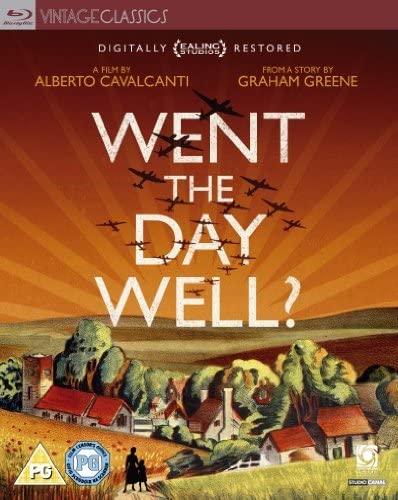
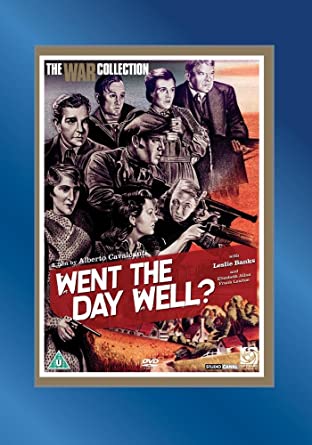
The story is told in flashback by a villager, played by Mervyn Johns, as though to a person visiting after the war. He recounts: one Saturday during the Second World War, a group of seemingly authentic British soldiers arrive in the small, fictitious English village of Bramley End It is the Whitsun weekend so life is even quieter than usual and there is almost no traffic of any kind. At first they are welcomed by the villagers, until doubts begin to grow about their true purpose and identity. After they are revealed to be German soldiers intended to form the vanguard of an invasion of Britain, they round up the residents and hold them captive in the local church. The vicar is shot while sounding the church bell in alarm.
In attempts to reach the outside world, many of the villagers take action. Such plans include writing a message on an egg and giving them to the local paper boy for his mother, but they are crushed when Mrs Fraser’s cousin runs over them. Mrs Fraser then puts a note in Cousin Maude’s pocket, but she uses it to hold her car window in place; her dog, Edward, then chews it to shreds after it blows onto the back seat. Mrs Collins, the postmistress, manages to kill a German with an axe used for chopping firewood, and tries to telephone for help, but the girls on the telephone exchange see her light and decide that she can wait. Mrs Collins waits, and is killed by another German who walks into the shop. The girl at the exchange then picks up the phone, but gets no response.
The captive civilians attempt to contact and warn the local Home Guard, but are betrayed by the village squire, who is revealed to be a long-time collaborator with the Germans. Members of the local Home Guard are ambushed and shot by the Germans. A young boy, George, escapes from the church. He is shot in the leg by a German, but manages to alert the British army. British soldiers arrive, and – aided by some of the villagers, including a group of Women’s Land Army girls, who have managed to escape, barricade themselves in, and arm themselves – defeat the Germans after a short battle. The squire is shot dead by the vicar’s daughter, who discovers his treachery as he attempts to let the Germans into the barricaded house. During the battle, many of the villagers who left to fight are wounded or killed; Mrs Fraser saves the children from a grenade, at the cost of her own life, and Tom’s father is shot in the arm and wrenches his ankle as he falls. The British troops then arrive at Bramley End and all ends well.
The villager retelling the story to the camera shows the Germans’ grave in the churchyard and explains proudly: “Yes, that’s the only bit of England they got.”
Cast
- Leslie Banks as Oliver Wilsford, the treacherous squire.
- C.V. France as the Reverend Ashton, the vicar.
- Valerie Taylor as Nora Ashton, the vicar’s daughter.
- Marie Lohr as Mrs Fraser.
- Basil Sydney as Kommandant Orlter, alias Major Hammond.
- David Farrar as Lt. Jung, alias Lt. Maxwell.
- Harry Fowler as George Truscott.
- Elizabeth Allan as Peggy Pryde (a Land Army Girl).
- Frank Lawton as Tom Sturry.
- Thora Hird as Ivy Dawking (a Land Army Girl).
- Muriel George as Mrs Collins, the postmistress.
- Patricia Hayes as Daisy.
- Mervyn Johns as Charles Sims.
- Norman Pierce as Jim Sturry.
- Kathleen Boutall as Mrs Sturry.
- Hilda Bayley as Cousin Maude.
- Edward Rigby as Bill Purvis, the poacher.
- Ellis Irving as Harry Drew.
- Irene Arnold as Mrs Drew.
- Norman Shelley as Bob Owen.
- Grace Arnold as Mrs Owen.
- Philippa Hiatt as Mrs Bates.
- Lillian Ellias as Bridget.
- Gerald Moore as Johnnie Wade.
- Charles Paton as Harry Brown.
- Josephine Middleton as Mrs Carter.
- Anthony Pilbeam as Ted Garbett.
- Arthur Ridley as Father Owen.
- Mavis Villiers as Violet.
- Josie Welsford as June.
- John Slater as German sergeant.
- James Donald as German corporal.
- Men of the Gloucestershire Regiment.
Trivia
- The film’s title is based on an epitaph written by the classical scholar John Maxwell Edmonds. It originally appeared in The Times on 06 February 1918 entitled Four Epitaphs: ‘
- Went the day well?
- We died and never knew.
- But, well or ill,
- Freedom, we died for you.
- “Went the day well” also appeared in an unidentified newspaper cutting in a scrapbook now held in the RAF Museum (AC97/127/50), and in a collection of First World War poems collated by Vivian Noakes.
- This was the first significant role of Thora Hird’s career, and one of the last for C.V. France.
- Exterior scenes were shot on location in the village of Turville in Buckinghamshire.
- The 1975 book, The Eagle Has Landed, and the later 1976 film (of the same name) use some of the same ideas.
Production & Filming Details
- Director(s): Alberto Cavalcanti.
- Producer(s): Michael Balcon.
- Writer(s): Graham Greene (story), John Dighton, Angus MacPhil, and Diana Morgan.
- Music: William Walton.
- Cinematography: Wilkie Cooper.
- Editor(s): Sidney Cole.
- Production: Ealing Studios.
- Distributor(s): United Artists.
- Release Date: 07 December 1942 (UK).
- Running time: 92 minutes.
- Country: UK.
- Language: English.
Video Link


 Military Gogglebox
Leave a comment