
Introduction
Warning from Space (宇宙人東京に現わる, Uchūjin Tokyo ni arawaru) (Translation: Spacemen Appear in Tokyo) is a Japanese science fiction tokusatsu film released in January 1956 by Daiei, and was the first Japanese science fiction film to be produced in colour.
In the film’s plot, starfish-like aliens disguised as humans travel to Earth to warn of the imminent collision of a rogue planet and Earth. As the planet rapidly accelerates toward Earth, a nuclear device is created at the last minute and destroys the approaching world.
Also known as The Mysterious Satellite in some areas, Asalto a la Tierra (Spain), and Le Satellite Mystérieux (France).
Outline
A small ship travels to a rotating space station. Aboard the station, a group of starfish-like beings discuss how to warn humans of an impending disaster, deciding on contacting Japanese scientist Dr. Kumara. Meanwhile, flying saucers are spotted over the skies of Tokyo, baffling scientists. A journalist tries to get a statement from Dr. Kumara about the sightings, but Kumara replies that there is not enough evidence to formulate a hypothesis. At an observatory, Professor Isobe spots an object in his telescope apparently releasing smaller objects.
Isobe discusses his findings with Kumara and a physician, Dr. Matsuda, who believes they should get photographs via a rocket. The photographs they retrieve, however, turn out to be unclear, though they deduce the object has a high energy output. In the meantime, the extraterrestrials have been unsuccessfully attempting to contact humans. They begin appearing in lakes and rivers, frightening local fishermen and sailors. One of the aliens manages to secure a photo of Hikari Aozora, a famous Japanese entertainer. Their plan is for one of the aliens to mutate into the form of Aozora. Back aboard the space station, one of the Pairan leaders, Ginko, volunteers herself. Her starfish form is slowly mutated into a human form.
On Earth, Toru, Isobe’s son, discovers the disguised alien floating in the water. After her rescue, she exhibits superhuman characteristics such as jumping ten feet and materialising in different places without walking. Soon, she disrupts Dr. Matsuda’s work on a nuclear device, explaining she understands the complex equations he was writing and warning against the effects of a device, leading him to believe she is not human. Shortly afterwards, as the team of scientists discuss her abnormal traits, the camouflaged Ginko appears and reveals her true identity, explaining she is from Paira, a world on the same orbit as Earth but on the opposite side of the Sun. She then continues to reveal her mission, to warn Earth of an imminent collision of a rogue planet, which is dubbed “Planet R” by the media. They appeal to the World Congress about the situation, but are swiftly rejected. Only after they show Planet R and its rapid acceleration in the telescope does the World Congress launch its nuclear weapons, which ineffectively explode on its surface.
In the meantime, a group of spies have abducted Matsuda and are attempting to steal his formula to the nuclear device the disguised Pairan warned him about. Matsuda does not comply and is eventually tied to a chair in a remote building. As the Earth’s atmosphere heats up due to the approaching world, Ginko again arrives to learn why Planet R is not yet destroyed. They locate Matsuda through Pairan technology and gather the formula for the device. The scientists then all watch as the nuclear device is shot from the space station and destroys Planet R, cooling the atmosphere and removing the threat. Ginko then changes back to her original form aboard the space station.
Cast
- Keizô Kawasaki as Dr. Toru Itsobe.
- Toyomi Karita as Hikari Aozora/Ginko.
- Bin Yagisawa as No. 2 Pairan.
- Shôzô Nanbu as The Elder Dr. Itsobe.
- Bontarô Miake as Dr. Kamura.
- Mieko Nagai as Taeko Kamura.
- Kiyoko Hirai as Mrs. Matsuda.
- Isao Yamagata as Dr. Matsuda.
Production
After the success of Toho’s 1954 film Godzilla, which depicted a giant dinosaur attacking Tokyo, many Japanese film studios began to produce similar monster films, including Warning from Space. Along with other films such as Shintōhō’s Terrifying Attack of the Flying Saucers and the American Forbidden Planet (1956), Warning from Space became part of a fledgling subgenre of films based around science fiction creatures. The film also used the theme of atomic bombs that was present in many films at the time, but showed how the weapons, which devastated the Japanese cities of Hiroshima and Nagasaki a decade earlier, could be put to good use. Still others noted the film used another common theme of cosmic collisions in the style of earlier films such as the 1931 film End of the World, which depicted a comet on a collision course with the Earth.
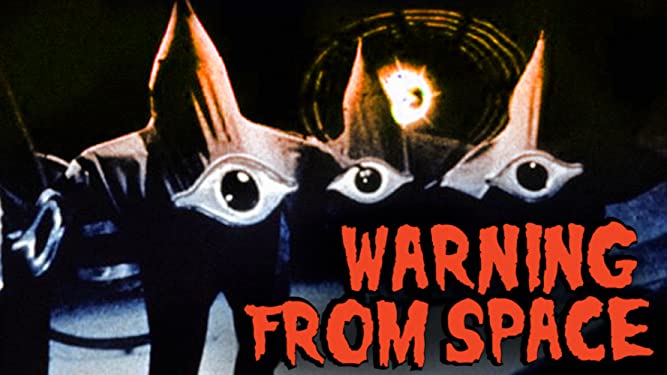
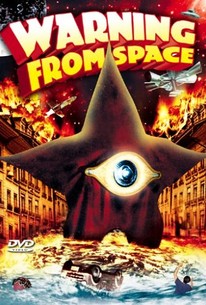
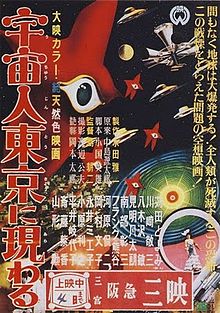
The Pairan aliens were designed by the prominent avant-garde artist Tarō Okamoto, which used a single eye that is common among science fiction aliens. Although official film posters showed the Pairan aliens towering over buildings, the actual cinematic version of the aliens were on the scale of humans, at about two metres. Walt Lee reports that Gentaro Nakajima’s novel, on which this film was based, was in turn based on the Japanese folktale Kaguya-hime. The film was one of fourteen Japanese colour pictures produced in early 1956, but the first colour Japanese science-fiction film.
Release
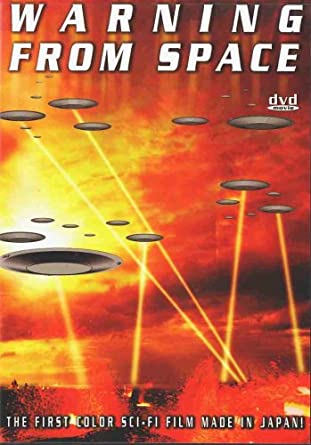
Warning From Space was released in Japan on 29 January 1956. Daiei also hoped to find a foreign market for Warning from Space, though the company found difficulty in selling it. Nevertheless, the film played at both King Cinema in Rangoon, Burma and Tai Khoon Theatre in Sandakan, Malaysia, in 1958. The film did help Daiei achieve some success in the genre. It was passed for release, anglicised as Warning from Space, by the BBFC in the United Kingdom in 1957, and later in the US in 1963. The film was also released as The Mysterious Satellite in some areas. It was shown in the US by American International Television later in the 1960’s as Warning From Space. The film was released in Spain as Asalto a la Tierra, and in France as Le Satellite Mystérieux. Warning from Space has since fallen into the public domain, allowing companies to distribute the film for free on DVD.
Legacy
Warning from Space influenced Toho’s Gorath, a 1963 film which depicts a rogue planet on a collision course with Earth. The planet Paira in Warning from Space may have been an influence in the later Daiei film Gamera vs. Guiron, which features the planet Terra, another planet on the opposite of Earth’s orbit. Critics have also noted plot similarities to the later Toho film Invasion of Astro-Monster, in that a friendly planet warns Japan of the atom bomb and subsequently assists in celestial defence. The Pairans’ asteroidean appearance is similar to that of a later pentagrammic creation, Starro, a villain from DC Comics’ Justice League.
Trivia
- The film, directed by Koji Shima, was one of many early Japanese monster films quickly produced after the success of Toho’s Godzilla in 1954.
- The film was loosely based on a novel by Gentaro Nakajima.
- After release, the film was met with negative reviews, with critics calling it “bizarre” and accusing it of using science fiction clichés.
- Warning from Space influenced many other Japanese science fiction films, such as Gorath.
- The film, along with other 1950s tokusatsu science fiction films, influenced director Stanley Kubrick, who would later direct 2001: A Space Odyssey.
Production & Filming Details
- Director(s): Koji Shima.
- Producer(s): Masaichi Nagata.
- Writer(s): Hideo Oguni.
- Music: Seitaro Omori.
- Cinematography: Kimio Watanabe.
- Editor(s): Toy Suzuki.
- Production: Daiei Film.
- Distributor(s):
- Release Date: 29 January 1956 (Japan).
- Running time: 87 minutes.
- Country: Japan.
- Language: Japanese.
Video Link


 Military Gogglebox
Leave a comment