

Introduction
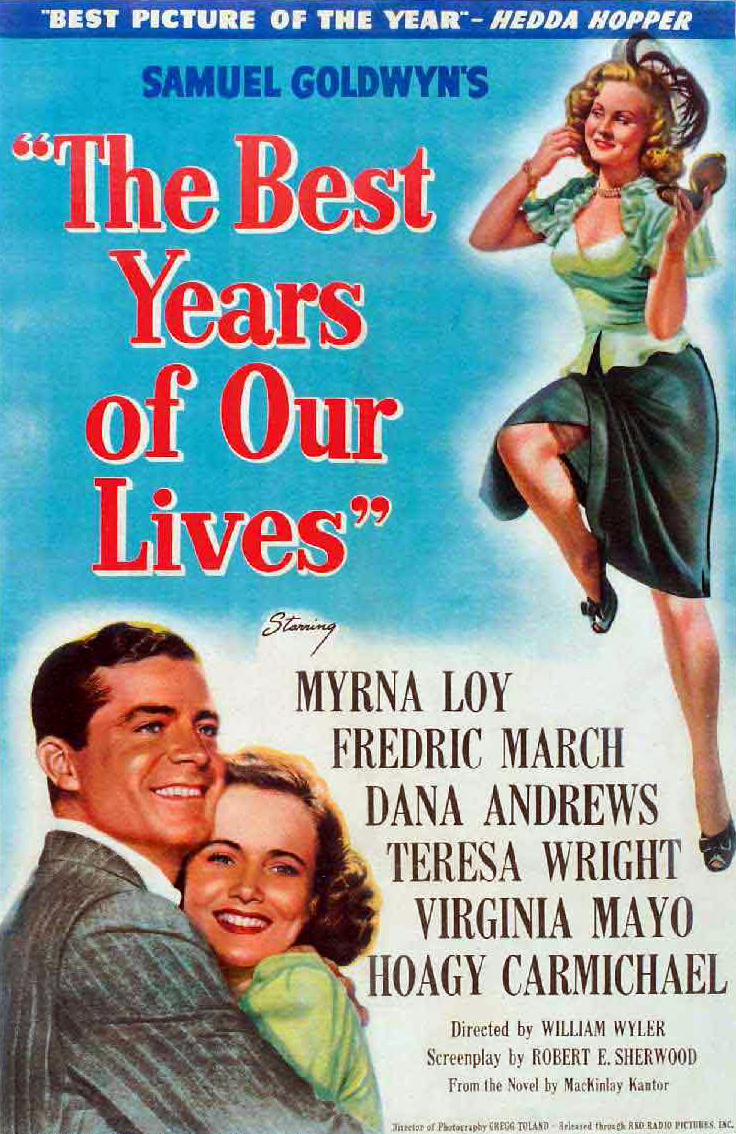
The Best Years of Our Lives (aka Glory for Me and Home Again) is a 1946 American epic drama film directed by William Wyler, and starring Myrna Loy, Fredric March, Dana Andrews, Teresa Wright, Virginia Mayo and Harold Russell. The film is about three United States servicemen re-adjusting to societal changes and civilian life after coming home from World War II. The three men come from different services and different class backgrounds which do not correspond with their class standing.
Released the same year but after the lesser known Till the End of Time (1946), it covers much the same topic: the adjustment of World War II veterans to post-war civilian life.
Also known as Glory for Me and Home Again (working titles, US).

Outline
In 1945, three veterans from different parts of the military meet on a return flight from service at the end of World War II. They travel together and arrive in their midwestern hometown of Boone City: USAAF bombardier captain Fred Derry, US Navy petty officer Homer Parrish, and US Army sergeant Al Stephenson. Before the war Fred, had a menial job at a drug store as their soda jerk and lived with his parents in the poorer part of town. Before becoming an officer in the Army Air Corps, he married his girlfriend Marie after a brief engagement, and shipped out shortly thereafter. Al worked was a high level officer at the local bank, and lived in an upscale apartment with his wife Millie and their two children, Peggy and Rob. Homer was a high school student living with his parents and sister. A star athlete at school, Homer also had been dating his next door neighbour, Wilma, and they commit to marrying upon his return.
Each man faces challenges integrating back into civilian life. Having lost both hands, Homer is the most obvious man damaged by the war, but each man suffers from mental injuries, Homer included. Homer has become quite functional in the use of his mechanical hooks, but he cannot bring himself to believe that Wilma will still want to marry him. Al, tired and jaded from the war, is asked to return to the bank and gets a large promotion which he feels obligated to take. The highly decorated and accomplished Fred suffers from PTSD flashbacks by night, and despite his skilled rank as Captain in the military, he cannot find a civilian job because of his lack of experience and is forced to return to the drug store to work behind the counter. The one bright spot for Fred is Al’s daughter Peggy, whom he met when they first returned to town after a long night drinking binge. Peggy feels sympathy for Fred and gives him her room as he passes out.
Fred and Peggy are attracted to each other, and when she stops by his work to check on him he asks her to meet him for lunch. Afterwards he walks her to her car, and though he knows it is wrong, kisses her. Fred’s relationship with Peggy puts him at odds with Al, who, despite his affection for Fred, does not want his daughter to be involved with a married man. Peggy on the other hand, is determined to “break the marriage apart” thinking that Fred deserves better than the craven Marie.
Homer continues to avoid his fiancé, Wilma, and much to the family’s anguish doesn’t seem to want to continue the relationship. Each night Homer’s father helps him remove the prosthetic arms and places him in bed. Homer appears lost and despite being as independent as he can, he still requires others to help him with day to day activities. Wilma confronts Homer who explodes in a rage and breaks a window when he cannot manage to open the door to get away from her, scaring his younger sister and friends.
Al continues to struggle with re-entry into normal life. Widely respected by the bank’s senior management for his past business acumen, Al finds himself aligning himself with veterans looking for loans-sometimes with little or no collateral which becomes an issue for the bank. His behaviour is made worse by his excessive drinking and he continues to seek solace away from his family obligations with the other veterans.
All 3 characters individual stories come to a head. When Homer visits the drugstore for an ice cream sundae, another customer strikes up a conversation with him. The topic turns sour when the customer alludes to the latest news that the country is now at odds with the Soviet Union and Chinese governments, saying, “You lost your arms fighting the wrong enemy.” Homer becomes angry and Fred comes to his aid and punches the disrespectful patron in face.
Al, under the influence, begins to go off the rails at a company dinner and barely finishes his speech without a major embarrassment as Millies comes to the rescue. His drinking clearly becoming a major issue for his personal and work performance.
Wilma catches Homer before his bedtime routine. Homer who is determined to avoid the topic of their relationship but Wilma announces that her parents want to send her to live with relatives with the primary purpose of leaving town and moving on from Homer. Homer, initially agrees with the decision but as Wilma presses him for his true feelings he agrees to show her his disabilities and what the future would entail. In a tender moment, Wilma buttons his shirt and kisses him goodnight, leaving Homer crying in bed.
Meanwhile, Fred’s wife Marie, frustrated with his lack of financial success and missing her past nightlife, tells Fred she is getting a divorce. Heartbroken and seeing no future in Boone City, Fred decides to pack up and catch the next plane out. While waiting at the airport he walks into an aircraft boneyard, where he climbs into one of the decommissioned B-17 bombers. Sitting at the bombardier’s site, his mind returns him to 1944, and another bombing run over Germany. He is roused out of his stressful memories by a work crew foreman, who informs him that the planes are being demolished for use in the growing pre-fab housing industry. Fred asks him if they need any help in the budding business, and is hired.
The finale of movie shows the entire cast at Homer and Wilma’s home wedding. Fred and Peggy have a polite reunion but as the vows are spoken between the newlyweds, they cannot help but look at each other. Peggy begins to weep and after the ceremony, Fred walks to her and they embrace while no one is looking. He expresses his love with the caveat that things may be a little rough financially but he is committed to the new job. Peggy is completely enthralled and the movie ends.
Cast
- Myrna Loy as Milly Stephenson.
- Fredric March as Technical Sergeant Al Stephenson.
- Dana Andrews as Captain Fred Derry.
- Teresa Wright as Peggy Stephenson.
- Virginia Mayo as Marie Derry.
- Cathy O’Donnell as Wilma Cameron.
- Hoagy Carmichael as Butch Engle, Homer’s uncle.
- Harold Russell as Petty Officer 2nd Class Homer Parrish.
- Gladys George as Hortense Derry.
- Roman Bohnen as Pat Derry.
- Ray Collins as Mr. Milton.
- Minna Gombell as Mrs. Parrish.
- Walter Baldwin as Mr. Parrish.
- Steve Cochran as Cliff.
- Dorothy Adams as Mrs. Cameron.
- Don Beddoe as Mr. Cameron.
- Marlene Aames as Luella Parrish.
- Charles Halton as Prew.
- Ray Teal as Mr. Mollett.
- Howland Chamberlain as Thorpe.
- Dean White as Novak.
- Erskine Sanford as Bullard.
- Michael Hall as Rob Stephenson.
Casting brought together established stars as well as character actors and relative unknowns. The jazz drummer Gene Krupa was seen in archival footage, while Tennessee Ernie Ford, later a television star, appeared as an uncredited “hillbilly singer” (in the first of his only three film appearances – At the time the film was shot, Ford was unknown as a singer. He worked in San Bernardino as a radio announcer-disc jockey).
Blake Edwards, later a film producer and director, appeared fleetingly as an uncredited “Corporal”. Wyler’s daughters, Catherine and Judy, were cast as uncredited customers seen in the drug store where Fred Derry works. Sean Penn’s father, Leo, played the uncredited part of the soldier working as the scheduling clerk in the A.T.C. Office at the beginning of the film.
Teresa Wright was only thirteen years younger than her on-screen mother, played by Myrna Loy. Michael Hall (1927-2020), with his role as Fredric March’s on-screen son, is absent after the first one-third of the film.
Production
Samuel Goldwyn was inspired to produce a film about veterans after reading an 07 August 1944, article in Time about the difficulties experienced by men returning to civilian life. Goldwyn hired former war correspondent MacKinlay Kantor to write a screenplay. His work was first published as a novella, Glory for Me, which Kantor wrote in blank verse. Robert E. Sherwood then adapted the novella as a screenplay.]
Director Wyler had flown combat missions over Europe in filming Memphis Belle (1944), and worked hard to get accurate depictions of the combat veterans he had encountered. Wyler changed the original casting, which had featured a veteran suffering from post-traumatic stress disorder, and sought out Harold Russell, a non-actor, to take on the exacting role of Homer Parrish.
For The Best Years of Our Lives, he asked the principal actors to purchase their own clothes, in order to connect with daily life and produce an authentic feeling. Other Wyler touches included constructing life-size sets, which went against the standard larger sets that were more suited to camera positions. The impact for the audience was immediate, as each scene played out in a realistic, natural way.
Recounting the interrelated story of three veterans right after the end of World War II, The Best Years of Our Lives began filming just over seven months after the war’s end, starting on 15 April 1946 at a variety of locations, including the Los Angeles County Arboretum and Botanic Garden, Ontario International Airport in Ontario, California, Raleigh Studios in Hollywood, and the Samuel Goldwyn/Warner Hollywood Studios.
In The Best Years of Our Lives cinematographer Gregg Toland used deep focus photography, in which objects both close to and distant from the camera are in sharp focus. For the passage of Fred Derry’s reliving a combat mission while sitting in the remains of a former bomber, Wyler used “zoom” effects to simulate Derry’s subjective state.
The fictional Boone City was patterned after Cincinnati, Ohio. The “Jackson High” football stadium seen early in aerial footage of the bomber flying over the Boone City, is Corcoran Stadium located at Xavier University in Cincinnati. A few seconds later Walnut Hills High School with its dome and football field can be seen along with the downtown Cincinnati skyline (Carew Tower and Fourth and Vine Tower) in the background.
After the war, the combat aircraft featured in the film were being destroyed and disassembled for reuse as scrap material. The scene of Derry’s walking among aircraft ruins was filmed at the Ontario Army Air Field in Ontario, California. The former training facility had been converted into a scrap yard, housing nearly 2,000 former combat aircraft in various states of disassembly and reclamation.
Release
Upon its release, The Best Years of Our Lives received extremely positive reviews from critics.
Popular Response
The Best Years of Our Lives was a massive commercial success, earning an estimated $10.2 million at the US and Canadian box office during its initial theatrical run, not only making it the highest-grossing film of 1946, but also the highest-grossing film of the 1940s decade. It benefited from much larger admission prices than the majority of films released that year which accounted for almost 70% of its earnings. When box office figures are adjusted for inflation, it remains one of the top 100 grossing films in US history.
Among films released before 1950, only Gone With the Wind, The Bells of St. Mary’s, The Big Parade and four Disney titles have done more total business, in part due to later re-releases (Reliable box office figures for certain early films such as The Birth of a Nation and Charlie Chaplin’s comedies are unavailable).
However, because of the distribution arrangement RKO had with Goldwyn, RKO recorded a loss of $660,000 on the film.
Russell Academy Award
Despite his Oscar-nominated performance, Harold Russell was not a professional actor. As the Academy Board of Governors considered him a long shot to win, they gave him an Academy Honorary Award “for bringing hope and courage to his fellow veterans through his appearance”. When Russell in fact won Best Supporting Actor, there was an enthusiastic response. He is the only actor to have received two Academy Awards for the same performance. In 1992, Russell sold his Best Supporting Actor statuette at auction for $60,500 ($111,600 today), to pay his wife’s medical bills.
National Film Registry
In 1989, the National Film Registry selected it for preservation in the United States Library of Congress as “culturally, historically, or aesthetically significant”.
American Film Institute included the film as #37 in its 1998 AFI’s 100 Years… 100 Movies, as #11 in its 2006 AFI’s 100 Years… 100 Cheers, and as #37 in its 2007 AFI’s 100 Years… 100 Movies (10th Anniversary Edition).
Radio Adaptations
In 1947 and 1949, there were four separate half-hour adaptations from Hedda Hopper’s This Is Hollywood, Screen Guild Theatre (two) and Screen Directors Playhouse. In all four cases, various actors reprised their film roles.
Trivia
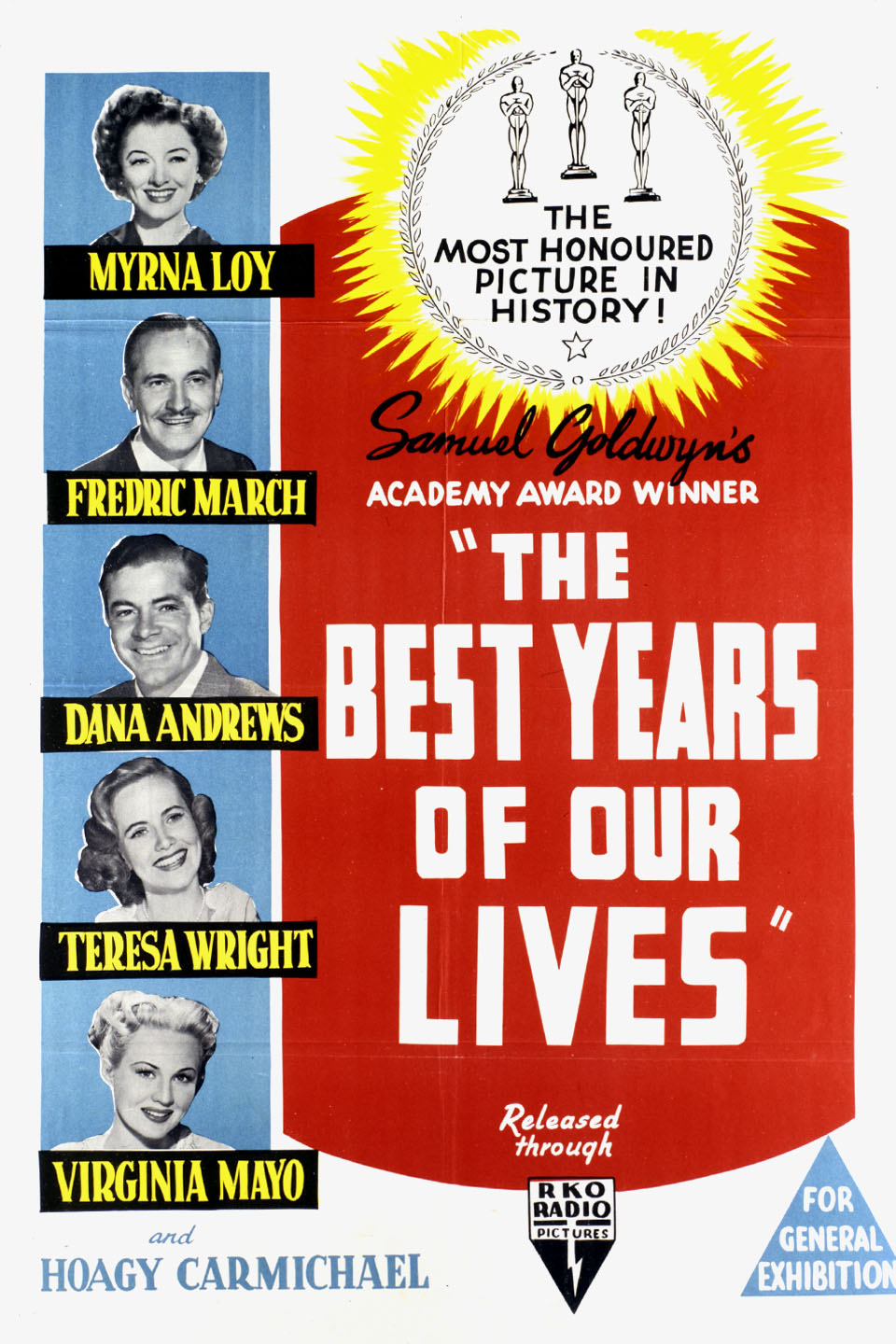
- It won seven Academy Awards: Best Picture, Best Director (William Wyler), Best Actor (Fredric March), Best Supporting Actor (Harold Russell), Best Film Editing (Daniel Mandell), Best Adapted Screenplay (Robert E. Sherwood), and Best Original Score (Hugo Friedhofer).
- It was the highest-grossing film in both the United States and United Kingdom since the release of Gone with the Wind, and is the sixth most-attended film of all time in the United Kingdom, with over 20 million tickets sold.
- William Wyler, who served as a major in the Army Air Force during World War II, incorporated his own wartime experiences into the film.
- Just as Fred Derry, Wyler flew in B-17s in combat over Germany, although not as a bombardier.
- Wyler shot footage for documentary films (His hearing was permanently damaged when an anti-aircraft shell exploded near his plane while on a bombing raid).
- Additionally, he modelled the reunion of Al and Milly – in which they first see each other at opposite ends of a long hallway – on his own homecoming to his wife, Margaret Tallichet.
- Harold Russell was first discovered by William Wyler when he saw him in an army training film called Diary of a Sergeant (1945), a film about the rehabilitation of wounded servicemen.
- Director William Wyler was furious when he learned that Samuel Goldwyn had sent Harold Russell for acting lessons: he preferred Russell’s untrained, natural acting.
- Harold Russell’s character was originally written as a war veteran suffering from combat trauma.
- This was changed to a physical disability when Russell joined the cast.
Production & Filming Details
- Director(s):
- William Wyler.
- Producer(s):
- Samuel Goldwyn … producer.
- Lester Koenig … associate producer (uncredited).
- Writer(s):
- Robert E. Sherwood … screenplay.
- MacKinlay Kantor … novel.
- Music:
- Hugo Friedhofer.
- Cinematography:
- Gregg Toland … director of photography.
- Editor(s):
- Daniel Mandell.
- Production:
- The Samuel Goldwyn Company.
- Distributor(s):
- RKO Radio Pictures (1946) (USA) (theatrical).
- RKO Distributing Corporation of Canada (1947) (Canada) (theatrical) (as RKO Distributing Corporation of Canada, Ltd).
- RKO Radio Pictures (1947) (UK) (theatrical) (as RKO Radio Pictures, Ltd).
- RKO Pictures (Australasia) (1947) (Australia) (theatrical).
- RKO Radio Pictures Argentina (1947) (Argentina) (theatrical).
- RKO Radio Films (1947) (France) (theatrical).
- RKO Radio Films (1947) (Belgium) (theatrical).
- RKO Radio Films (1947) (Sweden) (theatrical).
- RKO Radio Films A/S (1947) (Norway) (theatrical).
- RKO Radio Films (1948) (Finland) (theatrical).
- TWF (Trans World Films) (1948) (Italy) (theatrical).
- Herzog-Filmverleih (1948) (Germany) (theatrical).
- RKO Radio Pictures (1954) (USA) (theatrical) (re-release).
- Empire Universal Films (1954) (Canada) (theatrical) (re-release).
- Regal Films International (1959) (UK) (theatrical) (re-release).
- Wivefilm (1959) (Sweden) (theatrical) (re-release).
- Euro International Films (Italy) (theatrical) (re-release).
- Adams Filmi (1964) (Finland) (theatrical).
- Yleisradio (YLE) (1980) (Finland) (TV).
- Embassy Home Entertainment (1987) (USA) (VHS).
- M6 (1992) (France) (TV) (dubbed version).
- Pioneer Entertainment (1995) (USA) (video) (laserdisc).
- Home Box Office Home Video (HBO) (1997) (USA) (DVD).
- MGM Home Entertainment (2000) (USA) (DVD).
- MGM Home Entertainment (2000) (USA) (VHS).
- MGM Home Entertainment (2004) (Germany) (DVD).
- 20th Century Fox Home Entertainment (2006) (USA) (DVD).
- Warner Home Video (2013) (USA) (DVD).
- Sony Pictures Home Entertainment (2017) (Germany) (DVD).
- Universal Sony Pictures Home Entertainment Nordic (2017) (Finland) (DVD).
- Nelson Entertainment (USA) (video) (laserdisc).
- Release Date: 21 November 1946 (New York City, US).
- Rating: U.
- Running Time: 170 minutes.
- Country: US.
- Language: English.


 Military Gogglebox
Leave a comment