

Introduction
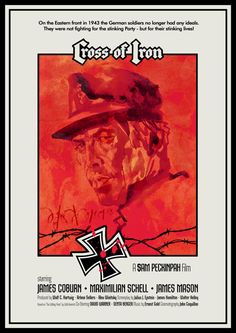
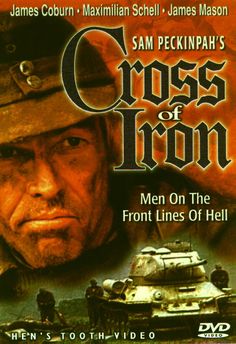
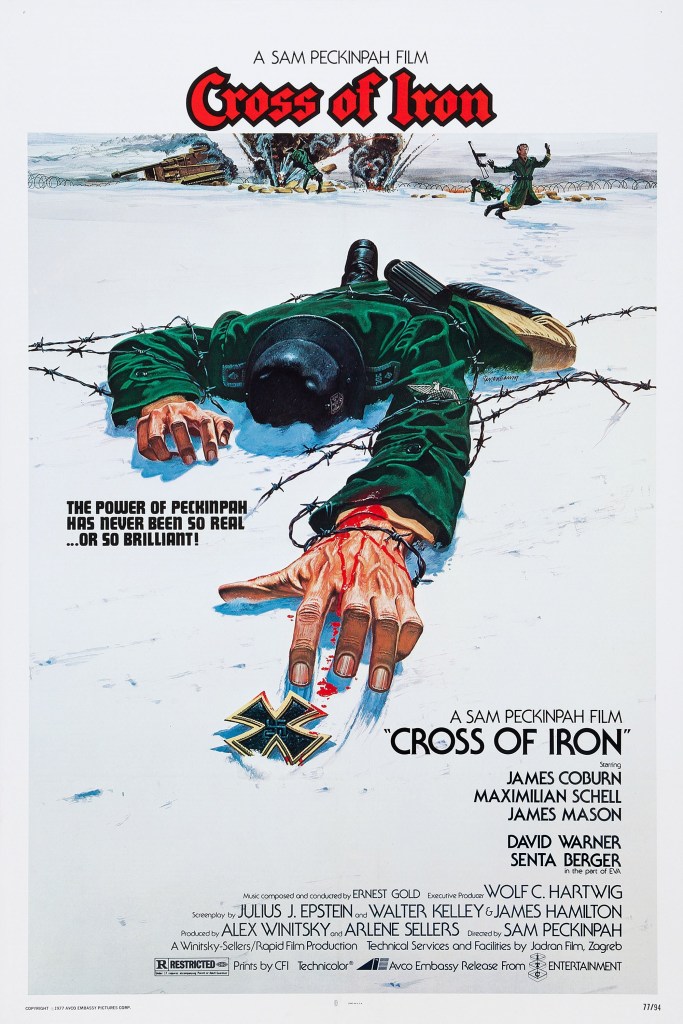
Cross of Iron (German: Steiner – Das Eiserne Kreuz, lit. “Steiner – The Iron Cross”) is a 1977 war film directed by Sam Peckinpah, featuring James Coburn, Maximilian Schell, James Mason and David Warner.
Set on the Eastern Front in World War II during the Soviets’ Caucasus operations against the German Kuban bridgehead on the Taman Peninsula in late 1943, the film focuses on the class conflict between a newly arrived, aristocratic Prussian officer who covets winning the Iron Cross and a cynical, battle-hardened infantry NCO.
It was followed by a sequel, Breakthrough, in 1979.
Outline
At the beginning of the movie the German song Hänschen Klein is heard over the credits which use footage of Hitler Youth boys and other Germans in happiness with the Hitler ethos.
Corporal Rolf Steiner is a veteran soldier of the Wehrmacht on the Eastern Front of World War II. During a successful raid on an enemy mortar position, his reconnaissance platoon captures a Russian boy soldier. As the platoon returns to friendly lines, Captain Stransky arrives to take command of Steiner’s battalion. The regiment’s commander, Colonel Brandt, wonders why Stransky would ask to be transferred to the Kuban bridgehead from more comfortable duties in occupied France. Stransky proudly tells Brandt and the regimental adjutant, Captain Kiesel, that he applied for transfer to front-line duty in Russia so that he can win the Iron Cross.
Stransky meets Steiner as he returns from the patrol and orders the prisoner shot. Steiner refuses and Corporal Schnurrbart takes the boy off into hiding. Steiner reports to Stransky shortly after, where he is informed of his promotion to senior sergeant. Following the meeting Stransky discerns that his adjutant, Lieutenant Triebig, is a closet homosexual which is a death penalty offence in the German Army.
The platoon celebrates the birthday of their leader, Lieutenant Meyer. Steiner takes the young Russian to the forward positions to release him, where he is accidentally killed by advancing Soviet troops in a major attack. The Germans are forced to defend their positions. Stransky is overcome by fear in his bunker while Meyer is killed leading a successful counterattack. Steiner is wounded and sent to a military hospital.
After his hospital stay, characterised by flashbacks and a romantic liaison, Steiner is offered a home leave but decides instead to return to his men. There he learns Stransky has been nominated for an Iron Cross for the counterattack Meyer had led. Stransky’s award requires two witnesses as confirmation. He blackmails Triebig and attempts to persuade Steiner to corroborate his claim with promises of preferential treatment after the war. Brandt questions Steiner in the hope that he will expose Stransky’s lies, but Steiner only states that he hates all officers, even those as “enlightened” as Brandt and Kiesel, and requests a few days to ponder his answer.
When his battalion is ordered to retreat, Stransky does not notify Steiner’s platoon. Making their way back through now-enemy territory, the men capture an all-female Russian detachment. While Steiner is busy, Zoll, a despised Nazi Party member, takes one of the women into the barn to rape her. She bites his genitals and he kills her. Meanwhile, young Dietz, left to guard the rest of the women alone, is distracted and killed as well. Disgusted, Steiner locks Zoll up with the vengeful Russian women, taking their uniforms to use as a disguise.
As the men near the German lines, they radio ahead to avoid friendly fire. Stransky suggests to Triebig that Steiner and his men be “mistaken” for Russians. Triebig orders his men to shoot the incoming Germans; only Steiner, Krüger and Anselm survive. Triebig denies responsibility, but Steiner kills him and makes Krüger the platoon leader, telling him to look after Anselm. Steiner then goes hunting for Stransky.
The Soviets launch a major assault. Brandt orders Kiesel to evacuate, telling him that men like him will be needed to rebuild Germany after the war. Brandt then rallies the fleeing troops for a counterattack.
Steiner locates Stransky. But instead of killing him, he hands him a weapon, and offers to show him “where the Iron Crosses grow”. Stransky accepts Steiner’s “challenge”, and they head off together for the battle. The film closes with Stransky trying to figure out how to reload his MP40, while being shot at by an adolescent Russian soldier who resembles the boy soldier released by Steiner. When Stransky asks Steiner for help, Steiner begins to laugh. His laughter continues through the credits, which feature “Hänschen klein” again and segues to black-and-white images of civilian victims from World War II and later conflicts.
Cast
- James Coburn as Feldwebel Rolf Steiner
- Maximilian Schell as Hauptmann Stransky
- James Mason as Oberst Brandt
- David Warner as Hauptmann Kiesel
- Klaus Löwitsch as Unteroffizier Krüger
- Vadim Glowna as Schütze Kern
- Roger Fritz as Leutnant Triebig
- Dieter Schidor as Schütze Anselm
- Burkhard Driest as Schütze Maag
- Fred Stillkrauth as Obergefreiter Karl “Schnurrbart” Reisenauer
- Michael Nowka as Schütze Dietz
- Véronique Vendell as Marga
- Arthur Brauss as Schütze Zoll
- Senta Berger as Eva
- Igor Galo as Leutnant Meyer
- Slavko Štimac as Russian Boy
- Demeter Bitenc as Hauptmann Pucher
- Vladan Živković as Gefreiter Wolf
- Bata Kameni as Gefreiter Joseph Keppler
- Hermina Pipinić as Russian Major
Production
Pre-Production
Cross of Iron was a joint Anglo-German production between EMI Films and ITC Entertainment of London and Rapid Films GmbH from Munich. Although the West German producer, Wolf C. Hartwig had secured a budget of $4 million, only a fraction of it was available as pre-production started. This created delays on location because local services and film crews demanded payment before commencing work.
In July 1975 EMI Films announced the film would be made as part of a slate of eleven films worth £6 million. The title was then Sergeant Steiner and the film would star Robert Shaw.
Writing
Screenplay credits are given to Julius Epstein, James Hamilton and Walter Kelley. Their source material was the 1956 novel The Willing Flesh by Willi Heinrich, a fictional work that was loosely based on the true story of Johann Schwerdfeger (1914-2015). The real-life Wehrmacht NCO was a highly decorated combat veteran who fought through both the Battle of the Caucasus and Kuban pocket.
Filming
Filming, which began on 29 March 1976, was shot on location at Trieste in Italy and Yugoslavia. Scenes were filmed around Obrov in Slovenia, and Zagreb and Savudrija in Croatia. Interiors were completed at Pinewood Studios in England.
The film is noted for featuring historically accurate weaponry and equipment such as Soviet T-34/85 tanks (which were obtained from the arsenal of the Yugoslav People’s Army), Russian PPSh-41s and German MG 42s and MP40s. According to star James Coburn, the Yugoslav government had promised that all the military equipment would be ready for the start of filming, but Hartwig’s lack of budget meant that considerable delays occurred when half the equipment was missing just as the production was about to begin.
Peckinpah’s alcoholism was also affecting the filming schedule because every day he was consuming 180° proof Slivovitz (Šljivovica). However every two to three weeks Peckinpah would go on a binge resulting in lost shooting days while he was allowed to regain his cognitive abilities.
Due to the various productions delays, the film had cost overruns of £2 million. With no more money, Hartwig and his co-producer Alex Winitsky tried to halt the production on 06 July 1976 (the 89th day of shooting) before the final scene had been filmed. The original ending was expected to take three days to film in an abandoned rail yard and special effects teams had already spent several days wiring pyrotechnics for the shoot. However, with the costs now at $6 million there was no more money. Coburn was so annoyed at this, he had Hartwig and Winitsky thrown off the set before making Peckinpah film a quick improvised ending for the film
Post Production
Peckinpah spent five weeks going through the rushes to create a final cut. Working continuously four to five hours a day overseeing the editing, he started snorting cocaine along with his drinking. He relied heavily on his experience with his 1969 Western The Wild Bunch to create the film’s pace (the slow motion during violent scenes) and its visual style.
Release
At the time of its release, the film did poorly at the box office in the US and received mixed reviews, its bleak, anti-war tone unable to get noticed amidst the hype of the release of the mega-popular Star Wars in the same year. However, it performed very well in West Germany, earning the best box-office takings of any film released there since The Sound of Music, and audiences and critics across Europe responded well to the film.
Re-Release
To coincide with its release on Blu-ray, a new print of Cross of Iron was screened at selected cinemas in Britain in June 2011
Sequel
The film Breakthrough, which was mostly financed by West German producers, was released in 1979. It was made by Anglo-American director Andrew McLaglen who, like Peckinpah, was known for Westerns. Several changes were made to the sequel. For instance, the action was moved from Russia to the Western Front and Richard Burton replaced Coburn as Sergeant Steiner. Breakthrough was panned by critics, who criticised it for a confusing plot, poor dialogue, aged cast, and undistinguished acting. The film involved Steiner saving the life of an American officer (Robert Mitchum) and a conspiracy to assassinate Adolf Hitler.
Trivia
- An international co-production between British and West German financiers, the film’s exteriors were shot on location in Yugoslavia.
- At forty-eight, James Coburn was widely felt to be too old to play Steiner.
- The man on whom his character was based, Johann Schwerdfeger, was only twenty-eight in the summer of 1943.
- Orson Welles said this was the best war movie he had seen since All Quiet on the Western Front (1930).
- He appreciated that the story was shown from the viewpoint of an ordinary soldier.
- Maximilian Schell’s (Captain Hauptmann Stransky’s) stumbling by the railway track in the final scene was actually an on-set accident during filming and not scripted (Director Sam Peckinpah simply hadn’t enough film left to retake the sequence).
- James Mason played a senior German officer who is faced with the scandal of an officer taking credit for the heroic deeds of a dead man.
- He faced the same scenario in The Blue Max (1966).
Production & Filming Details
- Director(s):
- Sam Peckinpah
- Producer(s):
- Pat Duggan … associate producer (uncredited)
- Lew Grade … executive producer (uncredited)
- Wolf C. Hartwig … producer
- Lothar H. Krischer … co-producer (uncredited)
- Arlene Sellers … producer (uncredited)
- Alex Winitsky … producer (uncredited)
- Writer(s):
- Julius J. Epstein … (screenplay) (as Julius Epstein)
- Walter Kelley … (screenplay)
- James Hamilton … (screenplay)
- Willi Heinrich … (based on the book by)
- Music:
- Ernest Gold
- Cinematography:
- John Coquillon … director of photography
- Editing:
- Michael Ellis
- Tony Lawson
- Murray Jordan … (uncredited)
- Herbert Taschner … (uncredited)
- Production:
- Anglo-EMI Film Distributors (Anglo-EMI Productions Ltd. London, England, An Anglo-German co-production of)
- Rapid Film (RAPID FILM Gmbh Munich, An Anglo-German co-production of)
- Terra-Filmkunst (Terra Filmkunst Gmbh Berlin, An Anglo-German co-production of)
- ITC Films (uncredited)
- Radiant Film GmbH (uncredited)
- Distributor(s):
- Constantin Film (West Germany, 1977)(theatrical)
- EMI Films (United Kingdom, 1977)(theatrical)
- Shochiku (Japan, 1977)(Shôchiku, theatrical)
- AVCO Embassy Pictures (United States, 1977)(theatrical)
- Astral Films (Canada, 1977)(theatrical)
- Release Date: 28 January 1977 (West Germany).
- Running time: 132 minutes.
- Rating: X.
- Country: US.
- Language: English.


 Military Gogglebox
Leave a comment