
Introduction
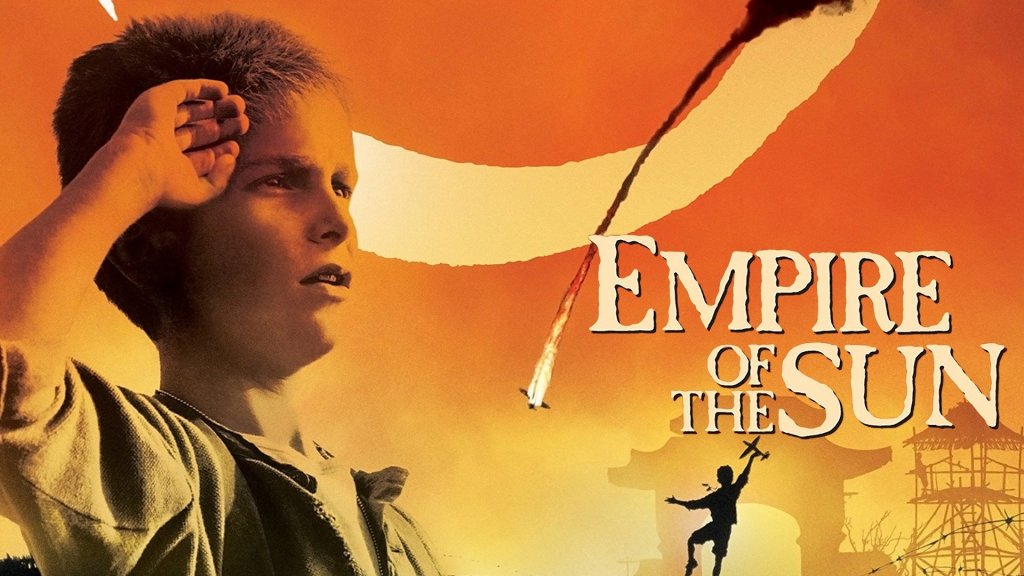
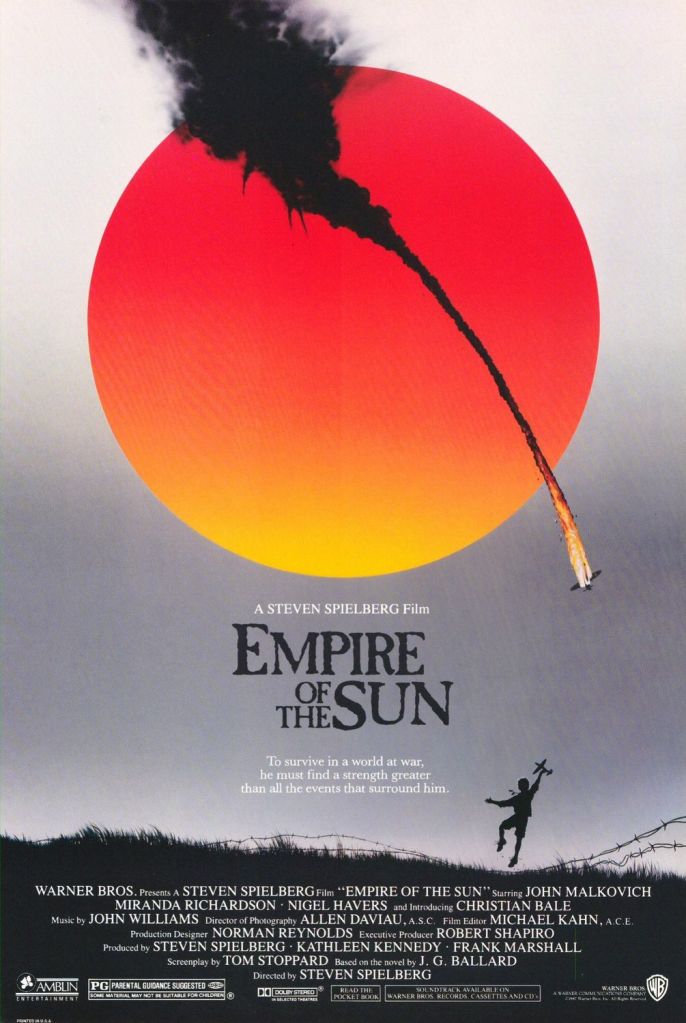
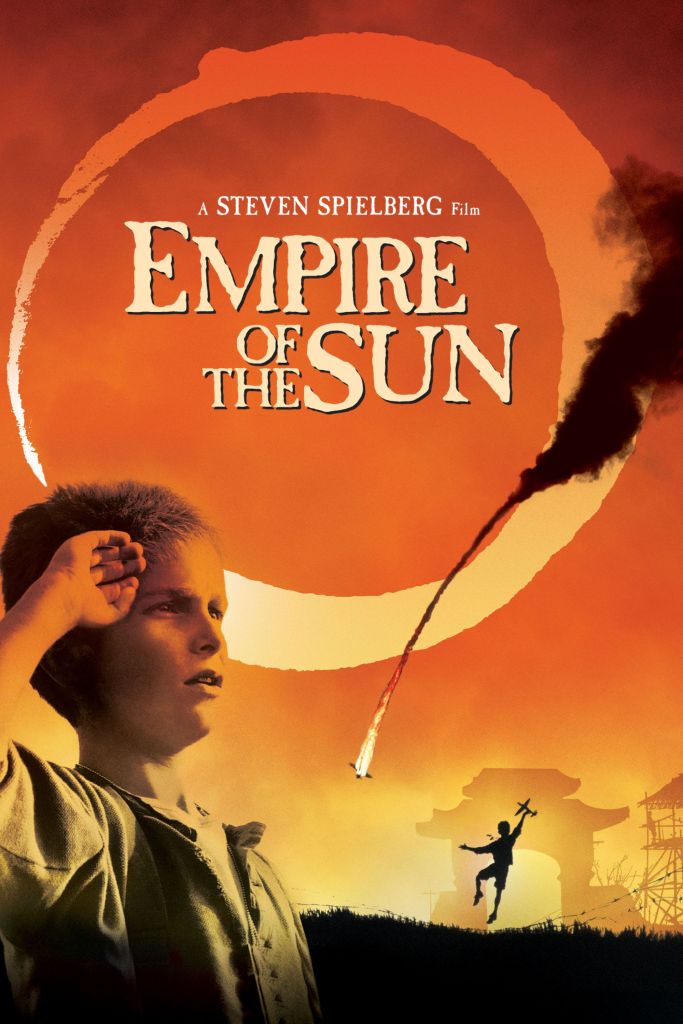
Empire of the Sun is a1987 American war film produced and directed by Steven Spielberg and based on J.G. Ballard ‘s 1984 novelof the same name.
It stars Christian Bale , John Malkovich , Miranda Richardson and Nigel Havers . The film tells the story of Jamie “Jim” Graham, a British boy who during World War II goes from living in a wealthy family to become a prisoner of war in a Japanese prison camp.
Outline
In 1937 Japan declared war on China (Second Sino-Japanese War), before also doing so against the United States and the United Kingdom. In the midst of this war situation lives Jamie Graham, a wealthy British boy fascinated by Japanese planes and pilots. Jamie lives a privileged life with his parents, oblivious to the disasters that occur a few meters from his mansion located in the international settlement of Shanghai. He presents himself as a rich and spoiled child.
One day he goes with his parents to a costume party for rich Westerners. Along the way, the family’s Chinese chauffeur is forced into a Shanghai suburb, where Jamie, who lives in a kind of British world apart, observes the harsh reality for the first time in the film: American sailors choosing prostitutes. Chinese women, a nice nun who greets you and street vendors. He also sees a Chinese boy who scares him by shouting ” no dad, no mom, no whiskey soda!””, just before being beaten by a British police officer. Later the cars enter en masse with desperate Chinese civilians, who scream and beg to enter the International Concession to save themselves from the Japanese soldiers, to the horror of the Westerners. They finally arrive to the party and, wandering with his toy plane, Jamie finds a downed Japanese plane and near it, a field full of entrenched Japanese soldiers. Jamie is totally surprised, as are the Japanese soldiers when they see him, not being aware of the imminent danger His father and another British man find him and insist that he leave that area, although without running.
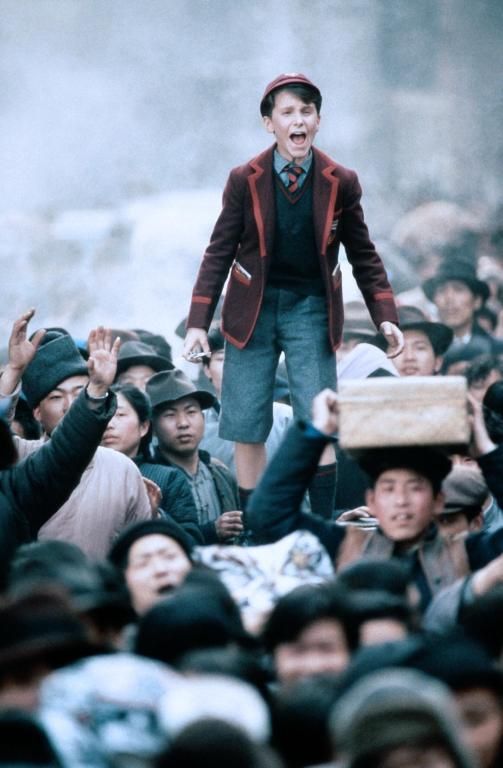
After the Japanese attack on Pearl Harbour in 1941, the Japanese begin the occupation of the international settlement of Shanghai and in the ensuing chaos to escape the city and take the ferry out, Jamie loses his parents among the crowds of frightened people, during which a shootout breaks out between members of the Chinese Resistance and the Imperial Japanese Army . Jamie returns home and waits for her parents for a while until their food supplies run out.
Hungry, Jamie wanders the streets desperately trying to surrender to the Japanese soldiers, who ignore him and mock him. After many hardships he meets Frank, who takes him to Basie (John Malkovich), an American conman with a dark past and dubious intentions who lives with Frank in an abandoned boat on a river. Jamie’s new “friends” nickname him Jim and try to sell him, but when they fail they want to abandon him, but he convinces them to find empty rich houses in the neighbourhood where he lived and guides them there, where they meet a group of Japanese soldiers who catch them.
They are all taken to the Lunghua Civilian Assembly Centre in Shanghai. There, life hangs by a thread and Basie teaches Jim how to survive by any means possible while Jim takes care of him. Some time later a van arrives to take inmates to the Suzhou Creek prison camp, which is next to a Japanese military airfield. Basie is chosen to go to the field, but Jim is not, although in the end he manages to go because he knows the way and can guide the driver. Upon arriving at the field, Jim is attracted by the rumour of men at work and finds himself wandering among the soldiers of the Mitsubishi A6M Zero fighter squadron. He finds a shiny plane and, hypnotised, touches it as if in a trance, when three fighter pilots appear, to whom Jim greets and they return the greeting.
In Lunghua, the Victors, a young, rich British couple, welcome Jim into their barracks. The woman, unlike her husband, has not accepted the new reality and, both she and other rich people, protest because the Japanese force them to work, being beaten, while Basie and Jim, intelligent survivors, go to work without complaint.
The years go by. It is the beginning of 1945 and there are only a few months left until the war in the Pacific ends. Jim has established himself in the field doing extensive swapping work that even reaches his commanding officer, Sergeant Nagata. Dr. Rawlings, a country doctor, becomes a father figure and teacher to him. Life in the countryside is a mixture of terror, disease and harsh living conditions. One night, a Boeing B-29 Superfortress is shot down and crashes next to the field, and Nagata, in retaliation, orders the destruction of the windows of the prisoners’ barracks. When some Japanese, accompanied by Nagata, go to break the windows of the infirmary, Dr. Rawlings tries to stop them, but Nagata begins to beat him. Jim appears, breaks a window of the infirmary himself and asks for mercy in fluent Japanese, ending, at least in part, the retaliation. Another day, through the fence, Jim observes a young Japanese man who plays with a toy airplane and wants to be a famous pilot. He also begins to discover sex, feeling attraction for Mrs. Victor, although the young woman is actually sick and is despotic towards the child.
Basie is comfortably installed in the American prisoner barracks and Jim visits him frequently as he idealises the Americans. One day, Basie tasks him with setting traps to catch birds outside the fence, promising him a place in the American flag if he gets it; In reality, Basie plans to escape and wants to use it to find out if there are mines in the area, Jim manages to set the traps with the help of his Japanese friend and is welcomed into the American pavilion in the meantime.
During a surprise inspection at the American barracks, Nagata discovers some soap that Jim had stolen for Basie, who receives a severe beating and, while in the infirmary, has all of his possessions stolen by the other men in the barracks. Jim returns to the British barracks.
One dawn, Jim witnesses a kamikaze ritual performed by three Japanese pilots at the air base next door. Fuelled by the excitement of the ceremony, he begins to sing the Welsh song ” Suo Gân “. When the Japanese begin to take off, an attack on the base occurs by a group of North American P-51 Mustang fighter-bombers. Overwhelmed by everything that is happening, Jim climbs the ruins of a nearby pagoda to get a better look at the air raid. The doctor goes to look for him and tries to get him to come down so that he doesn’t get hurt, but Jim doesn’t want to go down. In the end, very nervous, he bursts into tears and confesses to the doctor that he no longer remembers what his mother was like. As a result of the attack, the Japanese decide to evacuate the camp and during the ensuing confusion, Basie escapes, abandoning Jim despite her promise to take him.
The march of the prisoners across the countryside causes many deaths from fatigue, hunger and disease. Mrs. Victor dies and Jim believes that the light he sees in the sky is his soul ascending, but later he will learn that it was the light caused by the detonation of the Hiroshima atomic bomb many kilometers away and that war is about determine.
They eventually reach a football stadium near Nantao, but Jim escapes and returns to Soochow Creek. There, nearly dead from starvation, he is reunited with his Japanese friend, who cannot perform his duties as a kamikaze because his plane is not working. The young man offers Jim a mango and when he goes to cut it with his katana, Basie reappears with a group of Americans, looting the food containers sent by the Red Cross . One of the Americans shoots and kills the young Japanese man. Jim, furious, punches the killer. Basie pulls him aside and promises to take him back to Shanghai, but Jim rejects him, saying: “You taught me that people are capable of anything for a potato.”, showing that he has put aside childhood idealization. In the end, Jim is found by American troops, to whom he surrenders and is taken to an orphanage in Shanghai.
Some time later, Jim’s parents visit the orphanage but do not initially recognise him, as he has changed and hardened by what he has experienced. Later, his mother recognises him and they hug while the boy strangely observes his elegant appearance, oblivious to his current priorities and hardships. Jim closes his eyes as his suitcase, which accompanied him through all of his experiences in the war, is shown floating away in the river as a symbol of childhood and innocence that will not return.
Cast
- Christian Bale … Jim
- John Malkovich … Basie
- Miranda Richardson … Mrs. Victor
- Nigel Havers … Dr. Rawlins
- Joe Pantoliano … Frank Demarest
- Leslie Phillips … Maxton
- Masatô Ibu … Sgt. Nagata (as Masato Ibu)
- Emily Richard … Jim’s Mother
- Rupert Frazer … Jim’s Father
- Peter Gale … Mr. Victor
- Takatarô Kataoka … Kamikaze Boy Pilot (as Takatoro Kataoka)
Trivia
- Eric Flynn, who plays a British POW, was actually a POW as a child in a Japanese camp.
- Christian Bale was selected out of more than 4,000 who auditioned.
- Steven Spielberg had seen Bale in Anastasia: The Mystery of Anna (1986), and Amy Irving, who starred in it, personally recommended Bale to Spielberg, her then-husband.
- Spielberg had not thought much of Bale in the miniseries, but cast him in the role of Jim after he auditioned.
- The B-29 bomber which passes by in a short scene was a gigantic radio-controlled model.
- It had operating undercarriage, bomb doors and flaps, and a wing span of 18 feet.
- Six radio receivers in the plane and two transmitters were used to control the plane.
- The movie’s Japanese Zero fighters are American-built Harvard trainers, modified to look like the Zero.
- The portion set in the internment camp was significantly cut down.
- Many actors’ roles nearly turned into cameos, including Miranda Richardson.
- Tom Danaher was a Marine night fighter pilot in the Pacific in WWII and was credited with shooting down the last Japanese bomber of the war.
- He also flies one of the Japanese “Zeros” in the movie.
- During the prison camp scenes, Christian Bale was wearing a wig that made his hair look more rugged and not as sleek as in his school boy outfit.
Production & Filming Details
- Director(s):
- Steven Spielberg
- Producer(s):
- Kathleen Kennedy … producer
- Chris Kenny … associate producer
- Frank Marshall … producer
- Robert Shapiro … executive producer
- Steven Spielberg … producer
- Writer(s):
- Tom Stoppard … (screenplay by)
- J.G. Ballard … (based on the novel by)
- Menno Meyjes … (uncredited)
- Music:
- John Williams
- Cinematography:
- Allen Daviau … director of photography
- Editing:
- Michael Kahn
- Production:
- Amblin Entertainment
- Warner Bros.
- Distributor(s):
- Warner Bros.
- Release Date: 08 December 1987.
- Running time: 153 minutes.
- Rating: PG.
- Country: US.
- Language: English.


 Military Gogglebox
Leave a comment