

Introduction
Amerika is an American television miniseries that was broadcast in 1987 on ABC.
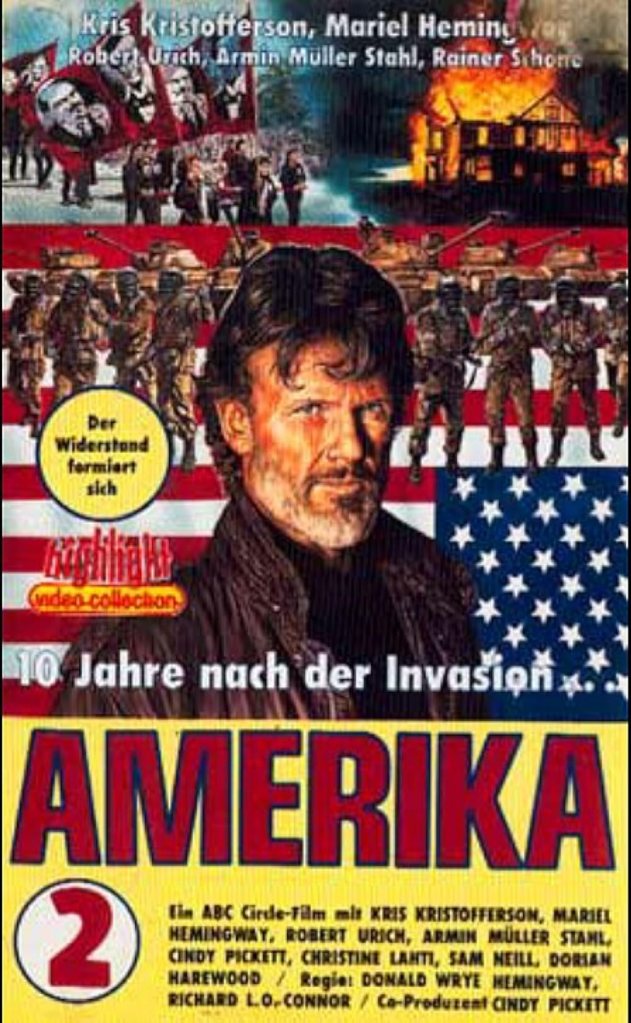
Amerika starred Kris Kristofferson, Mariel Hemingway, Sam Neill, Robert Urich, Christine Lahti, and a 17-year-old Lara Flynn Boyle in her first major role. Amerika was about life in the United States (US) after a bloodless takeover engineered by the Soviet Union. Not wanting to depict the actual takeover, ABC Entertainment president, Brandon Stoddard, set the miniseries ten years after the event, focusing on the demoralised US people a decade after the Soviet conquest. The intent, he later explained, was to explore the US spirit under such conditions, not to portray the conflict of the Soviet coup.
Refer to Red Dawn (1984), Red Dawn (2012), and The Man in the High Castle (2015-2019).


Background
Amerika has an indirect connection to another notable ABC programme, the 1983 television film The Day After, which some critics felt was too pacifist for portraying the doctrine of nuclear deterrence as pointless.
Outline
Major Characters
The storyline of Amerika primarily follows three political leaders:
- Devin Milford (played by Kris Kristofferson): a maverick politician before the Soviet occupation who ran for president in 1988 (in the novel, 1992), after the Soviet takeover began. Milford was placed in a prison camp for daring to speak the truth about the Soviet conquest; at the beginning of the miniseries, Devin is declared “rehabilitated” and released back into society into the custody of his father, who lives in the Nebraska county run by Peter Bradford.
- Colonel Andrei Denisov of the KGB (played by Sam Neill): the Soviet administrator for the American Central Administrative Area. He is romantically involved with actress Kimberly Ballard (played by Mariel Hemingway). Andrei’s superior and mentor is General Petya Samanov (played by Armin Mueller-Stahl), the Soviet military leader in charge of the United States.
- Peter Bradford (played by Robert Urich): a county administrator in Nebraska who cooperates with the Soviets to create a better life for his community. He attracts the attention of the Soviet leadership because, while cooperative, he is independent and respected by his constituents. At the series’ climax, the Soviets carve a new country called “Heartland” out of the Midwest, with Bradford as its “governor-general”.
Major female characters, in addition to Ballard, include Peter Bradford’s wife, Amanda (played by Cindy Pickett), Devin Milford’s ex-wife, Marion (played by Wendy Hughes), and most notably, Devin’s sister Alethea (played by Christine Lahti), who at the outset is prostituting herself to the local occupation leader. “Alethea is the centre”. noted Donald Wrye. “She is a metaphor for America – not just phonically – and it is she who discovers her moral core through(out) the course of the series.” Lara Flynn Boyle played Bradford’s teenage daughter, Jackie.
The human drama of these characters intersects with the political intrigue of the Soviet plans for the breakup of the US. Bradford, the pragmatist, clashes with Milford, the idealist; Bradford’s wife is Milford’s ex-girlfriend, who finds she still has feelings for Milford upon his release from the prison camp; Denisov appoints Milford’s ex-wife, a powerful magistrate (and General Samanov’s mistress), to serve as Bradford’s deputy and assistant in Heartland; and Kimberly’s renewed sense of US pride ultimately affects her relationship with Denisov.
Backstory
Towards the end of the 1980s, as the decline of the Soviet Union puts it in danger of losing the Cold War, the Soviet leadership makes a desperate gamble to rearrange the global balance of power. Four large thermonuclear weapons are detonated in the ionosphere over the US. The resulting electromagnetic pulse (or EMP) destroys the nation’s communications and computer systems, cripples the US electrical grid, and affects any equipment that relies on computer technology, such as most late-model automobiles. With its ICBMs inoperative – and the National Command Authority unable to contact US military forces abroad or their foreign allies in western Europe to launch a counterattack – the U.S. is forced to accept Soviet terms for surrender: unilateral disarmament, the end of the dollar as a reserve currency, and integration into the Soviet military/economic bloc. The US quickly falls under Soviet military occupation under the command of Russian General Petya Samanov, with the President and Congress becoming mere figureheads for their Soviet overseers. Communications between the administrative areas have been cut off, and the damage to the electrical grid caused by the EMP attack has never been fully repaired.
The above events are implied in the miniseries, although never directly explained. The description is taken from the novelisation of the miniseries, Amerika: The Triumph of the American Spirit by Brauna E. Pouns and Donald Wrye (Pocket Books, 1987), based on Wrye’s screenplay.
Geopolitical Situation
In 1997, a decade after its defeat, the contiguous US is occupied by a United Nations peacekeeping force, the United Nations Special Service Unit (UNSSU), composed primarily of Eastern Bloc forces. The UNSSU garrison in Milford is under a command of an officer from East Germany, Major Helmut Gurtman (played by Reiner Schöne). UNSSU troops periodically engage in destructive combined arms training exercises which are deliberately intimidating to the local population.
Those Americans who engage in dissent are stripped of their privileges and sent to exile camps, where they are anathema to the Soviets and their fellow citizens. Association and communication with the exiles is forbidden, although some risk their own remaining freedoms by offering humanitarian aid. Production quotas have been imposed, and foodstuffs rationed, with the surplus being shipped to the Soviet Union.
Against this background, Bradford ascends to the leadership as governor-general of Heartland. He acts the part of a collaborator, hoping to reform the Soviet occupation from within with ideals of the old US. Milford is released from the prison camp, hoping to be reunited with his children and fight to end the occupation and restore the US. Denisov hopes to “salvage as much as possible” of the old US, while realizing that the US essentially must cease to exist as a nation in order to appease the Soviet Union’s leadership.
Climax and Resolution
The Soviet leaders of the occupation are faced with the dual problem of keeping the US pacified and convincing the Politburo that their fears of a revitalised US are unfounded because the country can no longer pose a threat. The Politburo is not convinced, and considers exploding nuclear weapons over several unnamed US cities as a warning to the American people and to the world. Samanov and Denisov, both of whom want Soviet control of the US to be relatively humane, are horrified by this idea.
At great personal risk, Samanov convinces the Soviet leadership to accept a compromise plan. The US will be divided into “client states” such as Heartland. Additionally, members of the US Congress will be executed if they refuse to dissolve the nation’s government and disperse in peace. When Samanov asks the assembled Congress to disband the legislative body and dissolve the US government, the members angrily refuse to do so. Samanov walks out of the House of Representatives chamber and his men begin firing into the crowd of legislators. All members of Congress are killed in the attack, along with the speaker of the House of Representatives and the vice president. The US Capitol building and the artwork in its rotunda are destroyed. After the act is carried out, Samanov surveys the damage and the dead bodies of the members of Congress. He then sits in the House of Representatives chamber and commits suicide.
In the final episode of the miniseries, Heartland has seceded from the US, with other regions to follow within the next few weeks. Instead, Heartland soldiers and local militia attack the local UNSSU compound. There is talk of a “Second American Revolution” that could undermine the Soviet Union’s plans to break up the US. The miniseries ends on a downbeat note, Devin Milford is shown about to make a nationwide speech telling Americans to revolt against the Soviet occupation, however, Milford is shot to death. It is unclear if he managed to make a nationwide broadcast calling on Americans to resist the breakup of the US, but based on the ending, it appears that the US ceases to exist as a nation and is broken up into several independent countries.
The Divided States of America
In this fictional timeline, the US Congress divided the US into multiple “administrative areas” in 1988, one year after the communist takeover. These areas are intended to become polities modelled on the Soviet republics, joined together in a new North American Union. A map shown on screen reveals these administrative areas to be:
- California Special District: California, Nevada
- Western Semi-Autonomous: Colorado, Idaho, Montana, Utah, Wyoming
- Northwest: Oregon, Washington
- Southwest: Arizona, New Mexico
- North Central: Minnesota, North Dakota, South Dakota, Wisconsin, and the Upper Peninsula of Michigan.
- Central: Illinois, Iowa, Kansas, Missouri, Nebraska (this is Peter Bradford’s administrative area, and the territory which eventually becomes Heartland, with Omaha, Nebraska, as its capital)
- South Central: Arkansas, Louisiana, Oklahoma, Texas
- Southern: Alabama, Florida, Georgia, Mississippi
- Mid-Atlantic: Delaware, Maryland, North Carolina, South Carolina, Virginia
- Appalachia: Kentucky, Tennessee, West Virginia
- Ameritech: Indiana, the Lower Peninsula of Michigan, Ohio, Pennsylvania (presumably named after the phone company that serviced these areas)
- Northeastern: Connecticut, Maine, Massachusetts, New Hampshire, New Jersey, New York, Rhode Island, Vermont
In addition to these areas, Washington, D.C. comprises its own National Administrative District, South Florida is described by a character as the “Space Zone”, and there is a passing reference to three “International Cities”, one of which is San Francisco. Michigan is separated into two administrative regions, with the Lower Peninsula belonging to Ameritech, and the Upper Peninsula belonging to the North Central region. Alaska is described as never having been pacified, requiring continued engagement by Soviet troops, and there are pockets of armed resistance in the Rocky Mountains and in West Virginia. There is no mention of what has happened to Hawaii, or to US territories such as Puerto Rico, Guam, and American Samoa (even though Puerto Rico and the US Virgin Islands may have presumably been taken over by the “Greater Cuba”, led by Fidel Castro).
The Rust Belt (presumably “Ameritech”) faces its own special problems. Most of its advanced factory equipment was removed at the start of the occupation and taken to the Soviet Union. The region suffers 50% unemployment as a result, and its residents are not permitted to leave, except to volunteer for factory work in the Soviet Union, from which no one has yet returned.
Travel and communications between the various zones is heavily restricted, part of the “divide and conquer” plan of the Soviet occupation.
Communist Occupation Elsewhere
Both the novel and miniseries imply that the Soviet Union has conquered other countries after the US coup (it can be surmised, for example, that the EMP which disabled US technology also would have crippled Canada and Mexico, a minor character says that he and his wife fled East Germany for the United States and remarked that “the promised land [had] become worse than what [they] left”, and Denisov says at one point that “we control most of the world”).
In this new world, Fidel Castro heads what is now called “Greater Cuba”, embracing most of the Caribbean and Latin America, and Taiwan has been absorbed into China. North Korea has conquered South Korea and Korea is united under communist rule. A politician named “Mbele” heads the “Socialist Republic of Southern Africa” which also includes South Africa, “Barghout” is the leader of “Iraqistan” which includes present-day Israel and all of the Arab world in both the Middle East and North Africa. Eastern Europe is in a state of unrest, echoing the turmoil in the former US. The Soviet leader mentions being stationed in England before being posted in America, implying that Western Europe is also under Soviet control, much like America.
National Symbols
The flag of the occupation is the pale blue United Nations flag, with crossed US and Soviet flags superimposed on the sides. The US flag is shown without its stars, and this flag is displayed during the “Lincoln Week” ceremonies. The standard US flag is outlawed, although one scene shows a group of war veterans marching with the old US flag upside down, this being a distress signal. The US national anthem, “The Star-Spangled Banner”, also is outlawed, but this does not stop a group of citizens from singing it (haltingly at first) after the “Lincoln Week” parade.
Abraham Lincoln is included with Karl Marx and Vladimir Lenin in propaganda. One of the signature scenes in the film is a twenty-minute, dialogue-free depiction of the celebration of “Lincoln Week” (a holiday replacing the Fourth of July), with both Lincoln and Lenin displayed on red banners that were most likely intended to be striking and startling to television audiences of the time.
A new pledge of allegiance is given by “rehabilitated” political prisoners upon release from the US gulags. While the prisoners are told that they are free to refuse to make this pledge, the circumstances under which it is administered suggest otherwise. The pledge states:
I pledge my allegiance to the flag of the community of American, Soviet, and United Nations of the World, and to the principle for which it stands – a nation, indivisible with others of the Earth, joined in peace, and justice for all.
Cast
- Kris Kristofferson … Devin Milford7 episodes, 1987
- Robert Urich … Peter Bradford7 episodes, 1987
- Wendy Hughes … Marion Andrews7 episodes, 1987
- Sam Neill … Colonel Andrei Denisov7 episodes, 1987
- Cindy Pickett … Amanda Bradford7 episodes, 1987
- Armin Mueller-Stahl … General Petya Samanov7 episodes, 1987
- Christine Lahti … Alethea Milford7 episodes, 1987
- Jim Chad … Eng Cameraman7 episodes, 1987
- Richard Bradford … Ward Milford6 episodes, 1987
- Ivan Dixon … Dr. Alan Drummond6 episodes, 1987
- Ford Rainey … Will Milford6 episodes, 1987
- Graham Beckel … Clayton Cullen6 episodes, 1987
- Reiner Schöne … Major Helmut Gurtman6 episodes, 1987
- Dorian Harewood … Jeffrey Wyman6 episodes, 1987
- Mariel Hemingway … Kimberly Ballard6 episodes, 1987
- Marcel Hillaire … Dieter Heinlander5 episodes, 1987
- Lara Flynn Boyle … Jackie Bradford5 episodes, 1987
Release
Ratings
The first two nights of Amerika garnered big ratings, but audience numbers dropped thereafter, and the overall miniseries averaged a 19 rating and a 29 share of American television households, compared to a 46 rating/62 share for The Day After. “It wasn’t as big a hit as its supporters had hoped”, said Ted Koppel, “but it wasn’t a disaster, either.” Amerika was the second-highest rated miniseries of the 1986-1987 US television season.
Although a 35 share reportedly had been promised to advertisers, Stoddard was happy with the performance of Amerika, claiming that all or part of the miniseries had been watched by 100 million people – a ratings bonanza for ABC, then in third place among the three major networks.
Availability
Amerika has not been shown on US television since its original telecast on ABC. A VHS box set of the miniseries was released by Anchor Bay Entertainment in 1995, but no official DVD release is available. Portions of the soundtrack by Basil Poledouris were released on CD by Prometheus Records in 2004 (in a limited edition of 3,000 copies). The novelisation is widely available from used-book sellers and online auction sites. The miniseries itself can be found pirated on YouTube.
Parodies
In February 1987, the miniseries was parodied on the NBC show Saturday Night Live as “Amerida”, in which a debt-ridden US is mortgaged to Canada and subsequently repossessed. It posited Wayne Gretzky as the prime minister of Amerida. The US protagonist (played by Canadian actor Phil Hartman) longs for a country “where you don’t have money that’s all the colours of the rainbow” and “you can spell words like colour and flavour without a u.” To calm him down, his wife makes the offer of a beer: “How about a Labatt’s, eh?” The flag of Amerida was the US flag with the stars replaced by a white maple leaf.
The satirical Canadian radio programme Double Exposure parodied the series in a sketch called Kanada with a K, in which “Joe Klark with a K” rescues the nation from “Comrade Ed”.
Trivia
- Described in promotional materials as “the most ambitious American miniseries ever created”, Amerika aired for 14+1⁄2 hours (including commercials) over seven nights (beginning 15 February 1987), and reportedly cost $40 million to produce.
- The miniseries was filmed in Ontario, Canada, in the Golden Horseshoe and southwestern Ontario cities of Toronto, London, and Hamilton, as well as various locations in Nebraska – most notably the small town of Tecumseh, which served as “Milford”, the fictional setting for most of the series.
- Donald Wrye was the executive producer, director, and writer of Amerika, while composer Basil Poledouris scored the miniseries, ultimately recording (with the Hollywood Symphony Orchestra) eight hours of music – the equivalent of four feature films.
- The attack helicopters seen during the “Lincoln Week” parade were originally created for use in Blue Thunder (1983).
- In the scene where the assembled crowd recites the American Pledge of Allegiance, the extras had to be taught it since the miniseries was filmed in Canada.
Amerika Series
Production & Filming Details
- Director(s):
- Donald Wrye … (7 episodes, 1987)
- Producer(s):
- John Lugar … co-producer (7 episodes, 1987)
- Richard L. O’Connor … producer (7 episodes, 1987)
- Donald Wrye … executive producer (7 episodes, 1987)
- Writer(s):
- Donald Wrye … (writer) (7 episodes, 1987)
- Music:
- Basil Poledouris … (7 episodes, 1987)
- Cinematography:
- Hiro Narita … (7 episodes, 1987)
- Editor(s):
- Martin Cohen … (3 episodes, 1987)
- Frank Mazzola … (3 episodes, 1987)
- Michael Ripps … (3 episodes, 1987)
- Craig Bassett … (1 episode, 1987)
- Raja Gosnell … (1 episode, 1987)
- Dan Harville … (1 episode, 1987)
- Jacque Elaine Toberen … (1 episode, 1987)
- Production:
- ABC Circle Films
- Distributor(s):
- ABC
- Release Date: 15 February 1987 to 22 February 1987.
- Running time: 870 minutes (total running time).
- Rating: 15.
- Country: US.
- Language: English.


 Military Gogglebox
Leave a comment