

Introduction
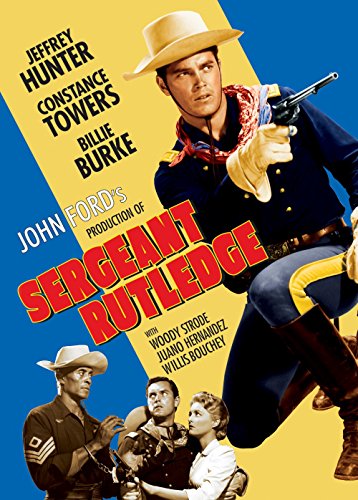
Sergeant Rutledge is a 1960 American Technicolor Western film directed by John Ford and starring Jeffrey Hunter, Constance Towers, Woody Strode and Billie Burke.
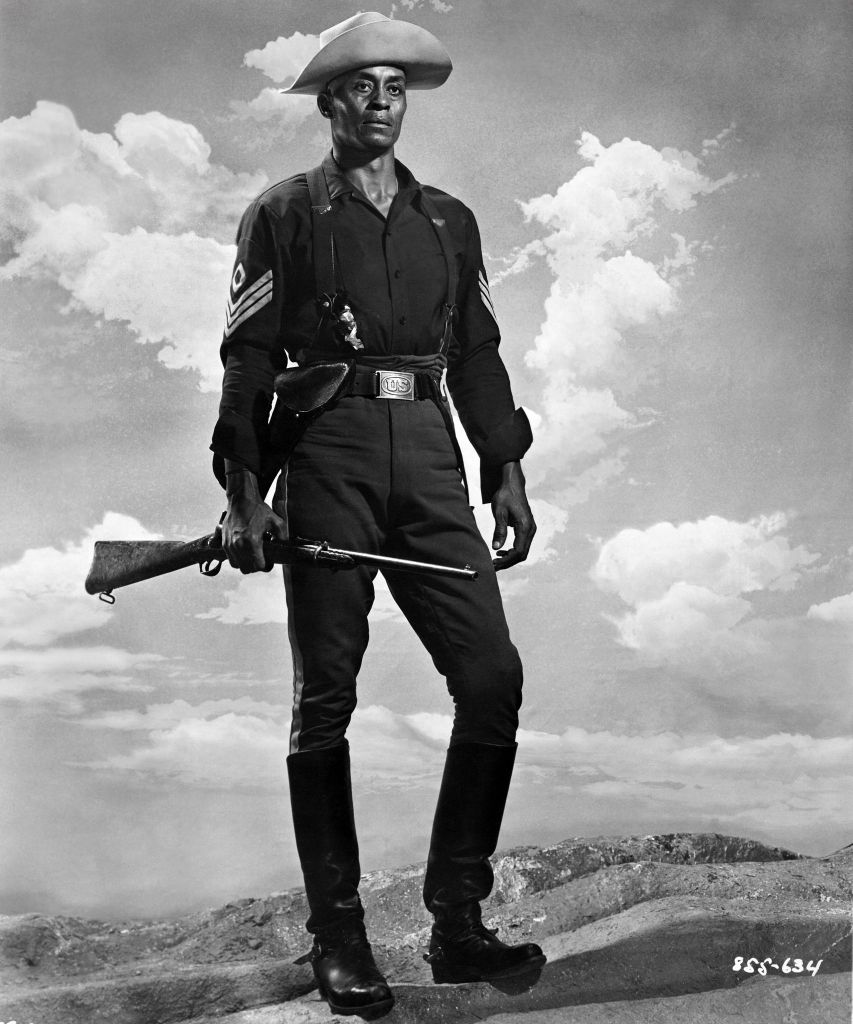
The film starred Strode as Sergeant Rutledge, a Black first sergeant in a coloured regiment of the United States Cavalry, known as “Buffalo Soldiers”. At a US Army fort in the early 1880s, he is being tried by a court-martial for the rape and murder of a white girl as well as for the murder of the girl’s father, who was the commanding officer of the fort. The story of these events is recounted through several flashbacks.
Outline
The film revolves around the fictional court-martial of 1st Sgt. Braxton Rutledge (Strode) of the 9th US Cavalry in 1881. At the time, the United States Army maintained four coloured regiments, including the 9th Cavalry.
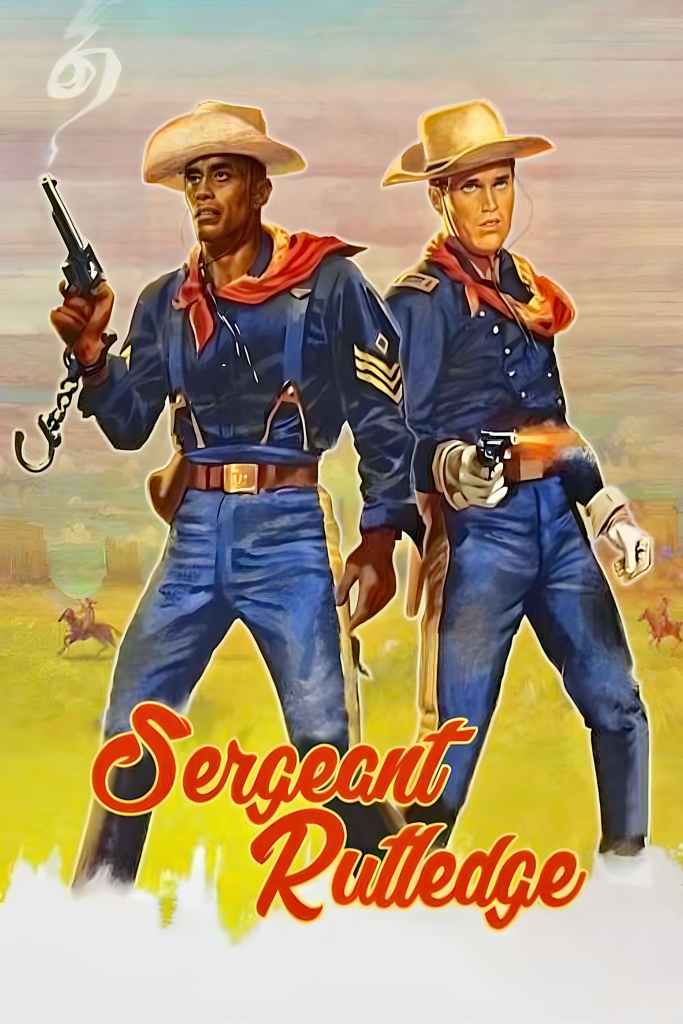
His defence is handled by Lt. Tom Cantrell (Hunter), who is also Rutledge’s troop officer. The story is told through a series of flashbacks, expanding the testimony of witnesses as they describe the events following the murder of Rutledge’s Commanding Officer, Major Custis Dabney, and the rape and murder of Dabney’s daughter Lucy, for which Rutledge is the accused. Mary Beecher, a woman in whom Cantrell shows romantic interest, gives evidence in Rutledge’s favour, noting that he saved her life when Apaches were attacking.
Circumstantial evidence suggests that Rutledge committed the crimes. Worse still, Rutledge deserts after the killings. Lt. Cantrell tracks Rutledge and arrests him. Subsequently, Rutledge escapes from captivity during an Indian raid. Aware of an impending ambush, he returns to warn his fellow cavalrymen and fights off the attack with them.
He is then brought back in to face a court-martial. A guilty verdict from the all-white military court appears inevitable, and the locals appear to enjoy the spectacle. Cantrell ultimately secures a confession when examining Chandler Hubble, the father of a young local man who was interested in Lucy, and Rutledge is exonerated. Cantrell and Beecher happily look forward to a life together.
Cast
- Jeffrey Hunter as 1st Lt. Tom Cantrell, 9th Cavalry (counsel for the defense). Hunter’s role in Sergeant Rutledge was the last of his three roles in films directed by Ford. He was previously cast in The Searchers and The Last Hurrah.
- Constance Towers as Mary Beecher. Towers had also been cast in Ford’s previous film, The Horse Soldiers.
- Billie Burke as Mrs. Cordelia Fosgate. Her part in Sergeant Rutledge was her final film role.
- Woody Strode as First Sergeant Braxton Rutledge, C Troop 9th US Cavalry. Sergeant Rutledge was the first of four films Strode made with John Ford. In an interview, Strode recalled how he was cast for the role: “The big studios wanted an actor like Sidney [Poitier] or [Harry] Belafonte,” recalled Strode. “And this is not being facetious, but Mr. Ford defended me; and I don’t know that this is going on. He said, “Well, they’re not tough enough to do what I want Sergeant Rutledge to be.”
- Juano Hernández as Sgt. Matthew Luke Skidmore, C Troop 9th US Cavalry
Willis Bouchey as Lt. Col. Otis Fosgate, 9th Cavalry (president of the court-martial) - Carleton Young as Capt. Shattuck, 14th Infantry (prosecutor)
- Judson Pratt as 2nd Lt. Mulqueen, 9th Cavalry (court-martial board member) (uncredited)
- Chuck Hayward as Capt. Dickinson, 9th US Cavalry.
- Rafer Johnson as Cpl. Krump, C Troop 9th US Cavalry
- Toby Michaels as Lucy Dabney (uncredited)
- Jack Mower as Courtroom Spectator (uncredited)
- Fred Libby as Chandler Hubble (uncredited)
Production
The screenplay for Sergeant Rutledge was original and was written by the film’s co-producer, Willis Goldbeck, and by James Warner Bellah. Bellah has written that he and Goldbeck interested John Ford in directing a film after a screenplay was completed. Bellah had previously written the stories on which John Ford based his “cavalry trilogy” of films: Fort Apache (1948), She Wore a Yellow Ribbon (1949), and Rio Grande (1950). The screenplay for Sergeant Rutledge was adapted by Bellah for a novel that was published in conjunction with the film’s release.
Parts of the film were shot in Monument Valley and the San Juan River at Mexican Hat in Utah.
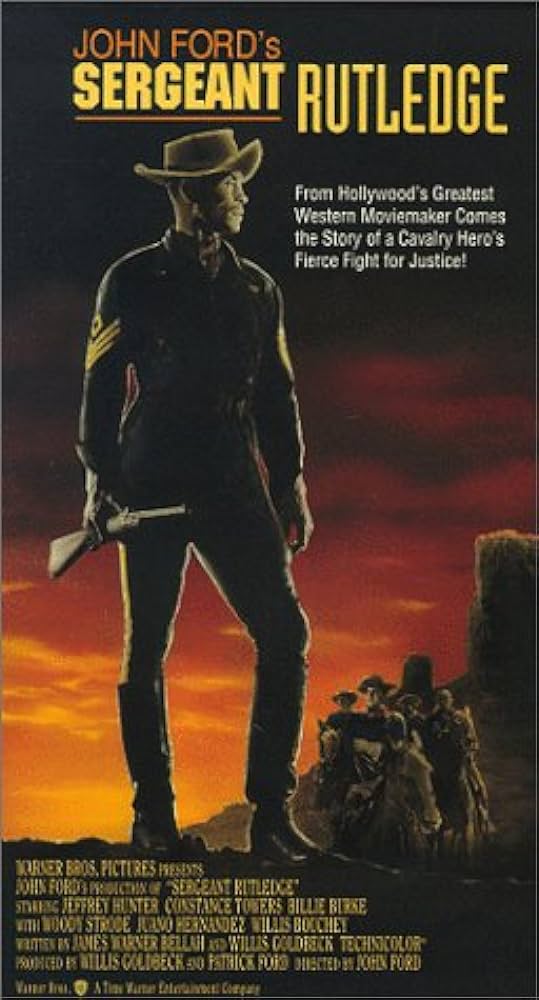
As illustrated in the poster image above, for the 1960 domestic theatrical release of the film the theatre patrons were warned that they could not be seated during the final 10 minutes of the film in order to preserve its suspense. The film did poorly in US theatres. Scott Eyman summarised: “Sergeant Rutledge is a film of considerable formal beauty about the bonds between a black band of brothers. Not surprisingly, it did miserably at the domestic box office, grossing $784,000. It did considerably better overseas, grossing $1.7 million, but was probably still a marginal financial failure.”
Release
Other Countries
In Spain, the film was shown under the title of El Sargento Negro (The Black Sergeant), in France under the title Le Sergent Noir (The Black Sergeant) and
in Italy under the title I dannati e gli eroi (The Damned and the Heroes).
Reception
Black Classic Movies mentions that this is one of the few American films of the 1960s to have a Black man in a leading role and the first mainstream western to do so.
Home Media
A region 1 DVD was released in 2006 in the United States as part of a set of movies directed by John Ford. In 2016 the film’s DVD was released individually. A VHS tape had been released in 1988.
Trivia
- The title was also used for the novelisation published in the same year.
- Decades later, the film continues to attract attention because it was one of the first mainstream films in the US to treat racism frankly and to give a starring role to an African-American actor.
- In 2017, film critic Richard Brody observed that “The greatest American political filmmaker, John Ford, relentlessly dramatized, in his Westerns, the mental and historical distortions arising from the country’s violent origins – including its legacy of racism, which he confronted throughout his career, nowhere more radically than in Sergeant Rutledge.”
- Unsatisfied with Woody Strode’s rehearsal of bullet-wounded drowsiness, director John Ford took his own steps to make Strode appear authentically weary for Rutledge’s gunshot early on in the film.
- The day before the scene was to be shot, Ford got Strode drunk early in the day and had an assistant follow him around for the rest of the day to make sure he stayed that way.
- When the time came for Strode to shoot the scene with Constance Towers, his hangover gave him the perfect (for Ford) appearance of a man who had been shot.
Production & Filming Details
- Director(s):
- John Ford
- Producer(s):
- Patrick Ford … producer
- Willis Goldbeck … producer
- Writer(s):
- James Warner Bellah … (written by)
- Willis Goldbeck … (written by)
- James Warner Bellah … (novel) (uncredited)
- Music:
- Howard Jackson
- Cinematography:
- Bert Glennon … director of photography
- Editor(s):
- Jack Murray
- Production:
- Warner Bros.
- John Ford Productions
- Distributor(s):
- Warner Bros.
- Release Date: 25 May 1960.
- Running Time: 111 minutes.
- Rating: PG.
- Country: US.
- Language: English.

 Military Gogglebox
Leave a comment