
Introduction
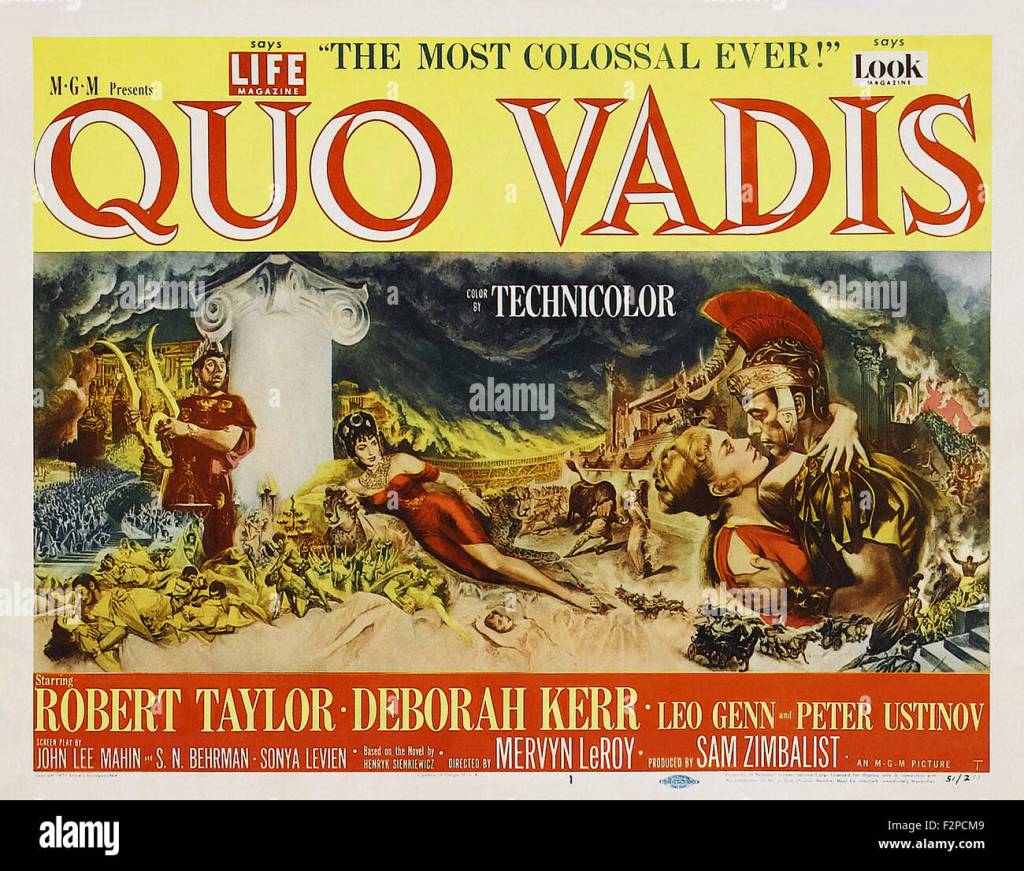
Quo Vadis (Latin for “Where are you going?”) is a 1951 American religious epic film set in ancient Rome during the final years of Emperor Nero’s reign, based on the 1896 novel of the same title by Polish Nobel Laureate author Henryk Sienkiewicz.
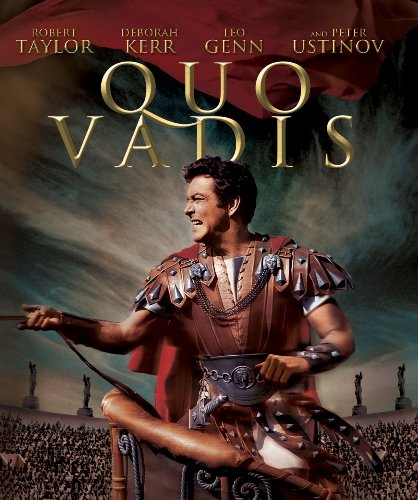
Produced by Metro-Goldwyn-Mayer and filmed in Technicolor, it was directed by Mervyn LeRoy from a screenplay by S.N. Behrman, Sonya Levien, and John Lee Mahin. It is the fourth screen adaptation of Sienkiewicz’s novel. The film stars Robert Taylor, Deborah Kerr, Leo Genn, and Peter Ustinov, and features Patricia Laffan, Finlay Currie, Abraham Sofaer, Marina Berti, Buddy Baer, and Felix Aylmer. Future Italian stars Sophia Loren and Bud Spencer appeared as uncredited extras.


Outline
Marcus Vinicius is a Roman military commander and the legate of the XIV Gemina. Returning from wars in Britain and Gaul, he falls in love with Lygia, a devout Christian; in spite of this, he continually tries to win her affections. Though she grew up as the beloved foster daughter of Aulus Plautius, a retired Roman general, Lygia is legally a Lygian hostage of Rome in the old general’s care. Petronius, Marcus’ uncle, persuades Nero to give her to his nephew as a reward for his services. Lygia resents this arrangement, but eventually falls in love with Marcus.
Meanwhile, Nero’s atrocities become increasingly outrageous and his behaviour more irrational. After Nero burns Rome and blames the Christians, Marcus sets out to rescue Lygia and her family. Nero arrests them, along with all the other Christians, and condemns them to be slaughtered in his Circus; some are killed by lions. Petronius, Nero’s most trusted advisor, warns him that the Christians will be celebrated as martyrs, but he cannot change the emperor’s mind. Then, tired of Nero’s insanity and suspecting that he may be about to turn on him, too, Petronius composes a letter to Nero expressing his derision for the emperor (which he previously had concealed to avoid being murdered by him) and commits suicide by severing an artery in his wrist. His slavegirl Eunice (who has fallen in love with him) elects to die with him, despite being freed. The Christian apostle Peter has also been arrested after returning to Rome in response to a sign from the Lord, and he marries Marcus and Lygia in the Circus prisons. Peter is later crucified upside-down, a form of execution conceived by Nero’s Praetorian Guard as an expression of mockery.
Poppaea, Nero’s wife, who lusts after Marcus, devises a diabolical revenge for his rejection of her. Lygia is tied to a stake in the Circus and a wild bull is released into the arena. Lygia’s bodyguard Ursus must attempt to kill the bull with his bare hands to save Lygia from being gored to death. Marcus is taken to the emperor’s box and forced to watch. This act outrages his loyal officers who are among the spectators. Ursus is able to topple the bull, though, and break its neck. At that moment Marcus manages to break free from his bonds and leaps into the arena to get to Lygia. Massively impressed by Ursus’s victory and seeing that Lygia is the beloved of Marcus who is still regarded as a great war hero, the crowd exhorts Nero to spare the couple. He refuses to do so, even after four of his courtiers, Seneca, architect Phaon, poet Lucan, and musician Terpnos add their endorsement of the mob’s demands. The decision enrages the crowd and Marcus’s loyal troop members rush to the arena to save the three. Marcus accuses Nero of burning Rome and announces that General Galba is at that moment marching on the city, intent on replacing Nero, and hails him as new Emperor of Rome.
The crowd revolts, now firmly believing that Nero, not the Christians, is responsible for the burning of Rome. Nero flees to his palace, where he strangles Poppaea, blaming her for inciting him to scapegoat the Christians. Then Acte, Nero’s discarded mistress who is still in love with him, appears and offers him a dagger to end his own life before the mob storming the palace kills him. Nero cannot do it, so Acte helps him to push the dagger into his chest, and he dies.
Marcus, Lygia, and Ursus are now free, and they leave Rome for Marcus’ estate in Sicily to begin a new life together. By the roadside, Peter’s crook, which he had left behind when he returned to Rome, has sprouted blossoms. A radiant light appears and a chorus intones, “I am the way, the truth, and the life,” words spoken by Jesus (John 14:6, New Testament).
Cast
- Robert Taylor as Marcus Vinicius
- Deborah Kerr as Lygia
- Leo Genn as Petronius
- Peter Ustinov as Emperor Nero
- Patricia Laffan as Poppaea Sabina
- Finlay Currie as Saint Peter
- Abraham Sofaer as Paul
- Marina Berti as Eunice
- Buddy Baer as Ursus
- Felix Aylmer as Plautius
- Nora Swinburne as Pomponia
- Ralph Truman as Tigellinus
- Norman Wooland as Nerva
- Peter Miles as Nazarius
- Geoffrey Dunn as Terpnos
- Nicholas Hannen as Seneca
- D.A. Clarke-Smith as Phaon
- Rosalie Crutchley as Acte
- John Ruddock as Chilo
- Arthur Walge as Croton
- Elspeth March as Miriam
- Strelsa Brown as Rufia
- Alfredo Varelli as Lucan
- Roberto Ottaviano as Flavius
- William Tubbs as Anaxander
- Pietro Tordi as Galba
The film features many uncredited supporting parts and cameos, including:
- Elizabeth Taylor as a Christian prisoner in arena;
- Sophia Loren as a Lygian slave;
- Christopher Lee as a chariot driver;
- Clelia Matania as Parmenida the hairdresser;
- Marika Aba as the Assyrian Dancer at Nero’s banquet;
- Richard Garrick as a slave with Marcus at Triumph;
- Giuseppe Tosi as a wrestler at Nero’s banquet;
- Adrienne Corri as an imprisoned Christian woman;
- Bud Spencer as an Imperial Guard;
- Robin Hughes as Jesus in a flashback tableau; and
- The narration was provided by an uncredited Walter Pidgeon.
Production
Pre-Production
In the late 1930s, MGM bought the talking-picture rights to the 1896 novel Quo Vadis from author Henryk Sienkiewicz’s heirs. (At the same time they had to buy the 1924 silent-screen version.) The company originally intended to make the film in Italy, but the outbreak of WWII caused it to be postponed. After the war, production was restarted. A lease was obtained on the huge Cinecitta Studios, eight miles outside Rome, with its 148 acres and nine soundstages.
After months of preparation, the art director, costume designer, and set decorator arrived in Rome in 1948. Construction of the outdoor sets began at once: the huge Circus of Nero and exterior of Nero’s palace, a whole section of Ancient Rome, a great bridge, and the Plautius villa. The manufacture of thousands of costumes for extras began, along with drapes and carpets, metal and glass goblets, and 10 chariots. Official permission was granted to refurbish a section of the Appian Way. One of Hollywood’s foremost animal experts began to procure lions, horses, bulls, and other animals from around Europe. Well in advance of filming, the producer, director, chief cinematographer, and casting director arrived in Rome. The film finally went into production on Monday 22 May 1950.
Casting
The film was originally cast in 1949 with Elizabeth Taylor as Lygia and Gregory Peck as Marcus Vinicius. When the production changed hands the following year, the roles went to Deborah Kerr and Robert Taylor. Elizabeth Taylor had an uncredited cameo role as a Christian in the Circus prisons.
Although most of the cast was British and a few Italian (Marina Berti, Alfredo Varelli, Roberto Ottaviano), Robert Taylor was certainly not the only American. Others included Buddy Baer (Ursus), Peter Miles (Nazarius), Arthur Walge (Croton), and William Tubbs (Anaxander). Also, several were among the uncredited cast; perhaps the most notable of these was 70-year-old Irish-American character actor Richard Garrick as the public slave who stands behind Marcus in his Triumph chariot, holding a victory laurel above his head, and repeating “Remember thou art only a man.” Ustinov recalled how he was cast as Nero in 1949: “An exciting proposition came my way when I was 28 years old. MGM were going to remake Quo Vadis, and I was a candidate for the role of Nero. Arthur Hornblow [Jr] was to be the producer, and I was tested by [the director] John Huston. I threw everything I knew into this test, and to my surprise, John Huston did little to restrain me, encouraging me in confidential whispers to be even madder. Apparently the test was a success, but then the huge machine came to a halt, and the project was postponed for a year. At the end of the year, the producer was Sam Zimbalist and the director Mervyn LeRoy. They also approved my test, but warned me in a wire that I might be found to be a little young for the part. I cabled back that if they postponed again, I might be too old, since Nero died at 31. A second cable from them read ‘Historical Research Has Proved You Correct Stop The Part Is Yours’.
Clark Gable turned down the role of Marcus Vinicius very early in the film’s production history because he thought he would look ridiculous in Roman costumes.
Sophia Loren appeared in the film as an extra. Italian star Bud Spencer (real name: Carlo Pedersoli) also had an uncredited extra role as a Praetorian guardsman inside Nero’s summer palace at Antium. (He answers Nero, but his voice may be dubbed.)
Audrey Hepburn, still widely unknown when the film was released, was considered for the part of Lygia. Director Mervyn LeRoy wanted to cast her, but the role went to established MGM contract star Deborah Kerr. Wardrobe stills of her in costume for the film still exist.
Patricia Laffan was selected by the producer and director for the major role of Poppaea after they watched a screen test she made for a smaller part in the film.
Ustinov relates in his autobiography Dear Me that director Mervyn LeRoy summarized the manner in which he envisioned Ustinov should play the Emperor Nero, very salaciously, as
Nero … The way I see him … He’s a guy plays with himself nights…. At the time I thought it a preposterous assessment, but a little later I was not so sure. It was a profundity at its most workaday level, and it led me to the eventual conviction that no nation can make Roman pictures as well as the Americans … The inevitable vulgarities of the script contributed as much to its authenticity as its rare felicities. I felt then as I feel today, in spite of the carping of critical voices, that Quo Vadis, good or bad according to taste, was an extraordinarily authentic film, and the nonsense Nero was sometimes made to speak was very much like the nonsense Nero probably did speak.
Filming
Produced for $7 million, it was the most expensive film ever made at the time. It became MGM’s largest grosser since Gone with the Wind (1939). Filmed at the sprawling Cinecitta Studios that had been opened by Benito Mussolini in 1937 as part of the dictator’s master plan to make Rome the pre-eminent world capital. (Mussolini and Hollywood producer Hal Roach later negotiated to form the R.A.M. [“Roach and Mussolini”] Corporation, which was ultimately aborted. This business alliance with the Fascist state horrified 1930s Hollywood moguls and ultimately led to Roach defecting from his MGM distribution deal to United Artists in 1937.)
Filming in postwar Italy offered American studios immense facilities and cheap Italian labor and extras, of which thousands were required. Hollywood returned to Cinecitta often, producing many of its biggest spectacles there, including Helen of Troy (1956), Ben-Hur (1959), and Cleopatra (1963) – the latter two dwarfing Quo Vadis in scale. The studio would later be used by many Italian producers and directors, including Federico Fellini. The first use of the phrase “Hollywood on the Tiber”, which has come to refer to a golden era of American runaway film production in Italy, was as the title of a Time article in the issue dated June 26, 1950, published while Quo Vadis was being shot in Rome.
Composer Miklós Rózsa said that he wrote most of his score at the Culver City studios while the film was being shot in Italy:
[The] rushes were being sent back to Hollywood for cutting at the same time as they were being cut back in Rome … I set to work so that at least something was ready, even if it had to be modified later. I worked with the chief supervising editor, Margaret Booth, whose technical knowledge is incomporable … Finally, the Rome contingent arrived home with their version. It wasn’t so very different from the one that Margaret had put together, and there were no insuperable problems. Sam Zimbalist was amazed and delighted that I had all the music ready in three weeks, thanks to the work Margaret and I had already done.
Ten Italian locations were used in the film. With the exception of the Via Appia, most of these have not been identified, but the final stage of the chariot chase was filmed along the 2000-year-old Viale dei Cipressi (Avenue of Cypresses) near the village Bolgheri. This landmark in Livorno Province, Tuscany, is easily recognisable.
In the summer of 1950, when Quo Vadis was in production, Rome was in the grip of an intense heatwave, as Peter Ustinov recalled: “Rome was in the throes of Holy Year, and bursting with pilgrims. It was also one of the hottest summers on record.” The heat affected not only the cast and crew, but also the lions. Mervyn LeRoy recalled that because of the heat, the lions were reluctant to enter the arena.
Due to equipment shortages in Italy, MGM had to import a reported two hundred tons of generators, lights and other electrical equipment from Culver City. The film holds the record for the most costumes used in one movie: 32,000.
At one point in the film, Nero shows his court a scale model illustrating his plans for the rebuilding of Rome as a new city to be called Neropolis. Studio publicity claimed that this was the model of Ancient Rome housed in the Museum of Roman Civilisation and that it had been borrowed from the Italian government. (This was originally constructed by Mussolini’s government for a 1937 exhibition of Roman architecture.) However, the museum model is of fourth-century Rome, not of first-century Rome as it would have looked when rebuilt after the Great Fire of AD 64. The screen model looks nothing like the museum model. (It was almost certainly constructed especially for the film – perhaps by its special effects model-maker, Donald Jahraus.)
Anthony Mann worked on the film as an uncredited second-unit director. He spent 24 nights (four working weeks) on the Cinecitta backlot shooting scenes for the Burning of Rome sequence. However, he was not the co-director of the film, as some of his admirers have claimed. The soundstage scenes for the same sequence were directed by Mervyn LeRoy.
Release
Box Office Performance
The film was a major commercial success. It was number one at the US box office for 6 consecutive weeks and 11 weeks in total. According to MGM’s records, during its initial theatrical release, it earned $11,143,000 in the US and Canada and $9,894,000 elsewhere, making it the highest-grossing film of 1951, and resulting in a profit to the studio of $5,440,000.
Home Media
A two-disc special edition of the movie was released on DVD in the US on 11 November 2008, after a long photochemical restoration process. A high-definition Blu-ray version was released 17 March 2009.
Trivia
- The movie’s huge box-office success was credited with saving MGM from bankruptcy.
- True to his reputation as a voluptuary, the real Petronius took a week to kill himself by allowing his wounds to bleed and binding them up again.
- Reportedly, he entertained friends, ate, drank, and slept during the week-long ordeal.
- Clark Gable turned down the role of Marcus Vinicius, because he thought the costume would make him look ridiculous.
- Cinecitta Studios simply didn’t have enough electrical power to cope with the demands of lighting such immense sets, so generators were shipped over from English studios.
- They even requisitioned a generator from a decommissioned Italian warship.
- After World War II Robert Taylor had worked on a series of relatively insignificant films until “Quo Vadis” re-established him as a major star.
Production & Filming Details
- Director(s):
- Mervyn LeRoy
- Anthony Mann … (uncredited)
- Producer(s):
- Sam Zimbalist … producer
- Writer(s):
- John Lee Mahin … (screen play)
- S.N. Behrman … (screen play)
- Sonya Levien … (screen play)
- Henryk Sienkiewicz … (based on the novel by)
- Hugh Gray … (contributing writer) (uncredited)
- Music:
- Miklós Rózsa … (as Miklos Rozsa)
- Cinematography:
- William V. Skall … director of photography
- Robert Surtees … director of photography
- Editor(s):
- Ralph E. Winters
- Production:
- Metro-Goldwyn-Mayer (MGM)
- Distributor(s):
- MGM
- Release Date: 08 November 1951 (US).
- Running Time: 166 minutes.
- Rating: PG.
- Country: US.
- Language: English.

 Military Gogglebox
Leave a comment