
Introduction
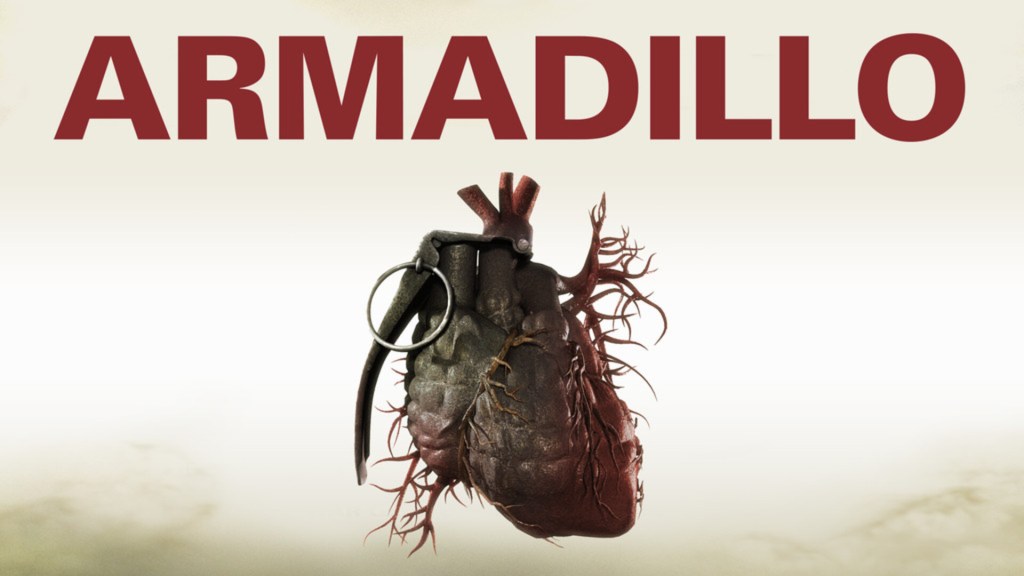
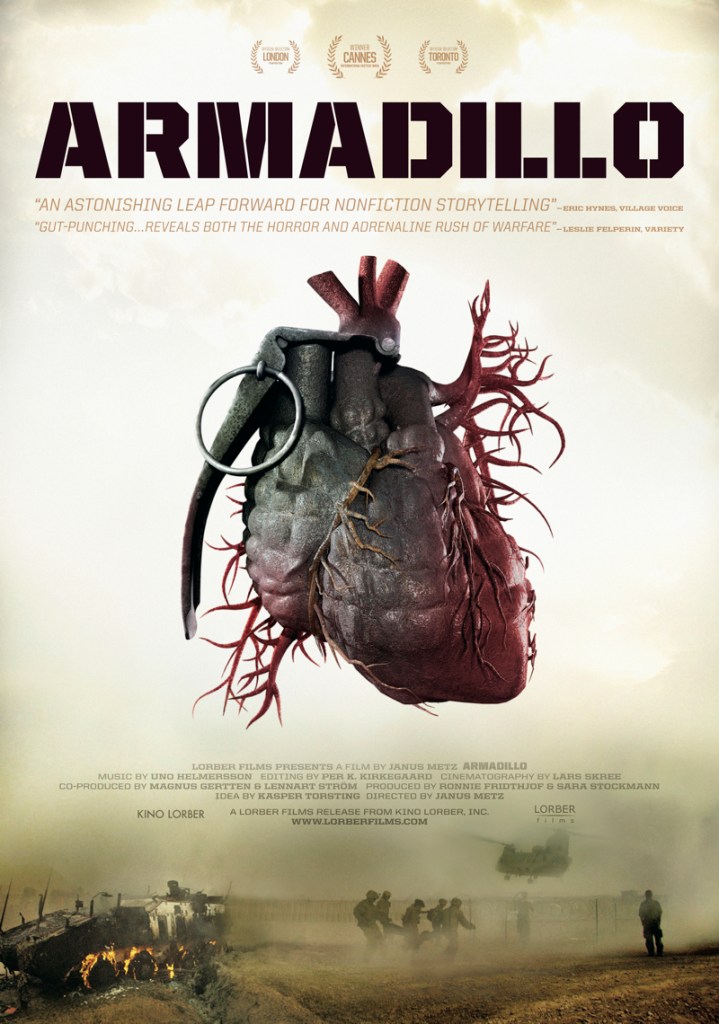
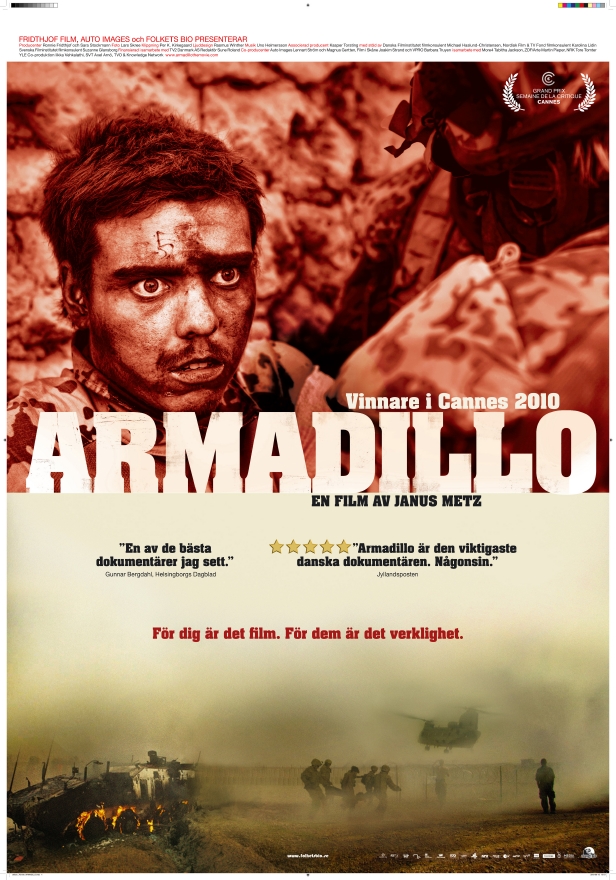
Armadillo is a 2010 Danish documentary film about Danish soldiers in the War in Afghanistan directed by Janus Metz.
The film follows a group of soldiers from the Guard Hussars Regiment who are on their first mission in Helmand Province at a forward operating base near Gereshk named FOB Armadillo.

Outline
The film starts with the soldiers’ last days in Denmark before leaving for Afghanistan. Scenes include their emotional goodbyes as well as a party with a striptease dancer.
They are posted for a six-month tour at FOB Armadillo, a forward operating base in Helmand Province, Afghanistan, where some 270 Danish and British soldiers are based.
The film shows the soldiers going out on patrol. They hand out candy and gifts to the children. They question a local man about the Taliban who declines to cooperate and they return to base without incident.
The film depicts them as dividing their leisure time between maintaining their equipment and working out, calling home, playing shooter games and watching pornographic videos amongst other things.
Later in the tour, the soldiers encounter armed resistance from the Taliban. In the ensuing battles, buildings are damaged and locals report livestock killed. Some locals receive compensations from the base.
A Danish commander becomes a victim of a roadside bomb and is evacuated to receive treatment for a skull fracture. He recovers and returns to Armadillo. Three Danish soldiers from a neighbouring camp die in an IED incident and the film records a memorial service for them. Directly following this there is a discussion over whether ambushing the Taliban will work and subsequently volunteers are recruited for a night patrol.
At dawn, civilians are seen fleeing the area. The patrol comes under fire and a soldier is hit. In the ensuing chaos the Taliban position is discovered to be directly in front of the patrol in a ditch only three metres away. A hand grenade is tossed into the ditch followed by the order to ‘neutralize them’ and subsequent sporadic gunfire is heard. Five Taliban are killed and there are graphic scenes of their bodies being pulled from the ditch and stripped of their weapons. It shows that the Taliban fighters were armed with a single RPG-7 rocket propelled grenade, two PK machine guns and one AKM. There is a subsequent air strike.
Back at base the patrol members congratulate each other on the morning’s work and there is a debriefing with accounts of at least one Taliban fighter supposedly found alive but severely wounded in the ditch. There are further insinuations that any movement within the ditch would have represented a possible threat and that it was thus deemed necessary to spray the enemy fighters with another volley of bullets to make sure they are not a threat.
Subsequently, it transpires that a soldier has called home discussing the episode with his parents and has given them the impression that wounded Taliban had been liquidated and that the soldiers had laughed about it at the debriefing. The parents contacted the Danish Command about it and the ranking officer addresses his men about the issues that raises. A discussion amongst the men ensues.
Later two of the soldiers on the patrol are awarded medals and the film concludes with scenes of jubilant homecomings and, for some, a return to civilian life. The final scene is a close-up shot of water streaming down onto the head and face of an introspective commander while he is taking a shower.
Controversy
The film generated a brief political controversy in Denmark when the Danish Socialist People’s Party accused the soldiers of deliberately breaking the rules of engagement during one of the firefights, and demanded an investigation. Following procedure, the Danish Defence Judge Advocate Corps conducted an independent investigation, and the soldiers were cleared of any wrongdoing.
Trivia
- The film was nominated in four categories for the 2012 News & Documentary Emmy Award, and won the Editing category.
- The film premièred in the Critics’ Week section at the 2010 Cannes Film Festival, where it won the Critics’ Week Grand Prix.
- Originally part of a six episode TV series called “Vores krig” by Kasper Torsting.
- Filmed in 2009 during the Danish ISAF team 7 in Helmand Afghanistan.
Production & Filming Details
- Director(s):
- Janus Metz … (as Janus Metz Pedersen)
- Producer(s):
- Jacob Ditlev … line producer
- Ronnie Fridthjof … producer
- Magnus Gertten … co-producer
- Tabitha Jackson … executive producer
- Sara Stockmann … producer
- Lennart Ström … co-producer
- Kasper Torsting … creative producer
- Toke Rude Trangbæk … post producer
- Barbara Truyen … commissioning editor
- Writer(s):
- Kasper Torsting … (idea)
- Music:
- Uno Helmersson
- Cinematography:
- Lars Skree
- Editor(s):
- Per K. Kirkegaard
- Production:
- Fridthjof Film
- Distributor(s):
- Atnine Film (South Korea, 2012)(theatrical)
- Bio Rex Distribution (Finland, 2010)(theatrical)
- DistriB Films (France, 2010)(theatrical)
- Lorber Films (United States, 2011)(subtitled, theatrical)
- TrustNordisk (World-wide, 2010)(theatrical)
- Uplink (Japan, 2013)(theatrical)
- Against Gravity (Poland, 2011)
- Ascot Elite Entertainment Group (Switzerland, 2010)
- DR Sales (Denmark, 2010)(TV)
- Film1 Sundance Channel (Netherlands, 2015)(limited, TV)
- Madman Entertainment (Australia, 2011)(DVD)
- NHK BS1 (Japan, 2011)(TV)
- Pan Vision Oy (Finland, 2011)(Blu-ray, DVD)
- Soda Pictures (United Kingdom, 2010)
- Vrijzinnig Protestantse Radio Omroep (VPRO) (Netherlands, 2016)(NPO2, TV)
- Yleisradio (YLE) (Finland, 2011)(TV)
- Release Date: 16 May 2010 (Cannes International Film Festival, France).
- Running Time: 105 minutes.
- Rating: 15.
- Country: Denmark.
- Language: Danish.

 Military Gogglebox
Leave a comment