
Introduction
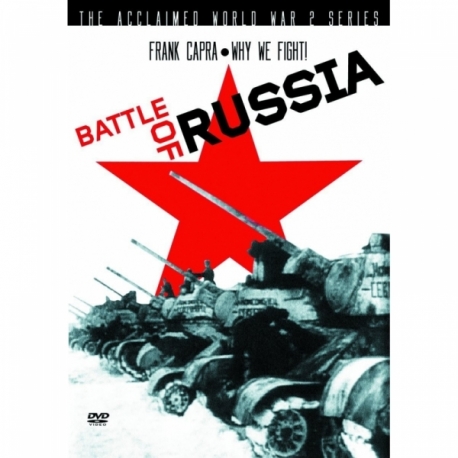
The Battle of Russia (1943) is the fifth film of Frank Capra’s Why We Fight documentary series, and the longest film of the series, consisting of two parts. The film was made in collaboration with Soviet-born Anatole Litvak as primary director under Capra’s supervision. Litvak gave the film its “shape and orientation,” and the film had seven writers with voice narration by Walter Huston. The score was done by Russian-born Hollywood composer, Dimitri Tiomkin, and drew heavily on Tchaikovsky along with traditional Russian folk songs and ballads.
Film historian Christopher Meir notes that the film’s popularity “extended beyond the military audience for it was initially intended, and was the second in the series to be nominated for an Academy Award for Best Documentary Feature.
Find out more in the docuseries “Five Came Back“.
Outline
The film begins with an overview of previous failed attempts to conquer Russia: by the Teutonic Knights in 1242 (footage from Sergei Eisenstein’s film Alexander Nevsky is used here), by Charles XII of Sweden in 1704 (footage from Vladimir Petrov’s film Peter the Great), by Napoleon I in 1812, and by Germany in World War I.
The vast natural resources of the Soviet Union are then described, showing why the land is such a hot prize for conquerors. To give a positive impression of the Soviet Union to the American audience, the country’s ethnic diversity is covered in detail, and later on, elements of Russian culture familiar to Americans, including the musical compositions of Tchaikovsky and Leo Tolstoy’s book War and Peace are also mentioned. Communism is never mentioned at any point in the film; instead, the Russian Orthodox Church is described as a force opposing Nazism. The start of the film includes a quote from US General Douglas MacArthur, who commended the Russian people’s defence of their nation as one of the most courageous feats in military history.
The film then covers the Nazi conquests in the Balkans, described as a preliminary to close off possible Allied counter-invasion routes, before the war against Russia was launched on 22 June 1941. The narration describes the German “keil und kessel” tactics for offensive warfare, and the Soviet “defence in depth” used to counter this. The scorched earth Soviet tactics, the room-to-room urban warfare in Soviet cities, and the guerrilla warfare behind enemy lines are also used to underline the Soviet resolve for victory against the Germans. The Siege of Leningrad and the Battle of Stalingrad conclude the film.
The episode, like the entire Why We Fight series, simply left out many facts, which could have cast doubts on the “good guy” status of the Soviets, such as the Soviet occupation of the Baltic States, the Winter War, the film also did not mention the word “Communism.”
Virtually in line with the Soviet propaganda, the series was not only screened but widely acclaimed in the Soviet Union. The episode has been described as “a blatant pro-Soviet propaganda posing as factual analysis” and was withdrawn from circulation during the Cold War. Capra commented about why certain material was left out:
“We had a political problem with Russia on that film. The problem was that a hell of a lot of people on our side were not about to be sold a bill of goods by the Communists. We were their allies, but that was all. Communism was not something we desired. So we stayed a way from politics and made it a people’s battle. As a result, The Battle of Russia was one of the best episodes of the series and a true one.”
Honours and Awards
- 1943: Winner, 1943 National Board of Review Award for Best Documentary Film.
- 1943: Special Award, New York Film Critics Circle Awards.
- 1944: Nominee, Academy Award for Best Documentary Feature, 16th Academy Awards.
- 2000: National Film Registry, as part of the Why We Fight series.
Why We Fight Series
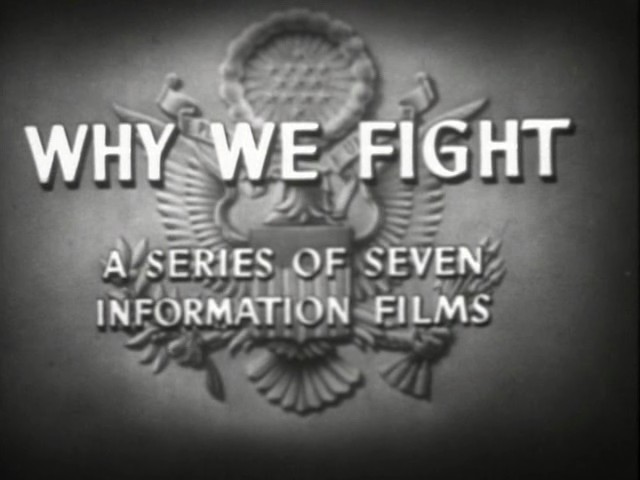
The Why We Fight was a series of seven documentary films commissioned by the US government during World War II to justify to US soldiers their country’s involvement in the war. Later on, they were also shown to the US public to persuade them to support US involvement in the war.
Most of the films were directed by Frank Capra, who was daunted, yet impressed and challenged, by Leni Riefenstahl’s propaganda film Triumph of the Will, and worked in direct response to it. The series faced a tough challenge: convincing a recently non-interventionist nation of the need to become involved in the war and ally with the Soviets, among other things. In many of the films, Capra and other directors spliced in Axis powers propaganda footage going back twenty years, and re-contextualised it so it promoted the cause of the Allies.
Why We Fight was edited primarily by William Hornbeck, although some parts were re-enacted “under War Department supervision” if there was no relevant footage available. The animated portions of the films were produced by the Disney studios – with the animated maps following a convention of depicting Axis-occupied territory in black.
- Prelude to War.
- The Nazis Strike.
- Divide and Conquer.
- The Battle of Britain.
- The Battle of Russia.
- The Battle of China.
- War Comes to America.
Production & Filming Details
- Director: Frank Capra and Anatole Litvak.
- Producer: War Department Special Service Division.
- Writers:Julius Epstein, Philip Epstein, Anatole Litvak, and Anthony Veiller.
- Narrators: Walter Huston and Anthony Veiller.
- Cinematography: Robert Flaherty.
- Editor: William Hornbeck.
- Distributors: US Office of War Information, War Activities Committee of the Motion Pictures Industry, and 20th Century Fox.
- Released Date: 13 November 1943.
- Running time: 83 minutes.
- Country: United States.
- Language: English.
YouTube Link


 Military Gogglebox
Leave a comment