
Introduction
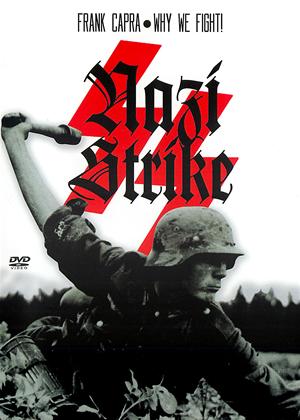
The Nazis Strike was the second film of Frank Capra’s Why We Fight propaganda film series. It introduces Germany as a nation whose aggressive ambitions began in 1863 with Otto von Bismarck and with the Nazis as their latest incarnation.
Heartland Theory
Hitler’s plan for world domination is described in terms of Halford Mackinder’s Heartland Theory, starting at about three minutes into the film:
In the Middle Ages a plague of slavery descended on the world. From the wilds of Mongolia rode a mighty army of fierce horsemen, led by Genghis Khan. Burning, looting, pillaging … the barbarian horde swept across Asia and Eastern Europe. Genghis Khan conquered most of the world of the thirteenth century. Adolf Hitler was determined to outdo him, and conquer all the world of the twentieth century.
Set up at Munich was an institute devoted to the little-known science of geopolitics, vaguely defined as “the military control of space”. Germany’s leading geopolitician, a former general, Karl Haushofer, was head man. Here has gathered together more information about your home town than you yourself know.
To the German geopolitician, the world is not made up of men and women and children, who live and love and dream of better things. It is made up of only two elements – labour and raw materials. The geopoliticians’ job was to transform Hitler’s ambition to control these elements into cold, hard reality.
On their map our planet is neatly divided into land and water. Water forms three quarters of the earth’s surface, land only one quarter. And in that one quarter of the earth’s surface lies the world’s wealth, all its natural resources – and the world’s manpower.
Control the land and you control the world – that was Hitler’s theory. This all-important “land” the geopoliticians now break up into two areas – one the Western Hemisphere which together with Australia and all the islands of the world including Japan, comprises one third of the total land area. The other area, which consists of Europe, Asia and Africa, makes up the other two thirds. This supercontinent, which they call the “World Island”, is not only twice as large as the rest of the land area, but also includes seven-eighths of the world’s population.
The heart of this “World Island” comprises Eastern Europe and most of Asia. This they call the “Heartland”, which just about coincides with the old empire of Genghis Khan.
Hitler’s step-by-step plan for world conquest can be summarised this way:
Conquer Eastern Europe and you dominate the Heartland.
Conquer the Heartland and you dominate the World Island.
Conquer the World Island………. and you dominate the World.
That was the dream in Hitler’s mind as he stood at Nuremberg.
Fifth Column Activity
The next focus of the film is the “softening-up” of the Western democracies using fascist organisations such as the Belgian Rexists, the French Cross of Fire, the Sudeten German National Socialist Party of Konrad Henlein, the British Union of Fascists and the German American Bund. Meanwhile, within Germany the Nazis are beginning an enormous process of rearmament.
Germany then begins its territorial expansion with the first target being Austria, Hitler’s “full-scale invasion test”. He then uses his Sudeten “stooges” under Konrad Henlein to “soften up” Czechoslovakia and annex the Sudetenland with the help of a Britain and France desperate to avoid war. Hitler’s use of the concept of self-determination as a justification for these annexations is ridiculed by reference to prominent German Americans thoroughly loyal to the Allied cause, including Admiral Chester Nimitz, Henry J. Kaiser, Wendell Willkie and Senator Robert Wagner.
Invasion of Poland
The film concludes with the Invasion of Poland, which is depicted with many inaccuracies.[1]
The extreme disparity between the two sides is emphasised – the Nazis have 5,000 modern tanks against Poland’s 600 obsolete models, while the Luftwaffe had 6,000 modern monoplanes opposed by the less than 1,000 aircraft of the Polish Air Force, many of which are outdated biplanes. Animation is also used to graphically show how Polish army units were encircled and destroyed. The film suggests that most of the Polish air force was destroyed on the ground, and that the Polish Army relied heavily on mounted cavalry (see Tuchola Forest myth) – suggesting that its makers learned the details of the Polish campaign largely from Nazi propaganda, where both claims were often made. The stubborn resistance of Polish forces in the Hel peninsula is recognised, as are the widespread Nazi atrocities following the Polish defeat. Overall, the movie gives the false impression that Polish army was ineffective, pathetic even, and did no damage to the Germans. The film also alleged that there was widespread collaboration (although not specifying from whom) with the invading Germans.
The Nazis are forced to stop at the Bug River when they meet the advancing Red Army. The film misrepresents the Nazi–Soviet alliance, claiming that the pact was signed only after West has turned down Soviet requests to ally themselves against the Germans, and that overall “it didn’t make any sense.” As the film was made when the Soviets were allied to the Western democracies against the Nazis, the film justifies this occupation by the Soviet need to obtain a buffer zone against a further Nazi advance to the east, and implies that the Soviets entered Poland to stop Hitler, this time repeating Soviet propaganda. The movie makes no mentions of the Soviet invasion and their battles with the Polish border forces, or that the Soviets broke their non-aggression pact with Poland. Soviet atrocities against the local population are omitted as well.
The film then notes that Hitler now turns west to finish off Britain and France, which have declared war on Nazi Germany, rather than risk a two-front war, leading to the third part of the instalment, which deals with the German invasion of Western Europe. It concludes with the quote by Winston Churchill from his speech to Allied delegates in 1941:
“What tragedies, what horrors, what crimes has Hitler and all that Hitler stands for brought upon Europe and the world! it is upon this foundation that Hitler […] pretends to build out of hatred [….] a new order for Europe. But nothing is more certain than that every trace of Hitler’s footsteps, every stain of his infected, and corroding fingers will be expunged, purged, and if need be, BLASTED from the surface of the earth. Lift up your hearts, all will come right. Out of depths of sorrow and sacrifice will be born again the glory of mankind.”
Why We Fight Series
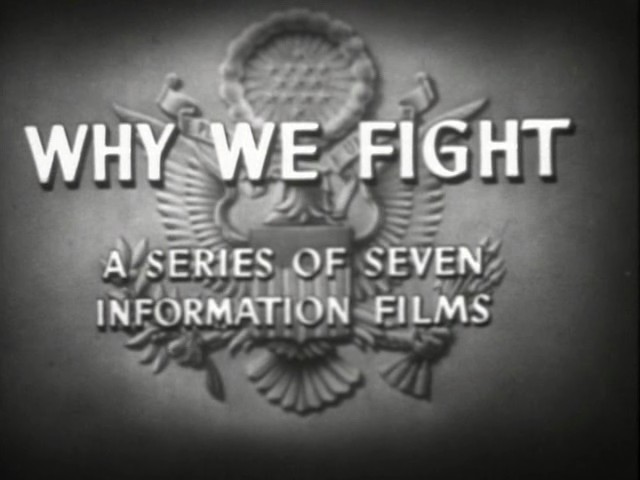
The Why We Fight was a series of seven documentary films commissioned by the US government during World War II to justify to US soldiers their country’s involvement in the war. Later on, they were also shown to the US public to persuade them to support US involvement in the war.
Most of the films were directed by Frank Capra, who was daunted, yet impressed and challenged, by Leni Riefenstahl’s propaganda film Triumph of the Will, and worked in direct response to it. The series faced a tough challenge: convincing a recently non-interventionist nation of the need to become involved in the war and ally with the Soviets, among other things. In many of the films, Capra and other directors spliced in Axis powers propaganda footage going back twenty years, and re-contextualised it so it promoted the cause of the Allies.
Why We Fight was edited primarily by William Hornbeck, although some parts were re-enacted “under War Department supervision” if there was no relevant footage available. The animated portions of the films were produced by the Disney studios – with the animated maps following a convention of depicting Axis-occupied territory in black.
- Prelude to War.
- The Nazis Strike.
- Divide and Conquer.
- The Battle of Britain.
- The Battle of Russia.
- The Battle of China.
- War Comes to America.
Production & Filming Details
- Director: Frank Capra and Anatole Litvak.
- Producer: Frank Capra.
- Writers:Julius Epstein, Philip Epstein and Anthony Veiller.
- Narrator: Walter Huston and Anthony Veiller.
- Cinematography: Robert Flaherty.
- Editor: William Hornbeck.
- Distributors: US Office of War Information.
- Production: US Army Pictorial Service and US Army Signal Corps.
- Released Date: 1943.
- Running time: 41 minutes.
- Country: United States.
- Language: English.
YouTube Link


 Military Gogglebox
Leave a comment