

Introduction
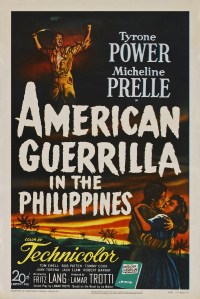
American soldiers stranded in the Philippines, after the Japanese invasion, form guerrilla bands to fight back.
Outline
In April 1942 in the Philippines, an American motor torpedo boat is destroyed by Japanese planes. The survivors, among them Ensign Chuck Palmer (Tyrone Power), make their way ashore on Cebu. Their commander orders them to split up. Chuck pairs up with Jim Mitchell (Tom Ewell) and reaches Colonel Benson on Leyte, only to be told that he has been ordered by General Douglas MacArthur to surrender his forces soon.
Chuck helps Jeanne Martinez (Micheline Presle), a Frenchwoman married to a Filipino planter, get medical assistance for a pregnant woman. Jeanne pleads with Chuck to stay and fight, but he buys an outrigger canoe and recruits a crew of Air Corps soldiers in a desperate, but unsuccessful attempt to sail to Australia. When the boat founders, the crew is rescued by Miguel (Tommy Cook), a member of the Filipino resistance. The Americans evade capture and Chuck eventually meets Jeanne again, as well as her husband Juan (Juan Torena), a secret supporter of the resistance movement.
Chuck is ordered to stay in the Philippines to help set up a network to gather intelligence on the Japanese. Later, Juan is beaten to death in front of Jeanne in an attempt to find out where the guerrillas are hiding out. Jeanne joins the resistance and is reunited with Chuck at Christmas 1943. They begin to fall in love.
After three years of fighting, Chuck, Jeanne, Jim and the rest of their band are trapped in a church by a Japanese patrol. Just when it looks as if they will be wiped out, squadrons of American planes appear overhead and explosions are heard, announcing the liberation of the Philippines is underway. The Japanese leave to face this greater threat.
Trivia & Goofs
- The bamboo dance in the movie is known as the Tinikling dance. It involves two people hitting bamboo poles on the ground and against each other in coordination with one or more dancers who step over and in between the poles in a dance. It is a Philippine traditional national dance that is still performed to this day at Fiesta.
- Director Fritz Lang only made the film to pay his bills. In later years, he actively denied even making it.
- This movie was filmed just prior to the outbreak of the Korean War in June of 1950, and used American warships to portray Japanese ships. One such ship, the U.S.S. Orleck (DD 886), exists to this day after serving in the Korean War, the Vietnam War and being sold for a while to the Turkish Navy, and is permanently docked in Lake Charles, LA, where it serves as a museum.
- In the book, which was based on a true story, Jeanne Martinez was not French, but a Filipina.
- When the Japanese navel vessel appears it is displaying the Hinomaru which is the national flag of Japan, however during the second world war both the Japanese army and Navy had their own respective flags.
- Ensign Palmer said the navy rank of Ensign was equal to an army Major. This is not true since an Ensign is pay grade O-1 (OF-1) and Major is pay grade O-4 (OF-3) . An Ensign would be equal to an Army Second Lieutenant.
Film Inspiration
The inspiration for the film is the 1945 book of the same name by Ira Wolfert.
The book tells the story of an American officer who stayed behind after Bataan fell. While massive battles were being fought, he quietly organised Filipino resistance. With nothing but nerve, with primitive weapons and home-made equipment, he put together an army. He stuck it out, with all odds against him, until MacArthur returned.
Production & Filming Details
- Director: Fritz Lang.
- Producer: Lamar Trotti.
- Writer: Lamar Trotti (screenplay).
- Narrator: Jack Elam.
- Music: Cyril Mockridge.
- Cinematography: Harry Jackson.
- Editor: Robert Simpson.
- Distribution: 20th Century Fox.
- Release Date: 08 November 1950 (US).
- Running time: 105 minutes.
- Country: US.
- Language: English.
YouTube Link


 Military Gogglebox
Leave a comment