
Introduction
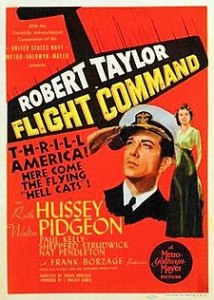
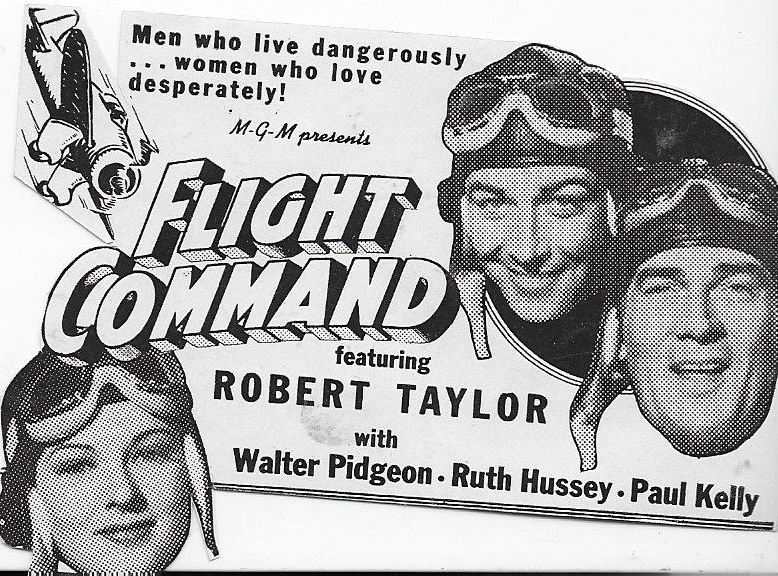
Flight Command is a 1940 American film about a cocky US Navy pilot who has problems with his new squadron and with the wife of his commander.
It stars Robert Taylor, Ruth Hussey and Walter Pidgeon.
Flight Command has the distinction of often being credited as the first Hollywood film glorifying the American military to be released after the outbreak of World War II in Europe, a year before the US entered the conflict.
Outline
Hotshot ensign Alan Drake (Robert Taylor), fresh from the flying academy at Pensacola, Florida, gets off to a bad start with the pilots of an elite squadron, nicknamed the “Hellcats”, to which he has been posted in San Diego. Making a nearly disastrous landing attempt in heavy fog against orders and disqualifying the squadron during a competitive shooting exercise by colliding with the target drogue does not endear him to his fellow pilots. He also asks out a woman he has met, Lorna (Ruth Hussey), not knowing that she is the squadron commander Billy Gary’s (Walter Pidgeon) wife.
However, Drake is earnest and contrite. He mixes with the Hellcats at the Garys’ large house, which the sociable couple have opened as an unofficial officers’ club. His flying and his social errors are forgiven, and his fellow pilots accept him, nicknaming him “Pensacola”.
Drake further proves himself when he helps Lieutenant Jerry Banning (Shepperd Strudwick) solve a problem in a blind-landing apparatus he is developing. Just after Commander Gary is sent out of town on assignment, Banning decides the apparatus is ready to test in fog — but it fails and Banning is killed. Working with Banning’s assistant, Drake soon identifies the problem, but no further testing is allowed until Commander Gary’s return.
Banning had been a childhood friend of Lorna Gary, and is not her first friend to die. She sinks into a deep depression. She also knows that Gary will expect her to hide her feelings and carry on, something that is very much not in her nature. Drake, appreciating the help the Garys gave him when he arrived, visits her at her home, and convinces her she should not suffer alone. They go for walks, drives, and tennis; he amuses her with jokes. Finally, at a restaurant she reaches for his hand and in doing so realises she is falling for him. She quickly breaks away, and says she cannot see him any more.
As soon as her husband returns, she tells him she needs to leave him for a while. She explains that she cannot again hide her feelings and carry on after a tragedy, as he expects. He is surprised, and says she should have said so before. Not mentioning Drake, she also says that she has changed. He tells her to leave if she must, but that he still loves her and hopes she will come back to him, but only if she loves him.
Because Drake and Lorna were seen together, and Lorna went away shortly after, Lieutenant Commander Dusty Rhodes and the squadron confront Drake, accusing him of trying to take Lorna from Gary. Out of respect for her privacy, Drake says nothing. But he is extremely offended that they would accuse him of this, and files a letter of resignation. Commander Gary tries to discourage him, but reluctantly puts it through channels. While waiting for a response, they participate in an emergency search and rescue, during which Gary’s engine fails, and he is badly injured in a crash-landing. Drake acts against orders, and goes to his rescue. Learning that San Diego is fogged in, he arranges to use Banning’s equipment to land, and then removes his radio and places Gary in the tail of the plane. Drake then uses the new equipment to lead his group of five down through the fog to a safe landing.
In response to a telegram about Gary’s crash, Lorna Gary returns to San Diego and visits her husband in the hospital. Rhodes witnesses her praying for him, their tearful reunion, and her promise to come home. Rhodes tells Drake that his resignation has been turned down, and apologises to Drake for his behaviour. But, Drake is still angry and says he will get a transfer. Mugger Martin says, “Come on Pensacola, give in!” and the rest of the squadron urge him to stay. He agrees.
Film Inspiration
N/A
Trivia & Goofs
- Flight Command had impressive aerial scenes due to the full cooperation of the US Navy, with the loan of VF-6 squadron, flying Grumman F3F biplanes.
- The USS Enterprise (CV-6) based in California and operating during manoeuvres off Hawaii, also featured prominently in the production.
- The squadron is based at Naval Air Station North Island, which still exists today in San Diego, California.
- When the squadron is searching for the downed seaplane, Commander Gary (Walter Pidgeon) reports to the tower that his formation of Grumman F3F-2s are flying at 10,000 feet at a speed of “300” (the units were not mentioned, but the moviegoer would logically assume 300 mph). The top speed of a Grumman F3F-2 was 264 mph. The F3F-2 could probably approach 300 mph in a vertical dive, but not in level flight as Commander Gary’s planes were.
Production & Filming Details
- Director: Frank Borzage.
- Producers: J. Wlater Ruben and Frank Borzage (uncredited).
- Writers: Harvey S. Haislip (story and screenplay), John Sutherland (story), and Wells Root (screenplay).
- Music: Franz Waxman.
- Cinematography: Harold Rosson.
- Editor: Robert Kern.
- Production: MGM..
- Distribution: Franz Borzage Production.
- Release Date: 27 December 1940 (US).
- Running time: 115 minutes.
- Country: US.
- Language: English.
YouTube Link



Leave a Reply