
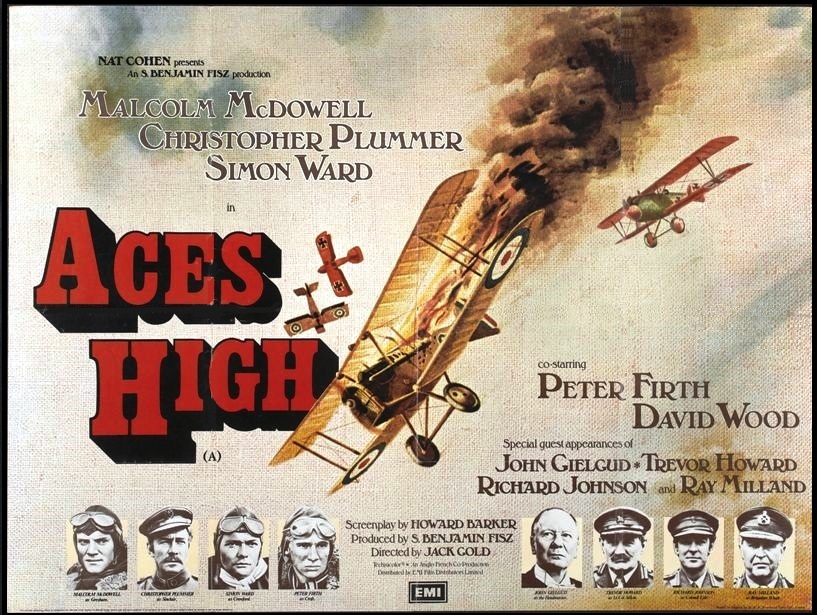
Introduction
Aces High is a 1976 Anglo-French war film directed by Jack Gold and starring Malcolm McDowell, Peter Firth, Christopher Plummer and Simon Ward.
The screenplay was written by Howard Barker.
As acknowledged in the opening credits, the film is based on the 1928 play Journey’s End by R. C. Sherriff with additional material from the memoir Sagittarius Rising by Cecil Lewis.
Aces High moves the action from the army in the trenches portrayed in Journey’s End to the Royal Flying Corps (RFC).
The film depicts an RFC squadron in the First World War during one week of battle, where the high death rate of pilots puts an enormous strain on those remaining.
Many characters from Journey’s End are still very recognisable, such as the idealistic officer whose sister is the girlfriend of a more senior officer who drinks too much, and the neuralgia-suffering officer accused of funking or cowardly fright.
Outline
The background story begins in October 1916, with fighter ace Major John Gresham (Malcolm McDowell) speaking to a class at Eton College. One year later, a new recruit, 2nd Lieutenant Croft (Peter Firth), arrives at Gresham’s temporary base in northern France. Gresham had been his house captain at Eton and is also the boyfriend of his older sister.
Gresham relies on alcohol to cope with the ongoing combat stress and to continue flying. The strain of being responsible for the safety of this young recruit (and the potential impact of his loss on his sister) is an additional burden, causing him to drink even more. Croft has to learn how to survive, not only in the air but on the ground as well, as he makes minor mistakes in squadron etiquette.
In Croft’s week-long rite of passage, from naive schoolboy to adult fighting soldier, his initial hero worship of Gresham crumbles, as he learns the realities of service at the front, but he gains a respect for Gresham and an understanding of the stresses with which he has to cope.
Shortly after Croft scores his first air victory and seems to have acquired the skills necessary to survive, he is unexpectedly killed in an air-to-air collision with a German aircraft. While looking out of his office window, Gresham sees an apparition of Croft returning from the battle field uninjured, which fades away. Gresham orders the new, replacement, recruits to be sent in for his inspection.
Film Inspiration
Journey’s End is a 1928 dramatic play, the seventh of English playwright R. C. Sherriff. It was first performed at the Apollo Theatre in London by the Incorporated Stage Society on 09 December 1928, starring a young Laurence Olivier, and soon moved to other West End theatres for a two-year run. It was included in Burns Mantle’s The Best Plays of 1928-1929. The piece quickly became internationally popular, with numerous productions and tours in English and other languages. A 1930 film version was followed by other adaptations, and the play set a high standard for other works dealing with similar themes, and influenced playwrights including Noël Coward.
Set in the trenches near Saint-Quentin, Aisne, in 1918, towards the end of the First World War, Journey’s End gives a glimpse into the experiences of the officers of a British Army infantry company. The story plays out in the officers’ dugout over four days from 18 March 1918 to 21 March 1918, the last few days before Operation Michael.
Sherriff considered calling it Suspense or Waiting, but eventually found a title in the closing line of a chapter of an unidentified book, “It was late in the evening when we came at last to our journey’s end”.
Journey’s End Films
You can find a full index of Journey’s End films here.
Production & Filming Details
- Director: Jack Gold.
- Producers: Benjamin Fisz and Jacques Roitfeld.
- Writer: Howard Barker.
- Music: Richard Hartley and Charles Chilton.
- Cinematography: Gerry Fisher.
- Editor: Anne V. Coates.
- Production: S. Banjamin Fisz Productions and Jacques Roitfeld (Les Productions).
- Distributor: EMI Films (UK).
- Release Date: 19 May 1976 (UK) and 08 June 1977 (France).
- Running Time: 114 minutes.
- Country: UK and France.
- Language: English.
YouTube Link


 Military Gogglebox
Leave a comment