
Introduction
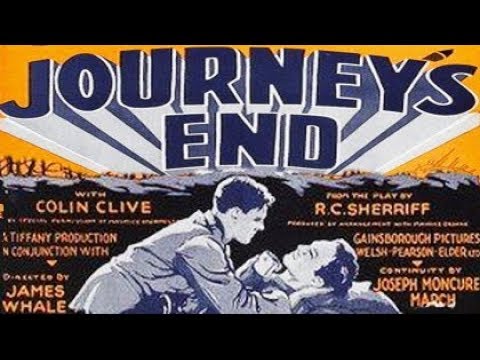
Journey’s End is a 1930 British-American war film directed by James Whale. Based on the play of the same name by R. C. Sherriff, the film tells the story of several British army officers involved in trench warfare during the First World War. The film, like the play before it, was an enormous critical and commercial success and launched the film careers of Whale and several of its stars.
Outline
On the eve of a battle in 1918, a new officer, Second Lieutenant Raleigh (David Manners), joins Captain Stanhope’s (Colin Clive) company in the British trench lines in France. The two men knew each other at school: the younger Raleigh hero-worshipping Stanhope, while Stanhope has come to love Raleigh’s sister. But the Stanhope whom Raleigh encounters now is a changed man who, after three years at the front, has turned to drink and seems close to a breakdown.
Stanhope is terrified that Raleigh will betray his decline to his sister, whom he hopes to marry after the war. An older officer, the avuncular Lieutenant Osborne (Ian Maclaren), desperately tries to keep Stanhope from cracking. Osborne and Raleigh are selected to lead a raiding party on the German trenches where a number of raiding party are killed, including Osborne. Later, when Raleigh, too, is mortally wounded, Stanhope faces a desperate time as, grief-stricken and without close friends, he prepares to face another furious enemy attack.
Film Inspiration
Journey’s End is a 1928 dramatic play, the seventh of English playwright R. C. Sherriff. It was first performed at the Apollo Theatre in London by the Incorporated Stage Society on 09 December 1928, starring a young Laurence Olivier, and soon moved to other West End theatres for a two-year run. It was included in Burns Mantle’s The Best Plays of 1928-1929. The piece quickly became internationally popular, with numerous productions and tours in English and other languages. A 1930 film version was followed by other adaptations, and the play set a high standard for other works dealing with similar themes, and influenced playwrights including Noël Coward.
Set in the trenches near Saint-Quentin, Aisne, in 1918, towards the end of the First World War, Journey’s End gives a glimpse into the experiences of the officers of a British Army infantry company. The story plays out in the officers’ dugout over four days from 18 March 1918 to 21 March 1918, the last few days before Operation Michael.
Sherriff considered calling it Suspense or Waiting, but eventually found a title in the closing line of a chapter of an unidentified book, “It was late in the evening when we came at last to our journey’s end”.
Journey’s End Films
You can find a full index of Journey’s End films here.
Production & Filming Details
- Director: James Whale.
- Producer: George Pearson.
- Writer: Joseph Moncure March.
- Cinematography: Benjamin H. Kline.
- Editor: Claude Berkeley.
- Production: Gainsborough Pictures and Tiffany Pictures.
- Distributor: Tiffany Pictures (US) and Woolf & Freedman Film Service (UK).
- Release Date: 14 April 1930 (UK) and 15 April 1930 (US).
- Running Time: 120 minutes.
- Country: UK and US.
- Language: English.
YouTube Link


 Military Gogglebox
Leave a comment