
Introduction

Journey’s End is a 1928 dramatic play, the seventh of English playwright R. C. Sherriff. It was first performed at the Apollo Theatre in London by the Incorporated Stage Society on 09 December 1928, starring a young Laurence Olivier, and soon moved to other West End theatres for a two-year run. It was included in Burns Mantle’s The Best Plays of 1928-1929. The piece quickly became internationally popular, with numerous productions and tours in English and other languages. A 1930 film version was followed by other adaptations, and the play set a high standard for other works dealing with similar themes, and influenced playwrights including Noël Coward.
Set in the trenches near Saint-Quentin, Aisne, in 1918, towards the end of the First World War, Journey’s End gives a glimpse into the experiences of the officers of a British Army infantry company. The story plays out in the officers’ dugout over four days from 18 March 1918 to 21 March 1918, the last few days before Operation Michael.
Sherriff considered calling it Suspense or Waiting, but eventually found a title in the closing line of a chapter of an unidentified book, “It was late in the evening when we came at last to our journey’s end”
Journey’s End Films
- In 1930, James Whale directed an eponymous film based on the play, starring Colin Clive, David Manners and Ian Maclaren.
- A German remake, The Other Side (Die andere Seite), was directed by Heinz Paul in 1931.
- The play was televised by the BBC Television Service, live from its Alexandra Palace studios, on 11 November 1937, in commemoration of Armistice Day.
- The play is the basis for the film Aces High (1976), although the action was switched from the infantry to the Royal Flying Corps.
- The play was adapted for television in 1988, starring Jeremy Northam as Stanhope, Edward Petherbridge as Osborne, and Timothy Spall as Trotter. It held close to the original script although there were changes, the most obvious being the depiction on camera of the raid, which happens off-stage in the theatre production.
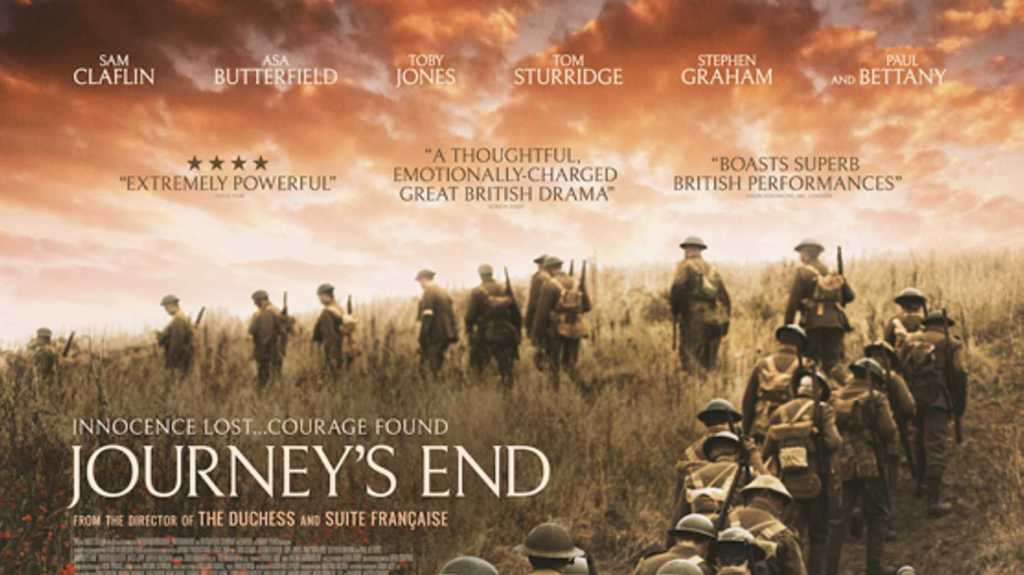
- A second eponymous English film adaptation was released in 2017, with a wider theatrical release in Spring 2018.
YouTube Link


 Military Gogglebox
Leave a comment