
Introduction
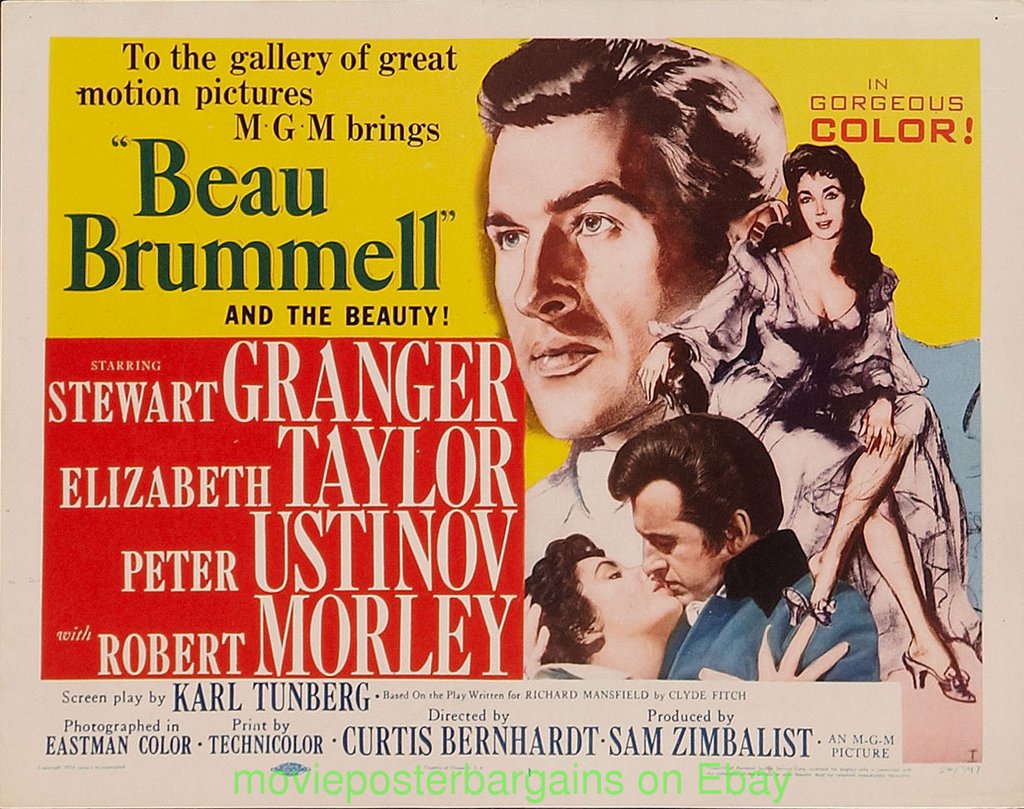
Beau Brummell is a 1954 American-British historical film released by Metro-Goldwyn-Mayer. It was directed by Curtis Bernhardt and produced by Sam Zimbalist from a screenplay by Karl Tunberg, based on the play Beau Brummell by Clyde Fitch.
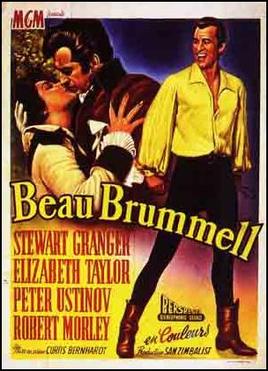
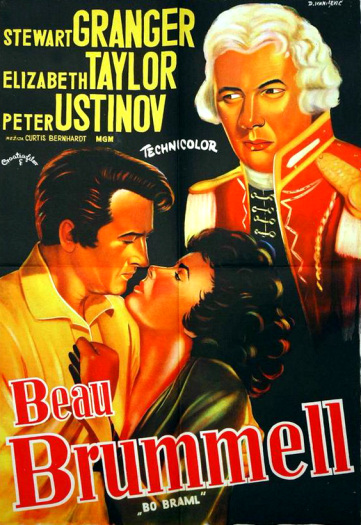
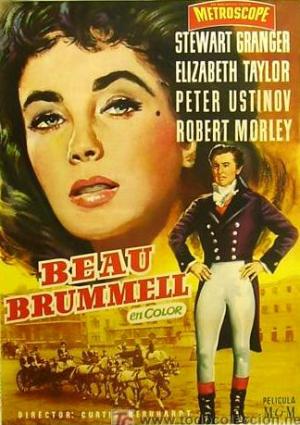
The play was previously adapted as a silent film made in 1913 and 1924.
Outline
George Bryan “Beau” Brummell (07 June 1778 – 30 March 1840) was an iconic figure in Regency England and for many years the arbiter of men’s fashion. At one time he was a close friend of the Prince Regent, the future King George IV, but after the two quarrelled, and Brummell got into debt, he had to take refuge in France. Eventually he died shabby and insane in Caen.
In June 1794 Brummell joined the Tenth Royal Hussars as a cornet, the lowest rank of commissioned officer.
You can read more about Brummel’s life here.
Cast
- Stewart Granger as George Bryan “Beau” Brummell.
- Elizabeth Taylor as Lady Patricia Belham.
- Peter Ustinov as the Prince of Wales.
- Robert Morley as King George III.
- James Donald as Lord Edwin Mercer.
- James Hayter as Mortimer.
- Rosemary Harris as Mrs. Maria Anne Fitzherbert.
- Paul Rogers as William Pitt.
- Noel Willman as Lord George Gordon Byron.
- Peter Dyneley as Midger.
- Charles Carson as Sir Geoffrey Baker.
- Ernest Clark as Doctor Warren.
- Peter Bull as Mr. Fox.
- Mark Dignam as Mr. Burke.
- Desmond Roberts as Colonel.
- David Horne as Thurlow.
- Ralph Truman as Sir Ralph Sidley.
- George De Warfaz as Doctor Dubois.
- Henry Oscar as Doctor Willis.
- Harold Kasket as Mayor.
- Elwyn Brook-Jones as Mr. Tupp (uncredited).
Trivia
- Clyde Fitch’s play was written in 1890 as a vehicle for Richard Mansfield.
- In 1934, there were two Beau Brummel projects announced.
- One was based on Fitch’s play, to be made by Warner Bros, starring Leslie Howard.
- The other was produced by Edward Small starring Robert Donat.
- Rights in the play went to MGM. In March 1939, they announced that Robert Donat would star in Beau Brummel to be made in London.
- Joseph Mankiewicz would produce.
- Filming was postponed due to the war.
- In March 1941, MGM said Clarence Brown would direct an adaptation of Fitch’s play in London, starring Donat.
- However this film was never made.
- In 1946, there was plans to make a British film about Brummel, which never materialised.
- In March 1951, MGM announced they would make a film from Fitch’s play as a vehicle for Stewart Granger, who had just made King Solomon’s Mines for the studio and been signed to a long-term contract.
- After delays so Granger could make other films, filming began in London on 15 November 1953.
- The film was given a Royal Command Film Performance in London in November 1954 where it was shown to an audience of 10,000 including Queen Elizabeth II and the Duke of Edinburgh.
- Some criticised this as being in bad taste as the film featured scenes depicting George III, an ancestor of the Queen, being insane.
- The film ends with a deathbed reconciliation between a dying Brummell and the Prince, who as George IV is passing through Le Havre between his British and Hanoverian kingdoms.
- There is no record the king met Brummell again after the latter fled, in debt, to France in 1816 and in any case the scene is an anachronism; Brummell died at Caen in 1840 having survived George by almost ten years.
- Elizabeth Taylor’s character was a combination of several women in Brummell’s life.
Production & Filming Details
- Director(s): Curtis Bernhardt.
- Producer(s): Sam Zimbalist.
- Writer(s): Karl Tunberg.
- Music: Richard Addinsell and Miklos Rozsa.
- Cinematography: Oswald Morris.
- Editor(s): Frank Clarke.
- Production: MGM.
- Distributor(s): MGM.
- Release Date: 01 October 1954.
- Running Time: 113 minutes.
- Country: UK and US.
- Language: English.


 Military Gogglebox
Leave a comment