
Introduction
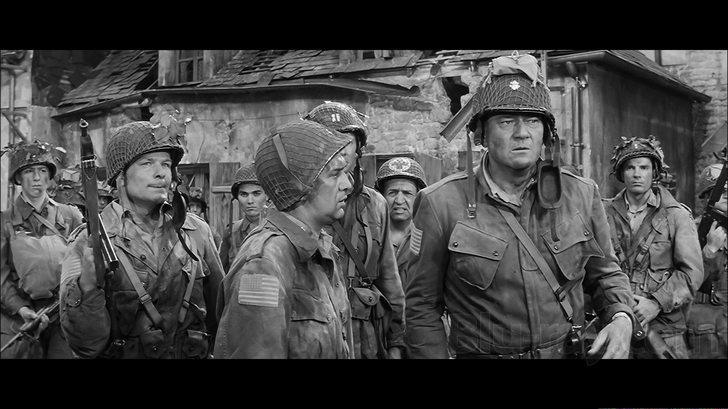
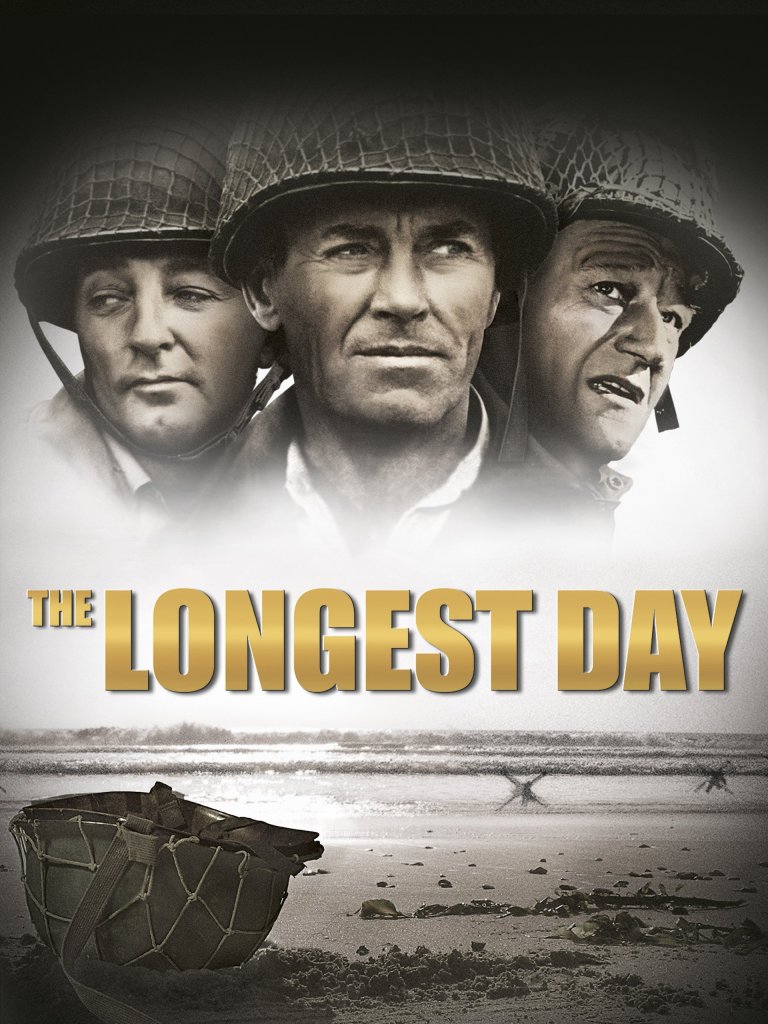
The Longest Day is a 1962 American epic war film based on Cornelius Ryan’s 1959 non-fiction of the same name about the D-Day landings at Normandy on 06 June 1944.
The film was produced by Darryl F. Zanuck, who paid author Ryan $175,000 for the film rights.
The screenplay was by Ryan, with additional material written by Romain Gary, James Jones, David Pursall, and Jack Seddon.
The film was followed by Up from the Beach in 1965.
Outline
Shot in a docudrama style (with subtitles identifying the different participants), the film opens in the days leading up to D-Day, concentrating on events on both sides of the English channel. The Allies wait for a break in the poor weather while anticipating the reaction of the Axis forces defending northern France. As Supreme Commander of SHAEF, Gen. Dwight Eisenhower makes the decision to go after reviewing the initial bad weather reports and the reports about the divisions within the German High Command as to where an invasion might happen and what should be their response.
Multiple scenes document the early hours of June 6: Allied airborne troops being sent in to take key locations inland, away from the beaches, and the French resistance reaction to the news that the invasion has started. Also chronicled are important events surrounding D-Day: British troops’ glider missions to secure Pegasus Bridge, the counterattacks launched by American paratroopers scattered around Sainte-Mère-Église, the infiltration and sabotage work conducted by the French resistance and SOE agents, and the response by the Wehrmacht to the invasion. Also shown is the uncertainty of German commanders regarding whether this is a feint in preparation for Allied crossings at the Strait of Dover (see Operation Fortitude), where the senior German staff had always assumed that the invasion would begin.
Set-piece scenes include the parachute drop into Sainte-Mère-Église, the advance inshore from the Normandy beaches, the U.S. Ranger Assault Group’s assault on the Pointe du Hoc, the attack on Ouistreham by Free French Forces, and the strafing of the beaches by two lone Luftwaffe pilots. The film concludes with a montage showing various Allied units consolidating their beachheads before they advance inland by crossing France to eventually reach Germany.
Cast
- Eddie Albert … Col. Thompson.
- Paul Anka … US Army Ranger.
- Arletty … Madame Barrault.
- Jean-Louis Barrault … Father Louis Roulland.
- Richard Beymer … Pvt. Dutch Schultz.
- Hans Christian Blech … Maj. Werner Pluskat.
- Bourvil Bourvil … Mayor of Colleville.
- Richard Burton … Flying Officer David Campbell.
- Wolfgang Büttner … Maj. Gen. Dr. Hans Speidel.
- Red Buttons … Pvt. John Steele.
- Pauline Carton … Maid.
- Sean Connery … Pvt. Flanagan.
- Ray Danton … Capt. Frank.
- Irina Demick … Janine Boitard (as Irina Demich).
- Fred Dur … US Army Ranger Major.
Trivia
- The Longest Day features a large international ensemble cast including John Wayne, Kenneth More, Richard Todd, Robert Mitchum, Richard Burton, Steve Forrest, Sean Connery, Henry Fonda, Red Buttons, Peter Lawford, Eddie Albert, Jeffrey Hunter, Stuart Whitman, Tom Tryon, Rod Steiger, Leo Genn, Gert Fröbe, Irina Demick, Bourvil, Curd Jürgens, George Segal, Robert Wagner, Paul Anka, and Arletty.
- Many of these actors played roles that were essentially cameo appearances.
- In addition, several cast members had seen action as servicemen during the war, including Albert, Fonda, Genn, More, Steiger, and Todd; Todd was among the first British officers to land in Normandy in Operation Overlord, and he participated in the assault on Pegasus Bridge.
- The film employed several Axis and Allied military consultants who had been actual participants on D-Day, and many had their roles re-enacted in the film. These included:
- Günther Blumentritt (a former German general), James M. Gavin (an American general).
- Frederick Morgan (Deputy Chief of Staff at SHAEF).
- John Howard (who led the airborne assault on the Pegasus Bridge).
- Lord Lovat (who commanded the 1st Special Service Brigade).
- Philippe Kieffer (who led his men in the assault on Ouistreham).
- Marie-Pierre Kœnig (who commanded the Free French Forces in the invasion).
- Max Pemsel (a German general).
- Werner Pluskat (the major who was the first German officer to see the invasion fleet).
- Josef “Pips” Priller (the hot-headed pilot).
- Lucie Rommel (widow of Field Marshal Erwin Rommel).
- Lt. Col. Benjamin Vandevoort was 27 years old on D-Day. He was very disappointed to find that he was being played in this movie by the 54-year-old John Wayne.
- While clearing a section of the Normandy beach near Ponte du Hoc, the crew unearthed a tank that had been buried in the sand since the original invasion. Mechanics cleaned it off, fixed it up and it was used in the movie as part of the British tank regiment.
- An estimated 23,000 troops were supplied by the US, Britain and France for filming (Germans only appeared as officers in speaking roles). The French contributed 1000 commandos, despite their involvement in the Algerian War at the time.
- The film won two Academy Awards and was nominated for three others.
- A colourised version of this film was released on VHS in 1994, the 50th anniversary of the D-Day invasion.
Production & Filming Details
- Director(s): Ken Annakin (British and French exteriors), Andrew Marton (American exteriors), and Bernhard Wicki (German scenes).
- Producer(s): Darryl F. Zanuck.
- Writer(s): Cornelius Ryan, Romain Gary, James Jones, David Pursall, and Jack Seddon.
- Music: Maurice Jarre.
- Cinematography: Jean Bourgoin and Walter Wottitz.
- Editor(s): Samuel E. Beetley.
- Production: Darryl F. Zanuck Productions, Inc.
- Distributor(s): 20th Century Fox.
- Release Date: 25 September 1962 (France and US).
- Running time: 178 minutes.
- Country: US.
- Language: English, German, and French.
Video Link


 Military Gogglebox
Leave a comment