
Introduction
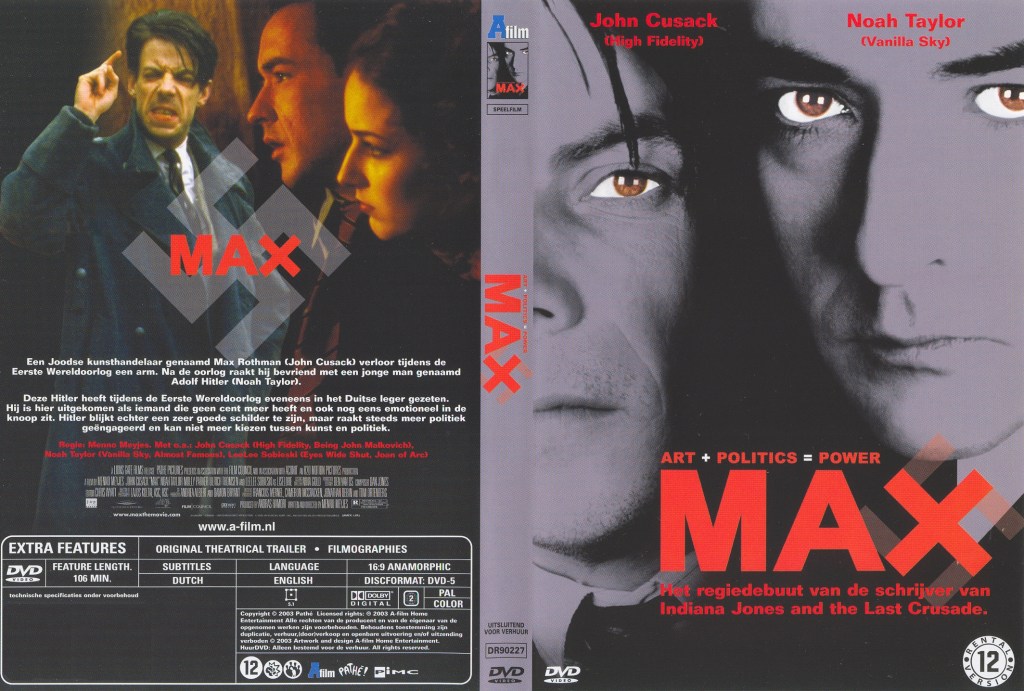
Max is a 2002 British-Hungarian-Canadian fictional drama film, that depicts a friendship between a Jewish art dealer, Max Rothman, and a young Austrian painter, Adolf Hitler.
The film explores Hitler’s views which began to take shape under Nazi ideology; while also studying the artistic and design implications of the Third Reich and how their visual appeal helped hypnotise the German people. The film goes on to study the question of what could have been had Hitler been accepted as an artist.
The film was the directorial debut of Menno Meyjes, who also wrote the film.

Outline
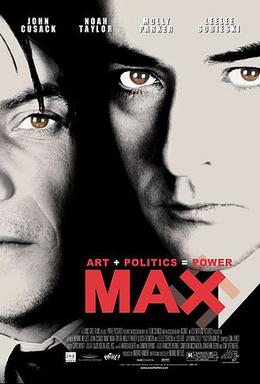
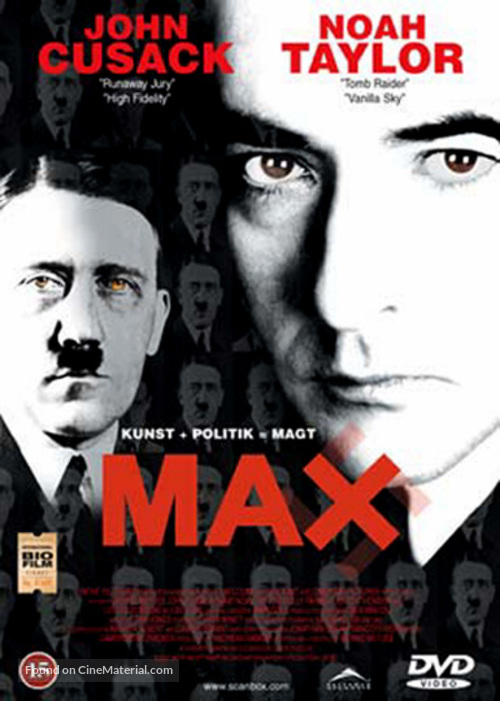
The year is 1918, and Max Rothman (John Cusack), a fictional Munich art dealer, is a veteran of the Third Battle of Ypres, where he lost his right arm during the latter stages of World War I, effectively ending his career as a painter. He returns to Germany and opens a modern art gallery. He is married to Nina (Molly Parker), but also has a mistress, Liselore von Peltz (Leelee Sobieski). Through a chance encounter, Rothman is approached by a young Adolf Hitler (Noah Taylor), a war veteran as well, disgruntled over Germany’s loss during the conflict and the country’s humiliation by the signing of the Versailles Treaty; Hitler wishes to have his artwork drawings displayed.
Rothman comes to believe that Hitler has talent, but has failed to tap his inner potential to create great art. While he is aware of Hitler’s anti-semitism, Rothman still encourages him to delve deeper in his art. Rothman feels sorry for Hitler, who had nothing to come home to after the war. Despite his overall doubts about Hitler, Rothman agrees to take some of his paintings under a contractual basis.
Meanwhile, Hitler meets Captain Karl Mayr (Ulrich Thomsen), a Reichswehr officer, who encourages him to go into politics and make a career out of anti-semitic propaganda. During a brief conversation in an army barracks, Mayr also offers to financially support him by having the army pay for his expenses, further enticing Hitler to join his national socialist movement, the German Workers’ Party.
Later, Rothman begins to question Hitler’s motives regarding his racial views. In an exchange of words, Hitler denies being anti-semitic and replies that on the contrary, he grudgingly admires the Jews and firmly believes the secret to their elite status in society is in the purity of their blood. He goes on to state that the German people would be better off if they did not integrate themselves with different races. Seeing Hitler’s architectural sketches, with their appeal to a romanticised national greatness, Rothman realises this is where Hitler’s talent lies, and that it would be far less dangerous if confined to art galleries. Hitler is thrilled by Rothman’s enthusiasm, not understanding it is partly motivated by fear of what he might become.
Rothman and Hitler have arranged to meet that evening to discuss Hitler’s future projects, and after making a violently anti-semitic speech to a group of supporters at a rally – with Mayr’s backing – Hitler goes to a cafe to discuss a series of new militaristic drawings with Rothman. As Rothman approaches the cafe for his interview with Hitler, he is savagely beaten by a group of anti-semites, who had attended Hitler’s rally and been incited into the racial attack on Rothman by Hitler’s words. As Rothman lies dying, an angry Hitler leaves the cafe, believing that Rothman has stood him up.
Cast
- John Cusack as Max Rothman.
- Noah Taylor as Adolf Hitler.
- Leelee Sobieski as Liselore von Peltz.
- Molly Parker as Nina Rothman.
- Ulrich Thomsen as Karl Mayr.
- Kevin McKidd as George Grosz.
- Peter Capaldi as David Cohn.
Production
The film was written and directed by screenwriter Menno Meyjes. When Meyjes was shopping the script around Hollywood, he first approached Amblin Entertainment for funding. As part of helping to finance the film, star John Cusack agreed to take no salary for his lead role. Steven Spielberg, for whom Meyjes had produced the Oscar and BAFTA-nominated script adaptation of The Colour Purple, told him that he felt the script was well written, but he would personally feel uncomfortable funding the film without insulting the memory of Holocaust survivors. He encouraged Meyjes to make the film, but without support from Amblin. Filming locations included Amsterdam, Netherlands and Budapest, Hungary as backdrops for early 20th century Germany.
Trivia
- The film went on to gross $539,879 in 37 theatres during its 15-week American release.
- The Region 1 Code widescreen edition of the film was released on DVD in the US on 20 May 2003.
- Special features include interviews with the cast and crew as well as an audio commentary on the entire film with director Menno Meyjes.
Production & Filming Details
- Director(s): Menno Meyjes.
- Producer(s): Andras Hamori.
- Writer(s): Menno Meyjes.
- Music: Dan Jones.
- Cinematography: Lajos Koltai.
- Editor(s): Chris Wyatt.
- Production: Pathe Pictures, Alliance Atlantis, UK Film Council, Kinowelt Medien, Aconit Pictures, and H2O Motion Pictures.
- Distributor(s): Pathe Pictures (UK) and Alliance Atlantis Distribution (Canada).
- Release Date: 20 September 2002 (Toronto International Film Festival) and 30 June 2003 (UK).
- Running Time: 106 minutes.
- Country: UK, Canada, and Hungary.
- Language: English.
Video Link


 Military Gogglebox
Leave a comment