
Introduction
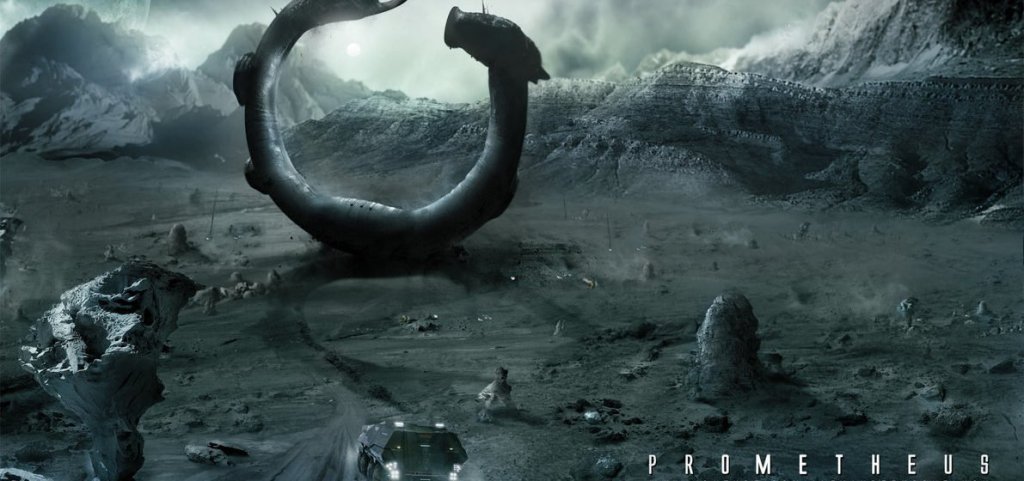
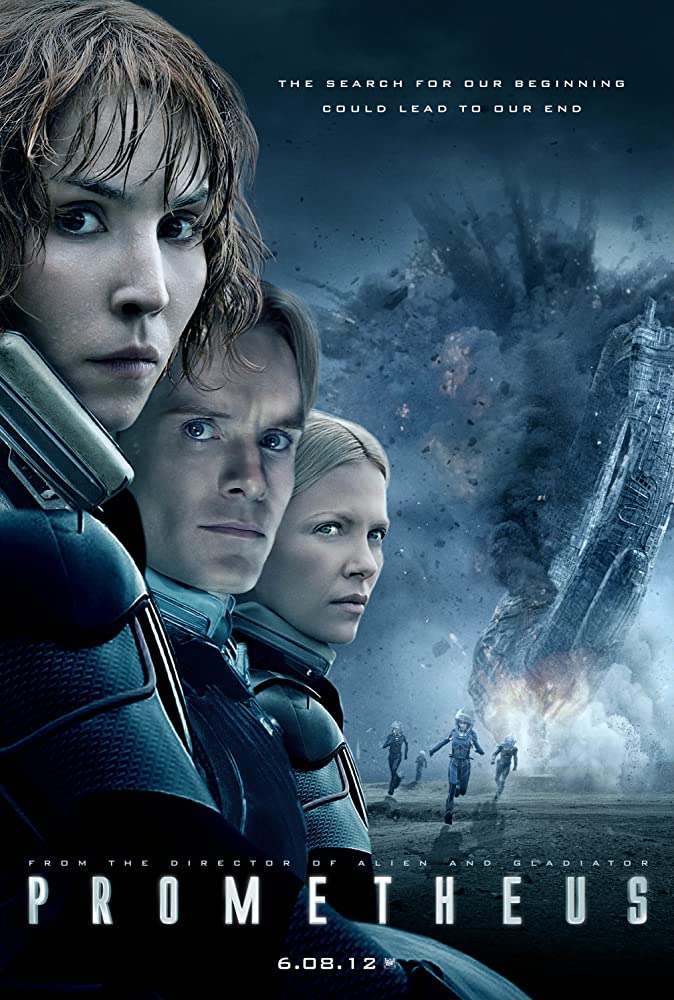
Prometheus is a 2012 science fiction film directed by Ridley Scott, written by Jon Spaihts and Damon Lindelof and starring Noomi Rapace, Michael Fassbender, Guy Pearce, Idris Elba, Logan Marshall-Green, and Charlize Theron.
It is set in the late 21st century and centres on the crew of the spaceship Prometheus as it follows a star map discovered among the artefacts of several ancient Earth cultures. Seeking the origins of humanity, the crew arrives on a distant world and discovers a threat that could cause the extinction of the human species.
A sequel, Alien: Covenant, was released in May 2017.
Development of the film began in the early 2000’s as a fifth instalment in the Alien franchise. Scott and director James Cameron developed ideas for a film that would serve as a prequel to Scott’s 1979 science-fiction horror film Alien.
In 2002, the development of Alien vs. Predator took precedence, and the project remained dormant until 2009 when Scott again showed interest. Spaihts wrote a script for a prequel to the events of the Alien films, but Scott opted for a different direction to avoid repeating cues from those films.
In late 2010, Lindelof joined the project to rewrite Spaihts’s script, and he and Scott developed a story that precedes the story of Alien but is not directly connected to that franchise. According to Scott, although the film shares “strands of Alien’s DNA, so to speak”, and takes place in the same universe, Prometheus explores its own mythology and ideas.
Outline
As a spacecraft departs a planet, a humanoid alien drinks an iridescent liquid, causing its body to dissolve. As its remains cascade into a waterfall, the alien’s DNA falls apart and recombines.
In 2089, archaeologists Elizabeth Shaw and Charlie Holloway discover a star map in Scotland that matches others from several unconnected ancient cultures. They interpret this as an invitation from humanity’s forerunners, the “Engineers”. Peter Weyland, the elderly CEO of Weyland Corporation, funds an expedition, aboard the scientific vessel Prometheus, to follow the map to the distant moon LV-223. The ship’s crew travels in stasis while the android David monitors their voyage. Arriving in December 2093, mission-director Meredith Vickers informs them of their mission to find the Engineers and not to make contact without her permission.
The Prometheus lands on the barren, mountainous surface near a large, artificial structure, which a team explores. Inside, they find stone cylinders, a monolithic statue of a humanoid head, and the decapitated corpse of a large alien, thought to be an Engineer; Shaw recovers its head. The crew finds other bodies, leading them to surmise the species is extinct. Crew members Millburn and Fifield grow uncomfortable with the discoveries and attempt to return to Prometheus, but become stranded in the structure when they get lost. The expedition is cut short when a storm forces the crew to return to the ship. David secretly takes a cylinder from the structure, while the remaining cylinders begin leaking a dark liquid. In the ship’s lab, the Engineer’s DNA is found to match that of humans. David investigates the cylinder and the liquid inside. He intentionally taints a drink with the liquid and gives it to the unsuspecting Holloway, who had stated he would do anything for answers. Shortly after, Shaw and Holloway have sex.
Inside the structure, a snake-like creature kills Millburn and sprays a corrosive fluid that melts Fifield’s helmet. Fifield falls face-first into a puddle of dark liquid. When the crew returns, they find Millburn’s corpse. David separately discovers a control room containing a surviving Engineer in stasis, and a large 3D holographic star map highlighting Earth. Meanwhile, Holloway sickens rapidly. He is rushed back to Prometheus, but Vickers refuses to let him aboard and, at his urging, burns him to death with a flamethrower. Later, a medical scan reveals that Shaw, despite being previously infertile, is now in advanced pregnancy. Fearing the worst, she uses an automated surgery table to extract a squid-like creature from her abdomen. Shaw then discovers that Weyland has been in stasis aboard Prometheus. He explains that he wants to ask the Engineers how to prevent his death from old age. As Weyland prepares to leave for the structure, Vickers addresses him as “Father”.
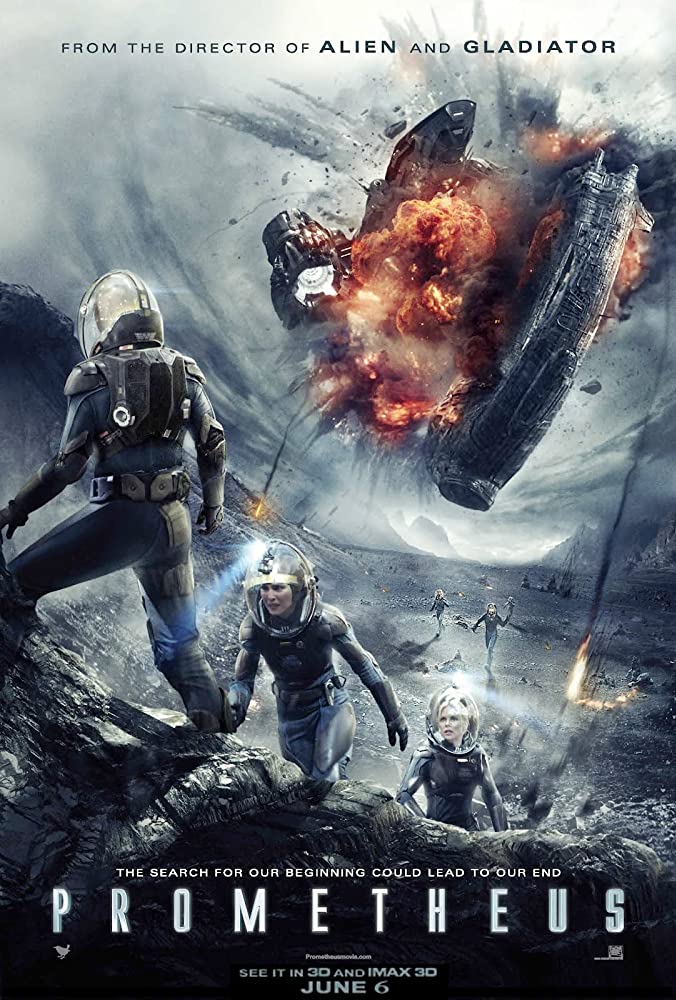
A monstrous, mutated Fifield returns to the Prometheus and kills several crew members before he is killed. The Prometheus’ captain, Janek, speculates that the structure was an Engineer military base that lost control of a virulent biological weapon, the dark liquid. He also determines that the structure houses a spacecraft. Weyland and a team return to the structure, accompanied by Shaw. David wakes the Engineer from stasis and speaks to him in Proto-Indo-European in an attempt to explain what Weyland wants. The Engineer responds by decapitating David and killing Weyland and his team, before reactivating the spacecraft. Shaw flees and warns Janek that the Engineer is planning to release the liquid on Earth, convincing him to stop the spacecraft. Janek and the remaining crew sacrifice themselves by ramming the Prometheus into the alien craft, ejecting the lifeboat in the process, while Vickers flees in an escape pod. The Engineer’s disabled spacecraft crashes onto the ground, killing Vickers. Shaw goes to the lifeboat and finds her alien offspring is alive and has grown to gigantic size. David’s still-active head warns Shaw that the Engineer is pursuing her. The Engineer forces open the lifeboat’s airlock and attacks Shaw, who releases her alien offspring onto the Engineer; it thrusts an ovipositor down the Engineer’s throat, subduing him. Shaw recovers David’s remains, and with his help, launches another Engineer spacecraft. She intends to reach the Engineers’ homeworld in an attempt to understand why they wanted to destroy humanity.
In the lifeboat, an alien creature bursts out of the Engineer’s chest.
Cast
- Noomi Rapace as Elizabeth Shaw:
- Rapace described Shaw, an archaeologist, as a believer in God with a very strong faith, and said that, “In the middle of the movie, things happen and she changes into more of a warrior. And in the end, she’s such a survivor.”
- To aid her method acting, she developed a complete backstory for Shaw, and worked with a dialect coach to achieve a British accent.
- She also asked her make-up artist to apply extra blood and sweat during filming to more accurately portray her character.
- Rapace said, “I was out there filming for about six months and it was super-intense, my body was in so much pain sometimes but it was absolutely amazing.”
- She dismissed comparisons to the Alien franchise‘s Ellen Ripley.
- Rapace came to director Ridley Scott’s attention for her performance as Lisbeth Salander in the 2009 drama film The Girl with the Dragon Tattoo.
- She met Scott in August 2010, and by January 2011 she had secured the role.
- Actresses Anne Hathaway, Natalie Portman, Gemma Arterton, Carey Mulligan, and Abbie Cornish were all considered for the role during development.
- Lucy Hutchinson, who was eight years old in 2012, portrays Shaw as a child.
- Michael Fassbender as David:
- David is an android that acts as the ship’s butler and maintenance man.
- It is designed to be indistinguishable from humans, and begins to develop “its own ego, insecurities, jealousy and envy”.
- Writer Damon Lindelof stated that the character provides a non-human perspective on the film’s events, and said, “what does the movie look like from the robot’s point of view? If you were to ask him, ‘What do you think about all of this? What’s going on? What do you think about these humans who are around you?’ Wouldn’t it be cool if we found a way for that robot to answer those questions?”
- Fassbender said, “David’s views on the human crew are somewhat childlike. He is jealous and arrogant because he realises that his knowledge is all-encompassing, and therefore he is superior to the humans. David wants to be acknowledged and praised for his brilliance”.
- In developing his character, Fassbender avoided watching the android characters of Alien (1979) and Aliens (1986), and instead studied the replicants in Scott’s 1982 science fiction film Blade Runner, with a focus on Sean Young’s character Rachael, whose “vacancy” and longing for a soul interested him.
- Fassbender drew further inspiration from the voice of the HAL 9000 computer in 2001: A Space Odyssey, the “funny walk and economy of movement” of Olympic diver Greg Louganis, and the performances of David Bowie in The Man Who Fell to Earth, Dirk Bogarde in The Servant, and Peter O’Toole in Lawrence of Arabia (1962).
- David’s blond hair was modelled on that of T. E. Lawrence.
- Scott favoured Fassbender for the role; by January 2011 he was confirmed to have joined the cast, despite earlier reports that his agents had sought too high a fee.
- Charlize Theron as Meredith Vickers:
- Vickers is a Weyland Corporation employee who is sent to monitor the expedition.
- Theron described the character as “a suit who slowly sheds [her] skin through the film”, and also as “somewhat of a villain … [who] definitely has an agenda”.
- She stated “Vickers is pragmatic, and desperately wants to control the situation.”
- Scott wanted the character to lurk in the background of scenes watching other characters instead of being the focus. Theron said that this helped layer her character because “you’re just so suspicious of her, instantly.”
- The similarities between the appearances and mannerisms of Vickers and David were intended to raise the possibility that David was based on Vickers’s DNA, or that Vickers is an android herself.
- After Theron was cast in the role, she developed three new scenes with Scott and Lindelof to expand her character.
- Physical action scenes, some of which involved her running through sand in 30-pound (14 kg) boots were a problem for Theron.
- It was intended that Theron would portray Shaw, but a prior commitment to Mad Max: Fury Road prevented her involvement. When that film was delayed, she was able to rejoin Prometheus.
- Michelle Yeoh and Angelina Jolie were considered for the role.
- Idris Elba as Janek:
- Janek is the captain of the Prometheus.
- Elba described the character as “a longshoreman and a sailor”, with a military background.
- He said, “[being the captain is] his life and the crew is his responsibility,” and “he’s a realistic, pragmatic character. He has to get involved … in a film with huge ideas, you need a character like this, who can go ‘Wait … why are we doing this?’”.
- Guy Pearce as Peter Weyland:
- Weyland is the billionaire founder and CEO of Weyland Corp.
- Lindelof described him as having a massive ego and suffering from a god complex.
- Applying the necessary prosthetics and make-up to transform Pearce into the ageing Weyland took five hours, and an hour to remove it.
- Pearce observed elderly individuals to gain insight into the movement for his character, as he found replicating the impeded physical movement the most difficult part of the role.
- Max von Sydow was Scott’s original choice to play Weyland, but the casting of Pearce made it possible for him to portray Weyland as both an elderly character, and a younger man who appeared in an earlier script draft.
- Logan Marshall-Green as Charlie Holloway:
- Holloway is an archaeologist and Shaw’s love interest.
- Marshall-Green was cast after he was seen performing on stage “off-off-off Broadway”.
- He described Holloway as the “X Games-type scientist”, and said that he liked the character’s “leap-before-looking” philosophy.
- He also said that Holloway “doesn’t want to meet his maker. He wants to stand next to his maker. He’s willing to go to the edge to get that.”
- Describing the character’s motivation, he said: “he goes to the extreme in everything he does, sometimes for the better, sometimes for the worse of the [Prometheus crew]. I think what drives him is the thrill of the search.”
- Marshall-Green contrasted Holloway with Shaw, and said: “she’s the believer. I’m the scientist. I’m the sceptic. I’m the atheist”.
- Sean Harris as Fifield:
- Fifield is a geologist who has become mentally unstable after many missions.
- Harris described the character as “someone who can sense when things are up. He’s your audience guy, going, ‘Don’t go in that tunnel. We should not be doing this!’”
- Fifield’s bright red mohawk hairstyle was designed by Harris and Scott, based on Scott’s sketch of a man with a “severe haircut”.
- Rafe Spall as Millburn:
- Millburn is a biologist. Spall auditioned for another role, but Scott wanted him to play Millburn.
- On his casting, Spall said “Alien is one of the best films ever made, and it’s a real buzz to be in a space suit on an Alien set with Ridley Scott coming and speaking to you. It’s incredible. That’s why I wanted to be an actor, to be in a space suit on an Alien set”.
Production
Development
Development on a fifth film in the Alien franchise was in progress by 2002. Scott considered returning to the series he created with his 1979 science fiction horror film Alien, to pursue a sequel that would explore the engineered origins of the series’s Alien creatures, and the “space jockey” – the extraterrestrial being, who briefly appears in Alien, as the deceased pilot of a derelict spaceship. Alien star Sigourney Weaver also expressed interest in returning to the series. Aliens director James Cameron discussed the potential for a sequel with Scott, and began working with another writer on a story for the film. It was then that 20th Century Fox approached Cameron with a script for a crossover film that would pit the series’s monsters against the title characters of the Predator films; this project became the 2004 science fiction film Alien vs. Predator. After Fox confirmed that it would pursue the crossover, Cameron stopped working on his own project, believing the crossover would “kill the validity of the franchise.” In 2006, Cameron confirmed that he would not return to the Alien sequel project, believing that the series was Fox’s asset, and he was unwilling to deal with the studio’s attempts to influence the potential sequel.
In May 2009, Fox said that the project was a “reboot” of the Alien franchise, and soon afterwards was reported as an untitled prequel to Alien. Development stopped in June 2009 when Fox clashed with Scott over his selection of former television advertisement director Carl Erik Rinsch as director. Fox was only interested in pursuing the project if Scott directed. By July 2009, Scott was contracted to direct the film, and screenwriter Jon Spaihts was hired to write the script based on his pitched idea for a direct Alien prequel. With the director and writer in place, and pleased with Spaihts’s pitch, Fox scheduled a release date for December 2011, but this was eventually cancelled. In June 2010, Scott announced that the script was complete and that pre-production would begin, and a filming date was set for January 2011. Fox eventually pushed to develop the project into an original work, and by July 2010, Lindelof had been hired to redevelop Spaihts’s screenplay. In October 2010, Lindelof submitted his rewritten screenplay to Fox. Scott had initially requested a $250 million budget and an adult oriented project, but Fox was reluctant to invest this amount of money, and wanted to ensure the film would receive a lower age-rating to broaden the potential audience.
In December 2010, it was reported that the film would be called Paradise, named after John Milton’s poem Paradise Lost, but Scott considered that this would convey too much information about the film. Fox CEO Thomas Rothman suggested Prometheus, which was confirmed as the title in January 2011. A release date was scheduled for 09 March 2012, but weeks later the release was postponed until 08 June 2012. With the name confirmed, the production team began to publicly distance the film from its Alien origins, and were deliberately vague about the connection between the films, believing it would build audience anticipation for Prometheus. Scott stated that “while Alien was indeed the jumping-off point for this project, out of the creative process evolved a new, grand mythology and universe in which this original story takes place. The keen fan will recognise strands of Alien’s DNA, so to speak, but the ideas tackled in this film are unique, large and provocative.” In June 2011, Scott and Lindelof confirmed that Prometheus takes place in the same universe as the events of the Alien series. In July 2011, Scott stated that “by the end of the third act you start to realise there’s a DNA of the very first Alien, but none of the subsequent [films].”
Writing
Spaihts met Scott in late 2009 and they discussed Scott’s desire to pursue an Alien prequel. Spaihts offered his concept, including a “bridge” that would connect the story of the film’s human characters to the Alien saga. Spaihts was quickly hired, which he credited to the reception of his “bridge” idea. Spaihts claimed he created the concept spontaneously, without preconception. Spaihts wrote a 20-page “extremely detailed outline”; within three and a half weeks he had completed his first draft, and he submitted it to the producers on Christmas Day, 2009. Within 12 hours, Scott returned the script with notes for changes, and Spaihts spent the Christmas holiday redrafting.
Spaihts was tasked with exploring unresolved mysteries from Alien, such as the Space Jockey. He considered the mysteries of Alien to be alien in nature, and said, “all the mysteries have alien players: the exoskeleton nightmare and … the elephantine titan that was called the ‘space jockey’ … How do you make anyone care about events between creatures like this?” His solution was to link the alien mysteries to the past and future of humanity. He said: “If that story is somehow ours and deeply enmeshed with the human story, that story changes meaning within our life, things of such significance that we think of our own lives differently.” Spaihts found translating Scott’s stylistic visual concepts to text difficult, and he periodically constrained some of Scott’s ideas. He reminded Scott that in the scene they were discussing, the characters were subject to gravity and so could not simply float. By April 2010, the script was on the fourth draft. Scott said about the script, “we are talking about gods and engineers. Engineers of space. And were the aliens designed as a form of biological warfare? Or biology that would go in and clean up a planet?” In June 2010, Scott announced that the script was complete and ready for filming.
However, Scott instead contacted Lindelof and asked him to review Spaihts’s script. Within the hour, a messenger delivered the script to Lindelof and informed him that he would wait outside to return it as soon as Lindelof had finished reading it. Lindelof was unaware of what Scott and the producers liked about the existing script, and informed them that he found the general concept appealing, but that the story relied too heavily on elements of the Alien films, such as the Alien creatures’ life-cycle. As a direct prequel to Alien, the story was shaped to lead into that film’s story, and to recreate the familiar cues of that series, and Scott wanted to avoid repeating his previous accomplishments. Lindelof said, “If the ending to [Prometheus] is just going to be the room that John Hurt walks into that’s full of [alien] eggs [in Alien], there’s nothing interesting in that, because we know where it’s going to end. Good stories, you don’t know where they’re going to end.” “A true prequel should essentially precede the events of the original film, but be about something entirely different, feature different characters, have an entirely different theme, although it takes place in that same world.”
Lindelof said that the other parts of the script were strong enough to survive without the Alien hallmarks, such as the Alien creature, which he believed had been diluted by the exposure it had received. He said, “[The producers] were just looking for someone to say to them, Hey, we don’t need the Alien stuff in here. It shouldn’t be about that. It can be a part of this movie, but it shouldn’t be what it’s about.” Lindelof said that the film could instead run parallel to the Alien series and that a sequel would be Prometheus 2 and not Alien, and submitted an idea for how such a sequel could work. Lindelof met with the producers the following morning, and was hired shortly afterward in late 2010. Under Lindelof, the script diverged from Spaihts’s Alien prequel into an original creation. Scott and Lindelof worked together five days a week between July and August 2010 to construct the vision Scott wanted to convey and decide what script changes were needed, including scaling back the Alien symbolism and tropes. In August and September 2010, Lindelof spent almost five weeks writing his first draft, which he submitted in mid-September 2010. Inspired by Blade Runner and Spaihts’s script, Lindelof thought that it would be possible to combine an Alien story of action and horror with “the Blade Runner thematic,” to ask bigger questions than he felt were normally posed in science fiction films.
Scott’s story concept was partially inspired by Chariots of the Gods?, Erich von Däniken’s work about the theory of ancient astronauts which hypothesizes that life on Earth was created by aliens. Scott said, “NASA and the Vatican agree that [it is] almost mathematically impossible that we can be where we are today without there being a little help along the way … That’s what we’re looking at [in the film], at some of Erich von Däniken’s ideas of how did we humans come about.” Spaihts originated the idea that David, the android, is like humans but does not want to be anything like them, eschewing a common theme in “robotic storytelling” such as Blade Runner. He also developed the theme that while the human crew is searching for their creators, David is already among its creators. Scott liked these ideas and further explored them in Lindelof’s rewrite. For Shaw, Lindelof felt it was important that she was distinct from Alien’s Ripley, to avoid inevitable comparisons between the two characters. In Spaihts’s draft, Shaw was directly responsible for the events of the plot because she wants to seek out potentially dangerous knowledge. As with David, Lindelof expanded this facet of the character during his rewrites. He spent approximately eight months developing the script, finishing in March 2011 as filming began.
Pre-production
Pre-production began in April 2010. A team developed graphic designs for the film. Scott convinced Fox to invest millions of dollars to hire scientists and conceptual artists to develop a vision of the late 21st century. The production of Prometheus was marked by a high degree of secrecy.
In July 2011, Lindelof said that the film would rely upon practical effects, and would use CGI generally for on-set pre-visualisation of external space visuals. Scott said that “you can pretty much do anything you want” with digital technology, and, “Doug Trumbull once said to me ‘If you can do it live, do it live.’ That was 29 years ago. Even though we have remarkable digital capabilities I still say do it live. It’s cheaper.” Cinematographer Dariusz Wolski convinced Scott that it would be possible to film in 3D with the same ease and efficiency of 2D filming. 3D company 3ality Technica provided some of the rigs and equipment to facilitate 3D filming, and trained the film’s crew in their proper operation. According to Scott, the decision to film in 3D added $10 million to the film’s budget. Since 3D films need high lighting levels on set, the hallmark dark and shadowy atmosphere of the Alien films was added in post-production using colour grading processes, and the 3D equipment was based on post-Avatar technology.
Principal Photography
Principal photography began on 21 March 2011, lasted 82 days, and had an estimated $120–130 million budget. Filming began at Shepperton Studios and Pinewood Studios in England. Scott used eight sound stages for filming, including the 007 Stage. Studio space was limited and the crew had to make five stages work for approximately 16 sets, and increased the size of the 007 stage by over 30%.
Exterior shots of the alien world were shot in Iceland, where filming occurred for two weeks. It commenced on 11 July 2011, at the base of Hekla, an active volcano in southern Iceland. Speaking about working at the volcano, Scott said, “If one is afraid of nature in this profession then it would be best to find a different job”. Filming also took place at Dettifoss, one of the most powerful waterfalls in Europe. The Iceland shoot involved 160 Icelandic crew members and over 200 imported crew. Scott said that the filming in Iceland comprised approximately fifteen minutes of footage for the film, and that the area represented the beginning of time. Morocco had been chosen as a location for these scenes, but the 2010 Arab Spring protests forced the change of venue. Alternatives including the Mojave Desert had been considered, but Scott explained that Iceland was ultimately chosen because “here it is so rough and ‘Jurassic-like’ and that proved decisive”.
In September 2011, filming moved to the Ciudad de la Luz audiovisual complex in Alicante, Spain. Shooting areas included the complex’s large water tank, and a nearby beach. The complex was booked from 22 August 2011, through to 10 December 2011, and set construction occurred from August until late September. Approximately 250 people worked on the three-month-long Spain shoot, generating over €1 million in the local economy. Filming also took place in the Wadi Rum valley in Jordan.
Scott avoided using green screens unless necessary. Instead, he used various items so the actors would know where they should be looking in any particular scene on the practical sets where CGI elements would be inserted in post-production. Rapace said that green screens were used fewer than six times during filming. The production used five 3ality Technical Atom 3D rigs, four of which were configured with Red Epic 3D cameras set on camera dollies and tripods, which were continuously in use during filming. The fifth rig used an Epic camera as a steadicam, which was used only occasionally.
Post-production
Scott used the 3D footage to increase the illusion of depth. Despite this being his first 3D film he found the process easy. He said, “You can literally twiddle a knob and the depth will increase”, and, “the trick is not to overdo it”. In December 2011, Rapace undertook additional dialogue recordings for the film. Additional pick-up scenes were filmed during January 2012, including a one-day shoot on the Isle of Skye, Scotland, and a new scene shot at a cave in the Scottish mountains. For dark scenes, the film was colour graded to specifically compensate for the light loss of 3D glasses, to ensure the image was comparable to the 2D version.
In July 2011, Scott said that he was filming Prometheus with both adult-oriented R and more accessible PG-13 film ratings in mind, allowing the more adult content to be cut if necessary without harming the overall presentation. Scott said he had a responsibility to 20th Century Fox to be able to present a PG-13 cut of the film if the studio demanded, allowing it to be viewed by a wider potential audience. When asked about the rating, Scott said, “the question is, do you go for the PG-13, or do you go for what it should be, which is R? Financially it makes quite a difference … essentially it’s kinda R … it’s not just about blood, it’s about ideas that are very stressful.” Scott also said that, regardless of rating, he would present the most aggressive cut of the film he could, while Rothman said that Scott would not be forced to compromise the film’s quality to avoid an R-rating. On 07 May 2012, Fox confirmed that the film had received an R-rating and would be released without any cuts being made. According to Scott, the scene of Shaw surgically removing her alien offspring was the significant cause of the restrictive rating, and it was suggested that removing the scene entirely would be the only way to gain a lower one. A fight scene between Shaw and the Engineer was shortened because Scott decided that Shaw directly wounding the Engineer diminished his role. Scott concluded work on the film in March 2012.
Music
Marc Streitenfeld, who had worked with Scott on earlier projects, composed the musical score for Prometheus. It took just over a week to record with a 90-piece orchestra at Abbey Road Studios in London, England. Streitenfeld began writing ideas for the score after reading the script before filming commenced. He used some unusual techniques to compose the score, and said, “I actually wrote out the sheet music backwards so the orchestra played it backwards and then I digitally flipped it. So you’re hearing the score as it’s written, the same melody, but with a backwards sounding orchestra which gives it a kind of unusual, unsettling sound.” The Prometheus (Original Motion Picture Soundtrack) album was released on iTunes on 15 May 2012, and on CD on 04 June 2012. It features 23 tracks by Streitenfeld and two supplemental tracks by Harry Gregson-Williams. Frédéric Chopin’s “Raindrop prelude” (1838) is also featured in the film.
Design
Production designer Arthur Max led the film’s design staff. His art team were tasked with deconstructing the art and visuals of Alien, and reverse-designing them for the chronologically earlier setting of Prometheus. Influence was drawn from the work of Alien creature designer H. R. Giger, and designers Ron Cobb and Chris Foss, including their designs for that film which Scott had been unable to develop at the time.
Costume Design
For the crew’s space suits, Scott was inspired to include spherical glass helmets after reading a story in Steve Jobs’ biography about building an office out of Gorilla Glass. Scott said, “If I’m in 2083 and I’m going into space, why would I design a helmet that has blind spots. What I want is something where I have 360 [vision]. Glass, by then, will be light and you won’t be able to break it with a bullet.” The interior of the prop helmets had nine functioning video screens, internal lighting, an air supply provided by two fans, and battery packs concealed within a backpack. The helmet’s exterior featured a functional light source and high definition video cameras with a transmitter and recorder. For the suit itself, Scott wanted to avoid the unwieldy NASA-style suit. His frequent collaborator, Janty Yates, used medical research concepts relating to skin replacement treatments and materials to develop a garment that would be believable, flexible and comfortable. The outfit comprised a neoprene suit worn under an outer space suit, a base to which the helmet could be attached, and a backpack.
Aboard the ship, Yates gave the characters their own distinct looks. Theron is dressed in an ice-silver, silk mohair suit. Yates said, “[Theron] is the ice queen. It was always our vision to make her look as sculptural as possible”. Fassbender’s David is dressed similarly to other crew members, but his outfit was given finer lines to produce a more linear appearance. To create a casual, relaxed appearance, Marshall-Green’s Holloway was dressed in hoodies, fisherman pants, and flip-flops, while Elba wore a canvas-greased jacket to represent his long career at the helm of a ship.
Sets and Vehicles
Arthur Max designed the sets such as the alien world landscape and structures, and the vehicles, including the Prometheus and the Engineer’s ship. Digital 3D models and miniature replicas of each set were built to allow the designers to envisage the connections between them and to know where the CGI elements would be inserted. To better blend the practical and the digital, the design team took rock samples from the Iceland location so they could match the graphical textures with the real rocks. To create the Prometheus, Max researched NASA and European Space Agency spacecraft designs, and extended these concepts with his own ideas of how future space vehicles might look. He said that he wanted “to do something that was state-of-the-art, which would represent a flagship spacecraft with every technology required to probe into the deepest corners of the galaxy.”
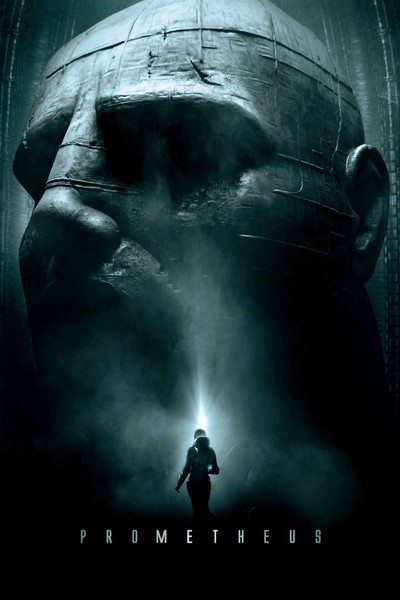
The interior of the Prometheus was built across a two-level structure, fronted by a large, faceted, wrap around windscreen. Theron’s quarters were designed to represent her high status in the crew, and were furnished with modern and futuristic items, including Swarovski chandeliers and a Fazioli piano. The ship’s garage was built on the backlot of Pinewood Studios in England. The vehicles inside were built in 11 weeks and were designed to operate on difficult terrain while having a futuristic aesthetic. Max created a large pyramid structure for the alien world, which had its main interior areas connected by a series of chambers, corridors, and tunnels; it was so large that some members of the film crew became lost inside it. The pyramid was enhanced in post-production to further increase its size. One of the key sets, the chamber where the crew find the humanoid-head statue, was designed to resemble the interior of a cathedral and convey a quasi-religious impression. Giger designed the murals that appear within the chamber.
For the scene of the Prometheus’ descent to the alien moon LV-223, visual effects art director Steven Messing referenced NASA imagery, including vortex cloud structures. He also used aerial photographs of locations in Iceland and Wadi Rum shot by VFX supervisor Richard Stammers and his team. Messing painted over these images and combined them with 3D set extensions to create a realistic altered landscape. Scott wanted the ship’s descent scenes to have a sense of grandeur to contrast the dark and shrouded descent featured in Alien. Much of LV-223s world was based upon the world visited in Alien, but scaled back as Scott felt some elements were too unrealistic. Other influences were the Martian mountain Olympus Mons and several large mountain structures on Earth. NASA advisers provided concepts for the aesthetics of alien worlds which were incorporated into the design work. MPC developed a digital representation of Wadi Rum using the design material, modified it to locate the alien pyramid and a landing area for the Prometheus, and resized the planet’s natural features relative to the alien structures.
Creature Effects
Neal Scanlan and Conor O’Sullivan developed the film’s alien creatures, aiming to convey that each creature has a logical biological function and purpose. Scanlan said that much of Scott’s inspiration for creature design is drawn from natural life, such as plants and sea creatures.[103] Creature designer Carlos Huante chose to make the creature designs pale to contrast the black-toned, Giger-influenced aesthetic of Alien. Huante designed them to be white and embryonic because the events in the film occur before Giger’s influence had taken effect. Huante took influences from references Scott was using to design the pale-skinned Engineers. Huante also referenced other Giger works, national monuments, large sculptures, and the Crazy Horse Memorial statue in South Dakota. Part of Huante’s early design work included developing precursors to Alien’s Facehugger, and a primitive Alien creature, but these were cut from the final release. When designing the Engineers, Scott and Huante referenced paintings by William Blake and J. M. W. Turner, and classical sculptures.[39] Scott wanted the Engineers to resemble Greco-Roman gods, and instructed designer Neville Page to reference the Statue of Liberty, Michelangelo’s David, and Elvis Presley. The 8-foot tall, humanoid Engineers were created by applying bulky, full-body prosthetics to the actors, whose facial features were diminished by the material, and were later digitally enhanced to preserve the “godlike” physical perfection. Scott described the Engineers as tall, elegant “dark angels”.
The snake-like alien dubbed the “Hammerpede” was given life through a mixture of CGI and practical effects, and the wires controlling the practical puppet were digitally removed. For a scene in which the Hammerpede is decapitated, the VFX team digitally animated and inserted the spontaneous growth of a replacement head. During the scene in which the Hammerpede erupts from Spall’s character’s corpse, Scott controlled the puppet using wires. Scott did not inform Dickie about what was to occur in the scene and her screaming reaction was real. The creature’s design was partially inspired by translucent sea creatures with visible arteries, veins, and organs beneath the skin’s surface, and cobras. The designers gave the creature a smooth, muscular, and powerful appearance. Early designs of the “Trilobite”, the tentacled offspring cut from Shaw, resembled an octopus or squid. Page redeveloped this creature as an embryo in an early state of development, with tentacles that began fused together and would gradually split, creating new tentacles, as the creature developed. The practical creature was a remotely operated animatronic creation with a silicone skin.
The mutated Fifield effects were achieved mainly through the use of make-up and prosthetics. Due to concerns that the practical effects would be unsatisfactory, the filmmakers completed an alternative version of the sequence, in which Fifield was rendered as “a digital character with elongated limbs and an engorged, translucent head, incorporating a semblance of Harris’s face”. Three other variations of the mutated Fifield were modelled, but these were rejected as being too inhuman.
For its grown form, the “Adult Trilobite”, Max found inspiration from an arthropod-like creature from Earth’s Cambrian period, and the alien octopus in Jean Giraud’s illustrations for the comic strip The Long Tomorrow. Further inspiration came after Max found a formaldehyde-preserved giant squid, an image which met with Scott’s approval. The film’s last-unveiled creature, the “Deacon”, was named by Scott for its long, pointed head that he considered resembled a bishop’s mitre. Scanlan aimed to represent the creature’s genetic lineage, beginning with Shaw and Holloway who produce the Trilobite which impregnates the Engineer, in its design. However, the creature was given a somewhat feminine appearance, since “it was born of a female before being born of a male.” Messing drew inspiration for the Deacon’s birth scene from the birth of foals, and created an iridescent appearance for its skin, based on the equine placenta. The Deacon’s protruding jaw was inspired by the goblin shark.
Sound Effects
Sound effects were generated with a variety of sources including Pop Rocks – a brand of popping candy – and a parrot. The glistening ice forming on the stone cylinders discovered in the film was created by applying the popping candy to materials such as wet metal and stone that was then sprayed with water to produce the “popping, cracking” sound. Sound designer Ann Scibelli’s parrot was recorded over several weeks to document her variety of vocalisations which were then used as beeps, alarms and the cries of Shaw’s alien offspring.
Visual Effects
Prometheus contains approximately 1,300 digital effect shots. The main effects studio was Moving Picture Company (MPC), which produced 420 of the shots. Several other studios, including Weta Digital, Fuel VFX, Rising Sun Pictures, Luma Pictures, Lola Visual Effects, and Hammerhead Productions, also produced effects shots for the film.
The creation of life from the disintegration of an Engineer in the film’s opening scene was created by WETA Digital. The scene was difficult to produce because it had to convey the story of the Engineer’s DNA breaking apart, reforming and recombining into Earth DNA in a limited span of time. The team focused on making the DNA stages distinct to convey its changing nature. Scott requested the studio to focus on the destruction occurring within the Engineer. A light colour scheme was used for the Engineer’s DNA and decayed fish spines were used as an image reference, while the infected DNA had a melted appearance. To find methods of depicting the DNA destruction, the team carved vein-like structures from silicone and pumped black ink and oils into them while filming the changes occurring over an extended period of time.
A key scene involving a large 3D hologram star map, dubbed the Orrery, was inspired by the 1766 Joseph Wright painting A Philosopher Lecturing on the Orrery, in which a scientist displays a mechanical planetarium by candlelight. While discussing the necessity of a star map with Spaihts, Scott mentioned that he envisaged a physical representation being similar to the painting, although he was unaware of its title and described it as “circles in circles with a candle lit image”. Using Scott’s description, Spaihts located an image of the painting. Spaihts said, “making the leap from a star map, to an Enlightenment painting, and then back into the far future. [Scott’s] mind just multiplexes in that way”. The Orrery was one of the most complex visual effects, contained 80-100 million polygons, and took several weeks to render as a single, complete shot.
Release
The premiere of Prometheus took place on 31 May 2012, at the Empire cinema in Leicester Square, London. The film was released in the UK on 01 June 2012, and in North America on 08 June 2012. It was simultaneously released in IMAX theatres and in 3D, and it is encoded for D-Box motion seats that provide physical feedback to the audience during the film.
Pre-release
In the UK, approximately £1 million ($1.6 million) of tickets were pre-sold. 18,827 tickets pre-sold for the London IMAX, the largest IMAX screen in the country, which broke the theatre records for the highest grossing week of pre-sales with £293,312 ($474,687), and the highest grossing first day of pre-sales with £137,000 ($221,717). It extended this record to 30,000 tickets sold and £470,977 ($737,588) earned, and become the most pre-booked film at that theatre, exceeding the performance of high-profile IMAX releases including Harry Potter and the Deathly Hallows – Part 2 and Avatar (2009).
In North America, audience tracking showed high interest among males, but low among females. In the week before the film’s release, predictions were conflicted on whether Prometheus or Madagascar 3: Europe’s Most Wanted (the first family-oriented film of the summer), which were released simultaneously, would reach number 1 for that weekend. On 06 June 2012, Fandango reported that with 42% of daily sales Prometheus was beating Madagascar 3. The online tracking for Prometheus surged with each additional promotional footage. Prometheus was predicted to earn approximately $30 million, and Madagascar 3 around $45 million. As the weekend approached, tracking suggested a $55 million debut for Madagascar 3 and $50–$55 million for Prometheus. Prometheus was disadvantaged by Madagascar opening in 264 more theatres and its adult rating.
Box Office
Prometheus was considered a financial success overall. After a strong start in North America, the film failed to meet the studio’s expectations, but it continued to perform strongly in other territories until the end of its theatrical run. Prometheus earned $126.4 million (31.4%) in North America and $276.9 million (68.6%) elsewhere for a worldwide total of $403.4 million, making it the 18th highest-grossing film of 2012, and at its peak it was the 155th highest-grossing film worldwide unadjusted for inflation.
Sequel
Scott discussed a continuation of the series in March 2012, saying that Prometheus leaves many questions unanswered and that these could be answered in a sequel. In June 2012, Lindelof said that while plot elements were deliberately left unresolved so that they could be answered in a sequel, he and Scott had thoroughly discussed what should be resolved so that Prometheus could stand alone, as a sequel was not guaranteed. By August 2012, a sequel was announced to be in development for release no earlier than 2014. Lindelof chose not to work on the new film, citing other commitments.
Titled Alien: Covenant, the sequel premiered in London, England on 04 May 2017, and was released in the US on 19 May 2017. Set eleven years after the events of Prometheus, Alien: Covenant’s story follows the crew of the Covenant space ship who land on an uncharted and seemingly uninhabited planet. The film stars Katherine Waterston, Danny McBride, Demián Bichir, Jussie Smollett, Amy Seimetz, Carmen Ejogo, Callie Hernandez, Alex England and Billy Crudup. On release, Alien: Covenant earned a worldwide box office gross of $240.7 million (compared to Prometheus’ $403.4 million), and received generally favourable reviews.
A sequel to Alien: Covenant is in development. In 2013, a comic book series was announced by Dark Horse Comics that serves as a spin-off to Prometheus. The series, titled Fire and Stone, is an Alien vs. Predator crossover featuring content exclusive to Prometheus. The first issue of Fire and Stone was released on 10 September 2014.
Trivia
- Prometheus entered production in April 2010, with extensive design phases during which the technology and creatures that the film required were developed.
- Principal photography began in March 2011, with an estimated $120-130 million budget.
- The project was shot using 3D cameras throughout, almost entirely on practical sets, and on location in England, Iceland, Spain, and Scotland.
- It was promoted with a marketing campaign that included viral activities on the web.
- Three videos featuring the film’s leading actors in character, which expanded on elements of the fictional universe, were released and met with a generally positive reception and awards.
- Prometheus was released on 01 June 2012, in the UK and on 08 June 2012, in North America.
- The film was praised for the designs, production values and cast performances, but received criticism for formulaic and unresolved plot points.
- The film grossed over $403 million worldwide.
- A sequel, Alien: Covenant, was released in May 2017.
Crossover
The Alien vs. Predator franchise combines the continuities of the Alien franchise with the Predator franchise and consists of two films as well as various series of comics, books, and video games.
Alien Series
You can find a full index and overview of the Alien Series here.
Production & Filming Details
- Director(s): Ridley Scott.
- Producer(s): David Giler, Walter Hill, and Ridley Scott.
- Writer(s): John Spaihts and Damon Lindelof.
- Music: Marc Streitenfeld.
- Cinematography: Dariusz Wolski.
- Editor(s): Pietro Scalia.
- Production: 20th Century Fox, Brandywine Productions, and Dune Entertainment.
- Distributor(s): 20th Century Fox.
- Release Date: 11 April 2012 (Paris), 01 June 2012 (UK), and 08 June 2012 (US).
- Running Time: 124 minutes.
- Rating: 15.
- Country: UK and US.
- Language: English.
Video Link


 Military Gogglebox
Leave a comment