
Introduction
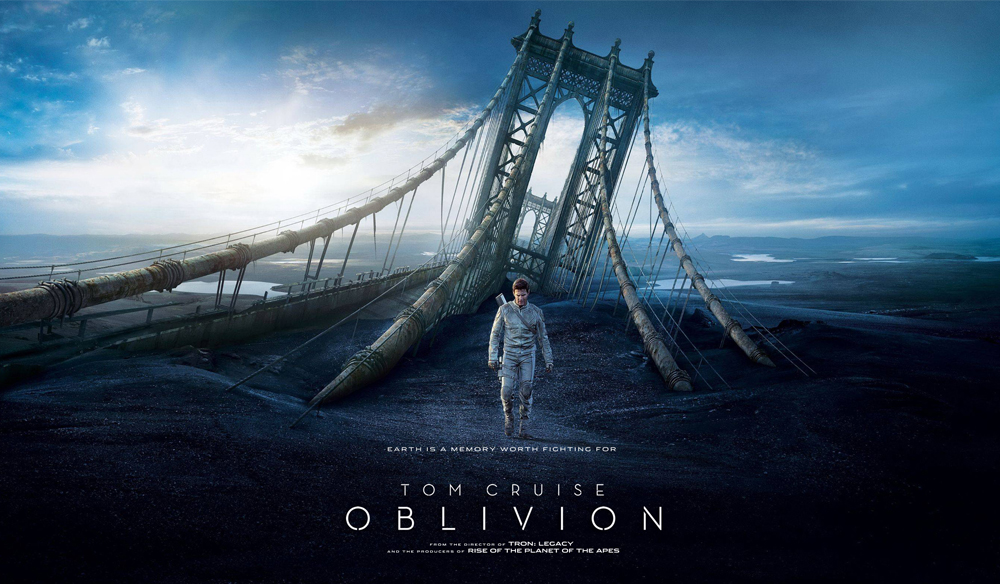
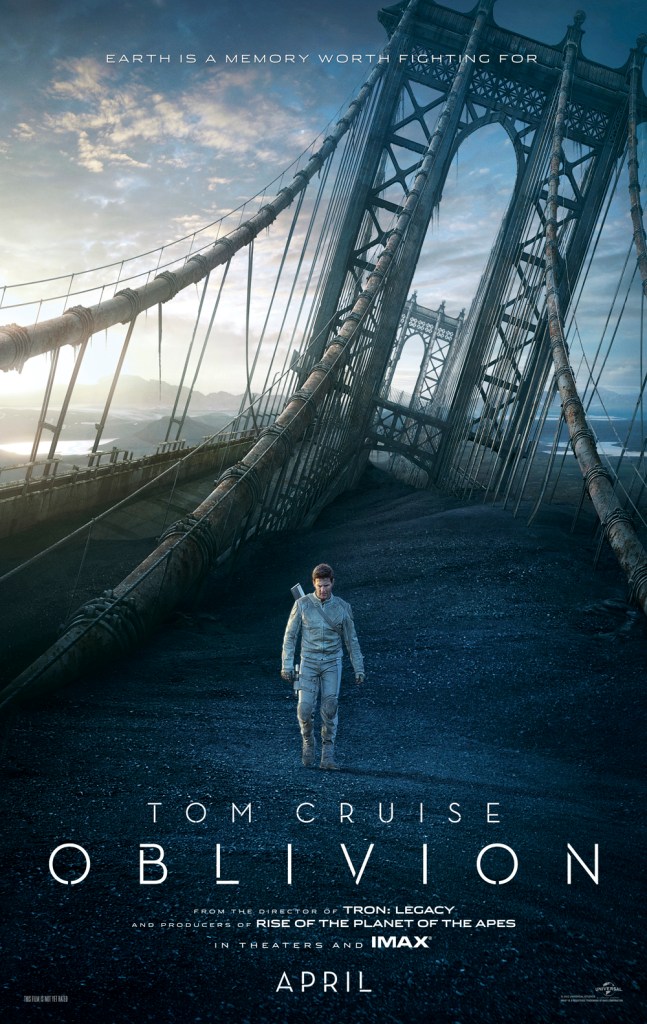
Oblivion is a 2013 American post-apocalyptic action-adventure film co-produced and directed by Joseph Kosinski, and produced by Peter Chernin with screenplay by Karl Gajdusek and Michael deBruyn, starring Tom Cruise in the main role alongside Olga Kurylenko, Andrea Riseborough, Morgan Freeman and Nikolaj Coster-Waldau in supporting roles.
Oblivion, based on Kosinski’s unpublished graphic novel of the same name, pays homage to 1970s science fiction films.
Oblivion takes place in 2077, on an Earth devastated by war with extraterrestrials that has caused humanity to relocate itself to Titan. The film follows the story of Jack Harper, a technician who has been sent back to Earth to service drones used in the fight against remaining extraterrestrials (scavengers). After witnessing a spacecraft crash, from which he is able to rescue a survivor, Harper is captured by scavengers and fights against a new and evolving alien threat.

Outline
In a voiceover, “Tech 49” Jack Harper tells of the state of the Earth on 14 March 2077. Sixty years earlier, a race of alien scavengers destroyed the Moon and invaded Earth to seize its resources. Humanity won the war, but the nuclear weapons they used, and the loss of the Moon, have left most of the planet in ruin.
Harper and his housemate and communications partner Victoria “Vika” Olsen are among the few people left on Earth. Working as a team, they repair the network of combat drones that hunt the remaining “scavs” and guard the fusion generators (“hydrorigs”) that draw seawater to extract energy. Led by mission director Sally aboard the Tet, a giant tetrahedral space station that orbits Earth, they are about to complete their five-year mission and return to the Tet to travel to humanity’s new home on Saturn’s moon Titan.
Although their memories have been wiped to help them focus on their mission, Jack’s affection for Earth and the remnants of its history that he finds make him uneasy. He also has recurring dreams of a time before the war and visions of an unknown dark-haired woman.
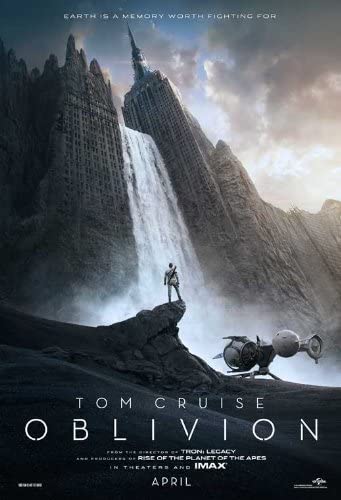
While on duty, Jack discovers the scavengers are using the Empire State Building’s antenna to transmit coordinates within Grid 17 to outer space. After he dismantles the transmitter he tells Vika he’ll perform a perimeter check around the border where the “radiation zone” meets the safe area. Instead, he visits a secret cabin he has built in a hidden lush green valley and filled with mementos from Earth’s past.
Jack soon awakens at the cabin to see unknown objects parachuting from the sky. When he finds the Odyssey in Grid 17, he sees it holds five humans in stasis chambers, one of which is the woman from his dreams. Though a drone arrives and begins to kill the survivors, Jack protects the woman’s chamber. When he brings her to the tower, she awakens, recognises Jack, and says her name is Julia. Against Jack’s wishes, Vika reports Julia’s presence to Sally, who requests Jack take Julia to the Tet.
Early the following morning, without Vika’s knowledge, Jack and Julia return to the crash site and recover Odyssey’s flight recorder. Soon afterward, the scavengers capture them and take them to the Raven Rock Mountain Complex, where they reveal themselves to be human. Their leader, Malcolm Beech, who was a young soldier during the war, asks Jack to reprogram a captured drone to carry nuclear fuel cells to the Tet to destroy it. When Jack refuses, Beech releases Jack and Julia to seek the truth in the supposed radiation zone. When they return to the remains of the Empire State Building, Julia reveals she is his wife, causing Jack to remember him proposing to her there.
When they return to the tower, Vika refuses to let them enter, having witnessed the couple’s exchange through the camera on Jack’s craft. Instead, she tells Sally she and Jack are “no longer an effective team”. Sally activates a drone that kills Vika before Julia destroys it. Though Jack and Julia escape in his craft and destroy two of the three drones that pursue them, a collision with the third forces them to eject over the radiation zone. After they land, they see another ship with a technician – a clone of Jack named “Tech 52” – who attempts to repair the drone. Jack incapacitates his clone, but Julia is shot during the fight. When Jack uses Tech 52’s craft to travel to his clone’s tower for medical supplies and finds a clone of Vika, he tricks her into believing he is “her” version of Jack.
At the base, Beech tells Jack and Julia the Tet is an alien artificial intelligence. Determined to acquire Earth’s natural resources and wipe out humanity, it destroyed the Moon and then used an army of Jack clones and drones to invade Earth. The story of the scavenger invasion and humanity’s move to Titan is a Tet fiction. Jack repairs the captured drone and prepares to launch it, but other drones attack the base. Although the humans fend off the attack, it leaves Beech gravely injured and the captured drone damaged beyond repair.
With no other choice, Jack volunteers to fly the nuclear device to the Tet and use his delivery of the ‘hibernating’ Julia to explain his presence. During the flight, Jack listens to the Odyssey’s flight recorder and learns the truth: he was the commander of a NASA mission to explore Titan, Vika was his co-pilot, and Sally was their mission director on Earth. When NASA discovered the Tet, they diverted the Odyssey to investigate. When the Tet drew in their ship, Jack jettisoned Odyssey’s sleep module that held Julia and the rest of the crew to allow it to return to Earth.
In the present, Jack enters the Tet and finds thousands of chambers that each contain clones of himself and Vika in stasis. He opens the stasis chamber to reveal the wounded Beech and a bomb made from the Odyssey’s fuel cell. They detonate it, killing themselves and destroying the Tet. On Earth, Julia witnesses the explosion from the lake house. Three years later, she and her young daughter meet the surviving resistance members accompanied by Tech 52, whose true memories were triggered by his encounter with Julia and Jack.
Cast
- Tom Cruise as Jack Harper, Tech 49:
- A technician who works to repair drones on Earth. Originally, he was the commander of a mission to Titan who was then captured and cloned to fight humanity by the Tet.
- Cruise also plays Jack Harper, Tech 52, a clone who initially remains loyal to the Tet.
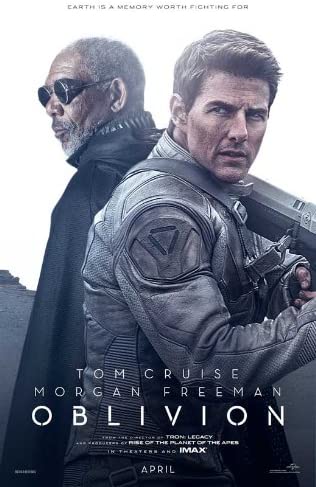
- Morgan Freeman as Malcolm Beech:
- A veteran soldier and leader of a large community of ‘scavengers’, or human survivors from the alien Tet’s attacks.
- Olga Kurylenko as Julia Rusakova Harper:
- Jack’s wife and a crew member on the Odyssey, who was sent to Earth by her husband to protect her from the Tet.
- Andrea Riseborough as Victoria “Vika” Olsen:
- Jack’s communications partner and housemate.
- Originally, she was the copilot of Jack’s mission to Titan who was captured and cloned to assist in the Tet’s war on humanity.
- Riseborough also plays a clone of Vika who Jack misleads in order to obtain medical supplies.
- Nikolaj Coster-Waldau as Sergeant Sykes:
- The main military commander of Beech’s community of scavengers who is skeptical of Jack.
- Melissa Leo as the Tet/’Sally’:
- An alien artificial intelligence seeking to acquire Earth’s natural resources and wipe out humanity.
- Sally was the mission director of Jack and Julia’s mission to Titan; her likeness was copied by the Tet to serve as its visual/auditory representation.
- Zoë Bell as Kara:
- A soldier and member of the scavengers.
Production
Development
Kosinski wanted to film a cinematic adaptation of the graphic novel Oblivion, which he started to co-write with Arvid Nelson for Radical Comics. The novel, however, was never finished, as Kosinski now admits that “It was just a stage in the project [of film development]”. He explained in an interview with Empire that “partnership with Radical Comics allowed me to continue working on the story by developing a series of images and continuing to refine the story more over a period of years. Then I basically used all that development as a pitch kit to the studio. So even though we really never released it as an illustrated novel the story is being told as a film, which was always the intention.”
Walt Disney Pictures, which produced Kosinski’s previous direction Tron: Legacy, acquired the Oblivion film adaptation rights from Radical Comics and Kosinski after a heated auction in August 2010. The film was a directing vehicle for Kosinski with Barry Levine producing and Jesse Berger as executive producer. Other studios that made bids on the film were Paramount, Fox’s Chernin Entertainment and Universal. Disney subsequently released the rights after realizing the PG-rated film they envisioned, in line with their family-oriented reputation, would require too many story changes. Universal Pictures, which had also bid for the original rights, then bought them from Kosinski and Radical Comics and authorised a PG-13 film version.
The script for the film was originally written by Kosinski and William Monahan and underwent a first rewrite by Karl Gajdusek. When the film passed into Universal’s hands, a final rewrite was done by Michael Arndt, under the pen name “Michael deBruyn”. Universal was particularly appreciative of the script, saying, “It’s one of the most beautiful scripts we’ve ever come across.”
The Bubble Ship operated by Cruise’s main character, Jack 49, was inspired by the Bell 47 helicopter (often colloquially referred to as a “bubble cockpit” helicopter), a utilitarian 1947 vehicle with a transparent round canopy that Kosinski saw in the lobby of the Museum of Modern Art in Manhattan, and which he likened to a dragonfly. Daniel Simon, who previously worked with Kosinski as the lead vehicle designer on Tron: Legacy, was tasked with creating the Bubble Ship from this basis, incorporating elements evocative of an advanced fighter jet with the Bell 47 to create a light, functional vehicle that was both practical and aesthetically pleasing, much as he observed with the ships in 2001: A Space Odyssey.
“When Kubrick made 2001, rather than going to the hotshot concept designers of the day, he hired NASA engineers”, said Simon. “I believe in form follows function. I’m not a fan of excessive decoration, of putting fins on something because it looks cool.” Rather than employ digital models, Wild Factory, a Camarillo concept car company, built the Bubble Ship as a 25-foot-long (7.6 m), 4,000–5,000 lb (1,800–2,300 kg), mostly aluminum prop. Elements of the cockpit, such as the placement of the joystick and pedals, were customized for Cruise, who is a qualified pilot, and who had some input into the design. The craft was also made to be easy to disassemble and assemble, in order to facilitate transport to the Iceland shooting locations, where it would be mounted on a gimbal for shots of it flying. The unmanned aerial drones that figure prominently in the plot were created to appear to be in the same design family as the Bubble Ship.
Casting
Tom Cruise had expressed interest in the film for a long time, and officially committed to it on 20 May 2011.
For casting the lead role of Julia opposite Cruise, the producers considered five actresses: Jessica Chastain, Olivia Wilde, Brit Marling, Noomi Rapace and Olga Kurylenko, and all five auditioned on 27 August 2011. It was subsequently announced that Chastain would play one of the film’s two female leads. In January 2012 Chastain entered into talks for a part in the Kathryn Bigelow film Zero Dark Thirty (2012) and subsequently dropped out of Oblivion contention. It was later announced that the role had been given to Kurylenko.
In preparation for the role, Kurylenko watched astronaut training videos as well as classic science fiction and romance films (such as Solaris, Notorious, and Casablanca). “What’s funny is I actually watched Solaris; Joseph never brought it up”, said Kurylenko. “I come from Tarkovsky-land, and at that point I hadn’t watched it for many years. I watched the new one as well, with George Clooney and Natascha McElhone. The story – both in Solaris and Oblivion – deals with space and memory.”
For the other leading role, Victoria, the producers initially considered Hayley Atwell, Diane Kruger and Kate Beckinsale. The three actresses traveled to Pittsburgh to screen-test with Cruise, who was filming Jack Reacher. The role finally went to Andrea Riseborough. Melissa Leo was cast at a later date as Sally.
Filming
Production began on 12 March 2012 and concluded on 14 July 2012. Filming locations included Baton Rouge and New Orleans, Louisiana. Out of approximately three months of shooting, 69 days were shot in Louisiana, from March through May 2012, 11 days were shot in New York in June 2012, a few in Mammoth in California in June 2012, and 10 days were filmed in Iceland in June 2012, when the daylight lasts for nearly 24 hours a day. As well as showcasing Iceland’s volcanic landscapes, the film’s director Joseph Kosinski sought to take advantage of the round-the-clock light, in particular the 6pm to 1am waning light known as “magic hour”, to “bring sci-fi out into the daylight”, in contrast with films such as Alien (1979), which spent their time in dark hulls or benighted planets.
The single most difficult scene to film was when Harper takes a break to admire the view and waters a flower. It was filmed by having Cruise sit next to an 800-foot (240-meter) drop at the top of Iceland’s Jarlhettur on the root of Langjökull, which is accessible only by helicopter. The scenes set at Harper’s idyllic forest retreat were filmed at Black’s Pond in June Lake, California.
Oblivion was filmed with Sony’s CineAlta F65 camera, which was shipped in January 2012. A Red Epic was also used for scenes that required going handheld or when body mount rigging was applied. The film was shot in 4K resolution in Sony’s proprietary raw image format, but for cost reasons (and over Kosinski’s protests), both the digital intermediate and final version were done at 2K resolution.
For the Sky Tower set (built on a soundstage in Baton Rouge), Kosinski and cinematographer Claudio Miranda worked closely with visual special-effects house Pixomondo to establish both environment and lighting by the use of 21 front-screen projectors aimed at a huge wraparound backdrop to form one continuous image, rather than blue screen backdrops. The backdrop consisted of a single seamless piece of painted white muslin, 500 by 42 feet (152 by 13 meters), which was wrapped around the set for 270-degree coverage. This enabled the full environment to be captured in camera, and assisted in lighting up to 90% of the set.
Had blue screen been used on the “glass house” Sky Tower, the glass would have disappeared into the blue lighting, and would have had to be reproduced digitally in post-production. The actors enjoyed working in the environment, as they could look outside and actually see sunrise or sunset imagery. This new technique allowed them to cut down on both the effects shots, which ended up at around 800 in total, and the expenses. Even the “control table” which Victoria operates was filmed then displayed on a large screen.
To obtain the necessary footage to create the illusion that the Sky Tower set was sitting high above the clouds, Pixomondo sent a crew to film the view from the peak of Haleakalā in Hawaii for four days with three Red Epic cameras mounted side-by-side on a single rig. Pixomondo’s Stuttgart office then stitched together the data from the three cameras to form a single gigantic video stream (with each still image consisting of 26 megapixels), and produced a variety of different time-of-day clips to be projected on the set.
Music
On 28 June 2012, it was announced that French electronic band M83 would compose the soundtrack for Oblivion. On why he chose M83 to score the film, director Joseph Kosinski said, “I went back and I found my first treatment for Oblivion from 2005 and it had listed in the treatment a soundtrack of M83. Obviously the Tron: Legacy collaboration with Daft Punk worked out as good as I would have ever hoped, [so] I wanted to do something similar in that I’m pulling an artist from outside the movie business to create an original sound for this film.” Kosinski continued, “Daft Punk’s music wouldn’t make sense for this movie. It had to be an artist whose music fit the themes and story I was trying to tell. And M83’s music I felt was fresh and original, and big and epic, but at the same time emotional and this is a very emotional film and it felt like a good fit.”
To guide Anthony Gonzalez of M83 through the scoring process, director Kosinski brought in Joseph Trapanese, who co-wrote the score alongside Gonzalez. Kosinski states, “Together they have created the score that I have dreamed about since I first put this story down on paper eight years ago.” Trapanese first came to Kosinski’s attention when he collaborated with Daft Punk on Tron: Legacy as arranger and orchestrator.
In an interview with Rolling Stone, M83 frontman Anthony Gonzalez said, “I started to write the soundtrack just reading the script, and then when you get the picture in, it’s different, and you kind of switch to another vibe and change stuff and start experimenting a lot with the music.” Gonzalez added, “I worked with Joseph a lot, and he’s very particular about the music in his movies, so we spent a lot of time talking about music and working the arrangements together.”
The soundtrack album was released on 09 April 2013, by Back Lot Music. A deluxe edition of the soundtrack was released the same day exclusively through iTunes. It features an additional 13 tracks.
Release
Marketing
Details about Oblivion were kept secret, though the studio was said to have been “very excited” about the film. Promotions began April 2012, with a part of the footage being screened at the 2012 CinemaCon despite the fact that filming had begun just one month prior to the event. The footage was described as “a combination of early concept art, rough animation, and unfinished dailies”, showcasing a glimpse of the film’s landscapes.
Theatrical Release
Oblivion was first presented in Buenos Aires on 26 March 2013, Dublin on 03 April, and in Hollywood on 10 April at the Dolby Theatre where Cruise himself announced before the screening that the film was actually the first feature to be mixed completely “from start to finish” in the latest state-of-the-art Dolby Atmos surround sound.
Home Media
The DVD and Blu-ray for Oblivion became available online for pre-order in North America on 24 April 2013, just five days after its initial release in the region. One month later it was announced that the UK branch of Universal Studios would be releasing the film on home video in its region on 06 August 2013 with the on-demand version on 18 August 2013. The release was scheduled to be in both a standard and a SteelBook Limited Edition form. In June 2013, it was announced that the film would be released on home video in America also on 06 August 2013. The Blu-ray releases will feature commentary with Tom Cruise and director Joseph Kosinski, deleted scenes, M83’s isolated score, and a series of making-of featurettes. The Blu-ray debuted at number 1 in sales for its opening week.
Box Office
In North America, the film earned US$37.1 million on its opening weekend, including US$5.5 million from IMAX screenings in 323 theatres, making it Cruise’s best North American opening after Mission: Impossible film series and War of the Worlds (2005).
The film closed on 27 June 2013. Oblivion grossed US$89.1 million in the US and US$198.8 million internationally, bringing the worldwide total to US$287.9 million.
Trivia
- Oblivion was released in IMAX by Universal Pictures on 09 April 2013 and held its world premiere in Buenos Aires on 26 March 2013.
- The film grossed $286 million worldwide, on a production budget of $120 million.
Production & Filming Details
- Director(s): Joseph Kosinski.
- Producer(s): Peter Chernin, Dylan Clark, Duncan Henderson, Joseph Kosinski, and Barry Levine.
- Writer(s): KArl Gajdusek, Michael deBruyn, and Joseph Kosinski.
- Music: Anthony Gonzalez and Joseph Trapanese.
- Cinematography: Claudio Miranda.
- Editor(s): Richard Francis-Bruce.
- Production: Relativity Media, Chernin Entertainment, Monolith Pictures, and Radical Studios.
- Distributor(s): Universal Pictures.
- Release Date: 26 March 2013 (Buenos Aires) and 19 April 2013 (US).
- Running Time: 124 minutes.
- Rating: PG-13.
- Country: US.
- Language: English.
Video Link


 Military Gogglebox
Leave a comment