
Introduction
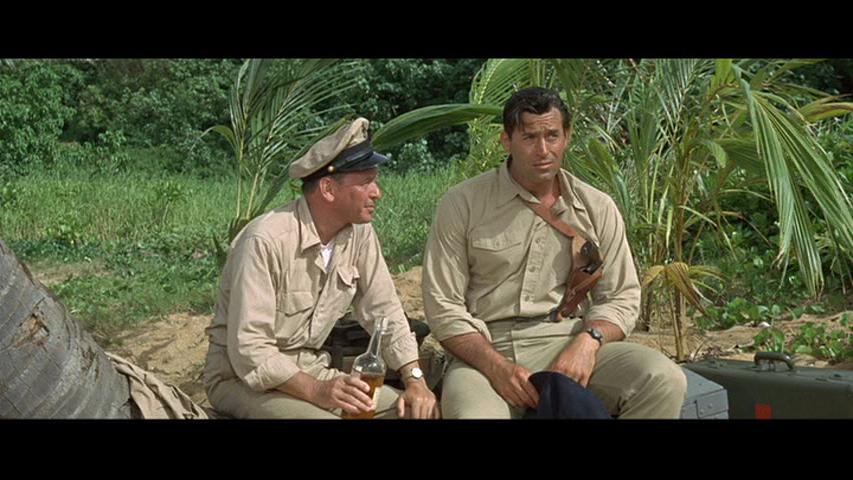
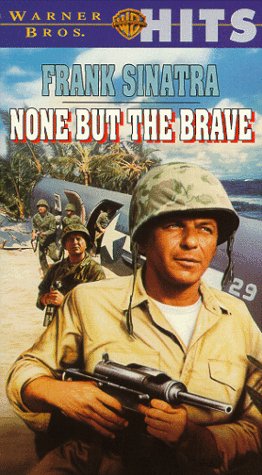
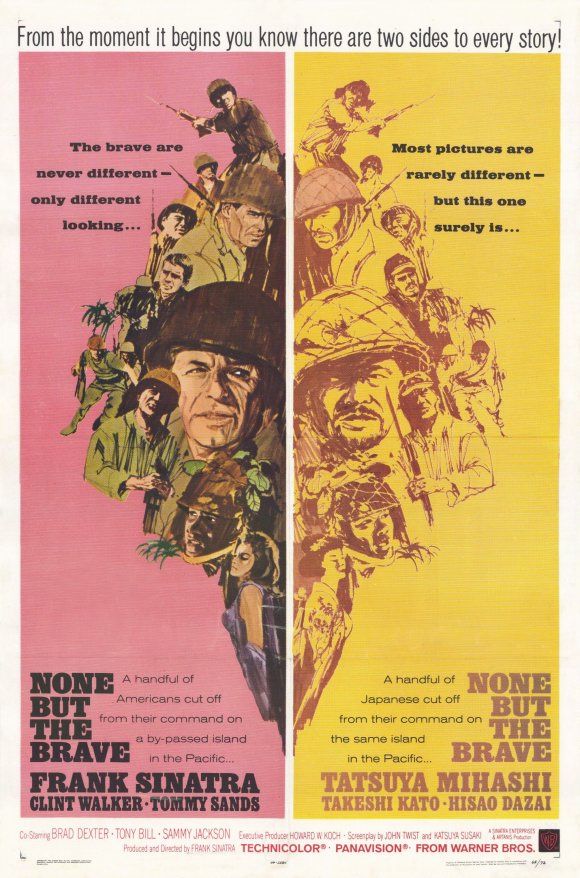
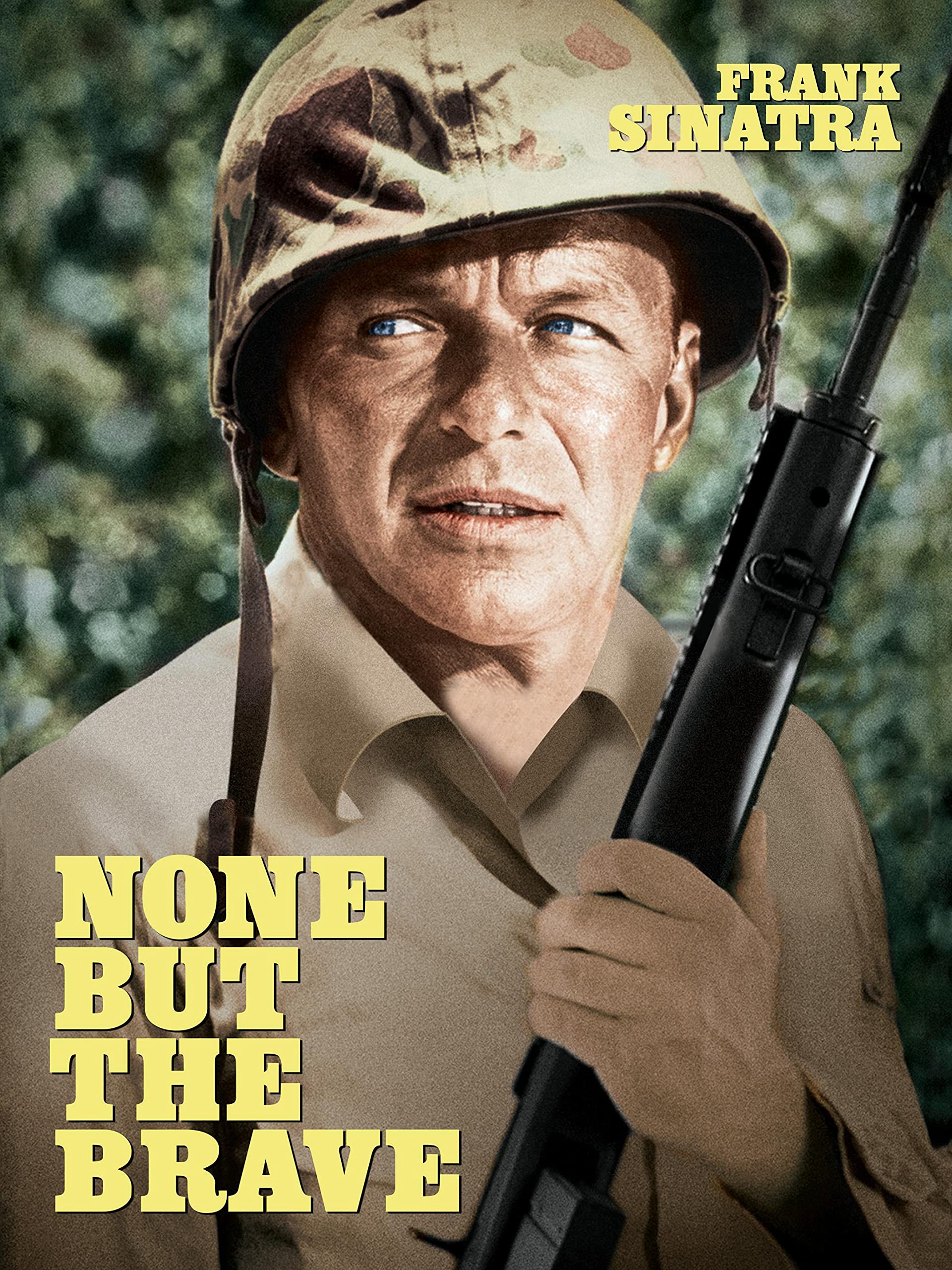
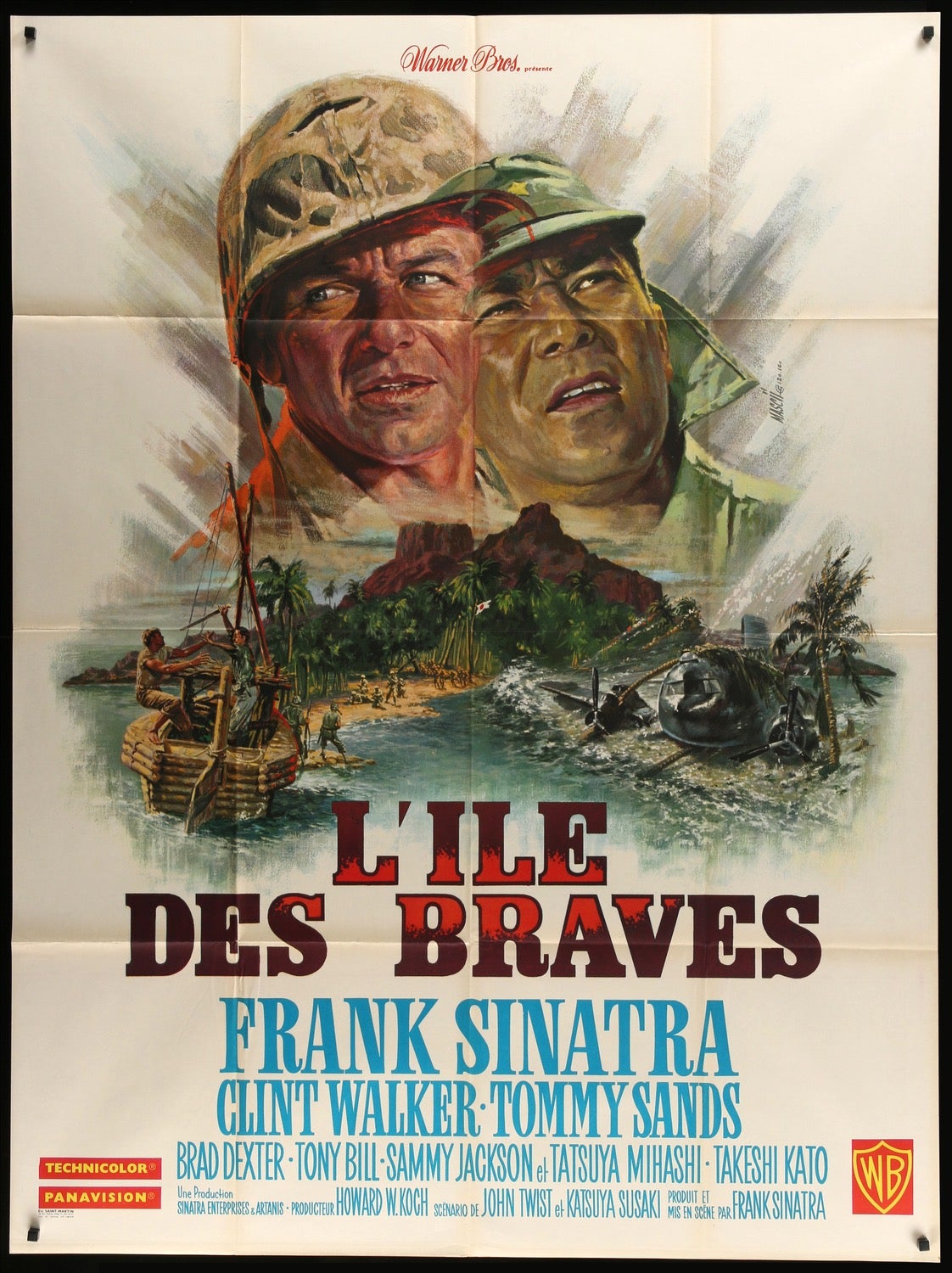
None but the Brave (勇者のみ, Yūsha Nomi) is a 1965 war film directed by Frank Sinatra, with special effects by Eiji Tsuburaya.
It was the first film international co-production between Japan and the United States.
Outline
Narrated in English by a Japanese officer named Kuroki (in the form of a journal he is writing for his wife), the film is set in the Asiatic-Pacific theatre during an unspecified period of World War II. A platoon of 16 Japanese soldiers is stranded on an island in the Pacific with no means of communicating with the outside world. Lieutenant Kuroki keeps his men firmly in hand and is supervising the building of a boat for their escape.
An American C-47/R4D transport plane is shot down by a Japanese Zero, crash landing on the same island. The Zero and an American F4U Corsair destroy each other, with no outside commands learning of the island. Marine Aircraft Wing Captain Dennis Bourke assumes command of the platoon of Marines he was transporting, over their buffoonish and incompetent 2nd Lieutenant Blair and Sergeant Bleeker. Confidante to Bourke is Navy chief pharmacist’s mate Francis. As the 19 Americans learn of the Japanese platoon’s existence on the island, tension mounts resulting in a battle for the Japanese boat. The vessel is destroyed and a Japanese soldier is seriously injured. Calling a truce, Koruki trades the Americans access to water in exchange for a visit from their doctor to treat the wounded soldier, whose leg has to be amputated.
The truce results in both platoons, reduced in numbers through their earlier conflicts and later natural disasters, choosing to live side by side – although a line is drawn forbidding one from encroaching on the other’s side of the island. There is some clandestine cooperation and trading and earnest respect and friendship.
When the Americans establish radio contact and their pickup by a US naval vessel is arranged, they demand that the Japanese surrender, but Kuroki re-establishes that they are at war. As the Americans proceed to the beach, Bourke orders his men to be ready to shoot to kill. When they are ambushed by the remaining 8 men of the Japanese platoon, the remaining 11 Americans are given no option but to retaliate, resulting in a bloody and pointless firefight during which all the Japanese and most of the Americans are shot dead. Only Francis, Bourke, Bleeker, Blair and Corporal Ruffino survive the skirmish. Bourke orders Francis to examine the mortally wounded Kuroki to see if he can be saved. They move onto the beach and wait to be rescued by the American naval vessel, stationed just offshore. Francis reports Kuroki’s death and hands Bourke the Japanese officer’s journal, written in Japanese with what appears to be an address. Bourke speculates that one day he will be able to deliver it to Kuroki’s widow. Kuroki’s final narration calls what he is to do “just another day.” The film ends with a long shot of the island, superimposed with the words “Nobody ever wins.”
Cast
- Japanese:
- Tatsuya Mihashi as Lieutenant Kuroki.
- Takeshi Katô as Sergeant Tamura.
- Homare Suguro as Lance Corporal Hirano.
- Kenji Sahara as Corporal Fujimoto.
- Mashahiko Tanimura as Lead Private Ando.
- Toru Ibuki as Private Arikawa.
- Ryucho Shunputei as Private Okunda (the fisherman).
- Hisao Dazai as Private Tokumaru.
- Susumu Kurobe as Private Goro.
- Takashi Inagaki as Private Ishii.
- Kenichi Hata as Private Sato.
- American:
- Frank Sinatra as Chief Pharmacist Mate Francis.
- Clint Walker as Captain Dennis Bourke.
- Tommy Sands as 2nd Lieutenant Blair.
- Brad Dexter as Sergeant Bleeker.
- Tony Bill as Air Crewman Keller.
- Sammy Jackson as Corporal Craddock.
- Richard Bakalyan as Corporal Ruffino.
- Rafer Johnson as Private Johnson.
- Jimmy Griffin as Private Dexter.
- Christopher Dark as Private Searcy.
- Don Dorrell as Private Hoxie.
- Phil Crosby as Private Magee.
- Howie Young as Private Waller.
- Roger Ewing as Private Swensholm.
- Richard Sinatra as Private Roth.
Production
The title is from the John Dryden poem, Alexander’s Feast, stanza 1: “None but the brave/deserves the fair.”
This was the sixth of nine films produced by Frank Sinatra, and the only film he directed. The executive producers carried extra fame in their own right – William H. Daniels was former president of the American Society of Cinematographers, while Howard W. Koch was former president of the Academy of Motion Picture Arts and Sciences.
During filming, on 10 May 1964 in Hawaii, Sinatra was caught in a riptide along with Ruth Koch, wife of Howard Koch. Actor Brad Dexter (Sergeant Bleeker) and two surfers were able to rescue Sinatra and Koch, saving their lives.
Release
None But the Brave was released in Japan on 15 January 1965 where it was distributed by Toho. It was released in the United States on February 1965.
Comic Book Adaption
Dell Movie Classic: None but the Brave (April-June 1965).
Production & Filming Details
- Director(s):
- Frank Sinatra.
- Producer(s):
- William H. Daniels … associate producer.
- Howard W. Koch … executive producer.
- Kikumaru Okuda … producer.
- Frank Sinatra … producer.
- Writer(s):
- John Twist … (screenplay).
- Katsuya Susaki … (screenplay).
- Kikumaru Okuda … (story).
- Music:
- John Williams … (as Johnny Williams).
- Cinematography:
- Harold Lipstein … director of photography.
- Editor(s):
- Sam O’Steen.
- Production:
- Warner Bros. (presents) (as Warner Bros. Pictures).
- Tokyo Eiga Co Ltd. (A Co-Production Of) (for Tokyo Eiga Co. Ltd.) (as Tokyo Eiga Co. Ltd., Toho Film & Artanis Productions, Inc.).
- Toho Film (Eiga) Co. Ltd. (A Co-Production Of) (for Tokyo Eiga Co. Ltd.) (as Tokyo Eiga Co. Ltd., Toho Film & Artanis Productions, Inc.).
- Artanis Productions Inc. (A Co-Production Of) (for Tokyo Eiga Co. Ltd.) (as Tokyo Eiga Co. Ltd., Toho Film & Artanis Productions, Inc.).
- Sinatra Enterprises (as A Sinatra Enterprises Production).
- Distributor(s):
- Warner Bros. (1965) (USA) (theatrical).
- Warner-Pathé Distributors (1965) (UK) (theatrical).
- Warner Bros. (1965) (Norway) (theatrical).
- Warner-Tonefilm (1965) (Sweden) (theatrical).
- CBS (1970) (USA) (TV).
- Warner Home Video (1991) (USA) (VHS) (pan and scan).
- Warner Home Video (2008) (Germany) (DVD).
- BBC Two (2016) (UK) (TV).
- Release Date: 15 January 1965 (Japan) and 24 February 1965 (US).
- Rating: A.
- Running Time: 106 minutes.
- Country: US.
- Language: English.


 Military Gogglebox
Leave a comment