
Introduction
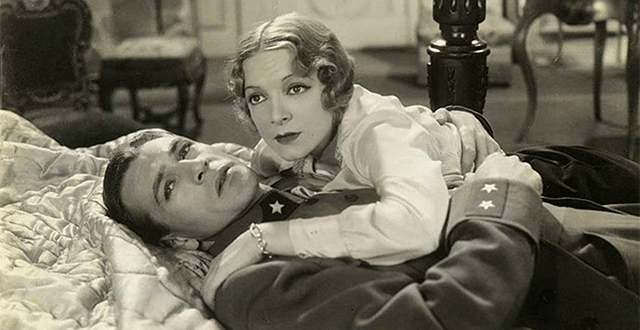
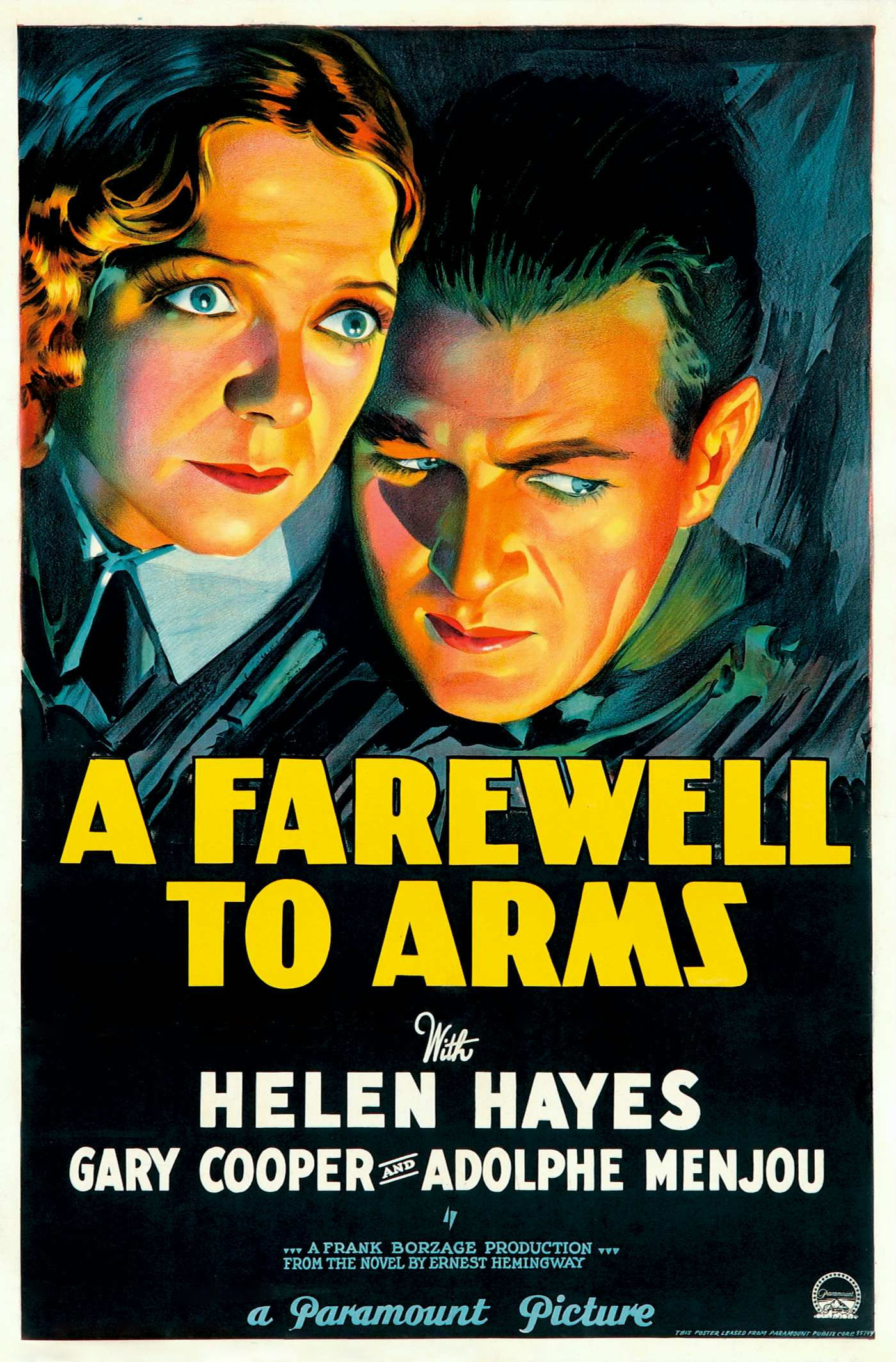
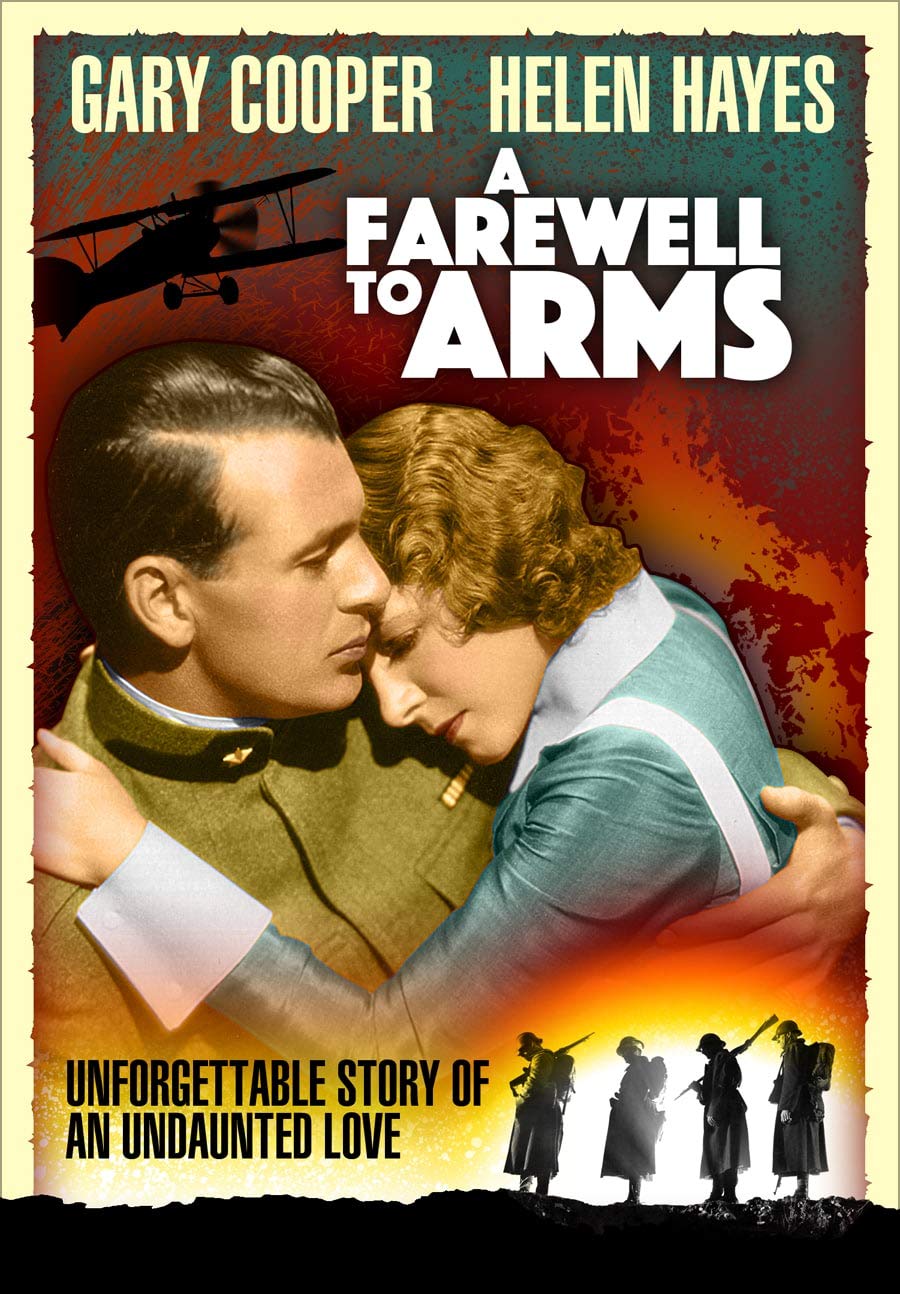
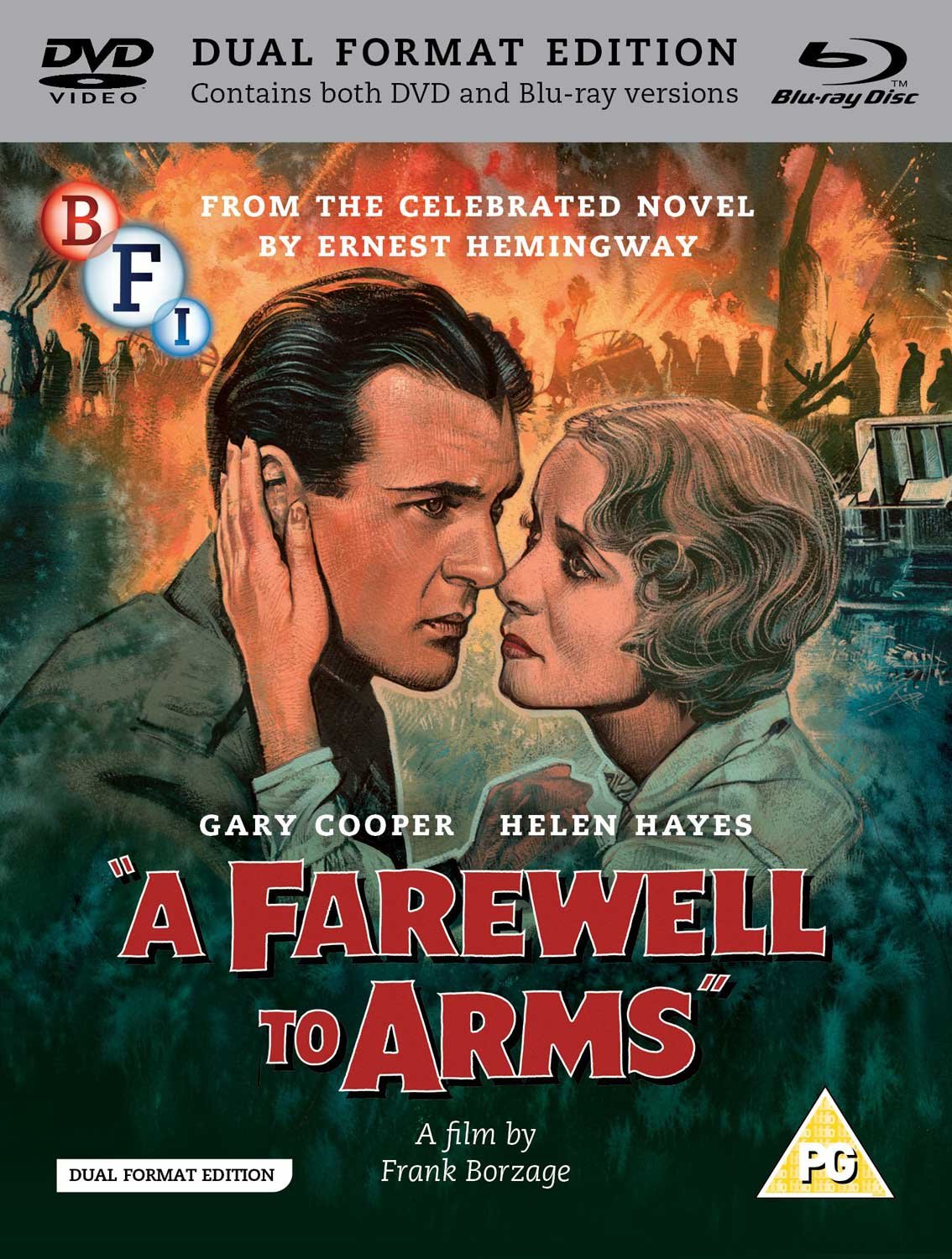
A Farewell to Arms is a 1932 American pre-Code romance drama film directed by Frank Borzage and starring Helen Hayes, Gary Cooper, and Adolphe Menjou.
Based on the 1929 semi-autobiographical novel A Farewell to Arms by Ernest Hemingway, with a screenplay by Oliver H.P. Garrett and Benjamin Glazer, the film is about a tragic romantic love affair between an American ambulance driver and an English nurse in Italy during World War I.
Outline
This is the plot of the original 1932 film, as aired on Turner Classic Movies. The film suffered from editing and censorship even at its initial release (refer to Ending section below).
On the Italian front during World War I, Lieutenant Frederic Henry (Gary Cooper), an American architect serving as an officer on an ambulance in the Italian Army, delivers some wounded soldiers to a hospital. While out carousing with his friend, Italian Captain Rinaldi (Adolphe Menjou), they are interrupted by a bombing raid. Frederic and English Red Cross nurse Catherine Barkley (Helen Hayes), who fled from the nurses’ dormitory in her nightclothes, take shelter in the same dark stairwell. The somewhat drunk Frederic makes a poor first impression.
Rinaldi persuades Frederic to go on a double date with him and two nurses, who turn out to be Catherine and her friend Helen Ferguson (Mary Philips), or “Fergie”. During a concert for officers and nurses, Frederic and Catherine walk into the garden, and Catherine reveals that she had been engaged for eight years to a soldier who was killed in battle. Away by themselves, he tries to kiss her and she slaps him, but after they talk more, she asks him to kiss her again. In the darkness, he romantically seduces her, over her resistance, and is taken aback and touched to discover she was a virgin. Frederic tells her he loves her.
In the morning, three ambulances, including Frederic’s, are leaving for what will be known as the Second Battle of the Piave River. Frederic finds Catherine and tells her that he will be away and that he wants her to know that what happened between them was important to him, and that he will survive the battle unscathed. Catherine gives him the St. Anthony medal she wears around her neck. Rinaldi observes all of this, and then enters a major’s office where it is revealed that Rinaldi had orchestrated the separation to prevent Frederic from being with Catherine. The head nurse then suggests sending Catherine back to base, but instead, the Major (Gilbert Emery) transfers Catherine to Milan.
At the front, Frederic is badly wounded in the legs and head when an artillery shell blows up his bunker. Frederic is sent to the hospital in Milan where he receives a chilly reception from Fergie while Catherine rushes to his bed to embrace him. Later that night, an Italian Army chaplain (Jack La Rue) known as “Padre” visits Frederic and sees that he and Catherine are lovers. He asks if they would marry if they could, and they answer “yes”. He then performs an unofficial wedding service for the couple.
Months later, Catherine and Frederic ask Fergie for their wedding, who rejects the offer saying they won’t marry due to the war. As she leaves, she warns Frederic that if he gets Catherine pregnant, she will kill him. Back at the hospital, Frederic is told his convalescent leave is cancelled. While waiting for his train, Catherine confides to Frederic that she is scared of each of them dying. He promises he will always come back, and they kiss before he leaves. Catherine then meets with Fergie and reveals to her that she is pregnant and is going to Switzerland to have the child.
While apart, Catherine writes letters to Frederic, never revealing her pregnancy. In Turin, Rinaldi tries to entice Frederic to have some fun, but Frederic is intent on writing to Catherine, who, unbeknownst to him, is having all his letters from Catherine censored by Rinaldi. Meanwhile, the hospital at Milan returns all of Frederic’s letters to him, marked “person unknown.” He tells the Padre that he is deserting and going to Milan to find Catherine.
Frederic makes it to Milan but finds only Fergie is there, who refuses to tell him anything except that Catherine was pregnant and is gone. Rinaldi meets Frederic at a hotel where Frederic reveals that Catherine is going to have a baby. Rinaldi, realising his mistakes, tells Frederic that she is in Brissago, Switzerland and helps Frederic get there, apologising for keeping the lovers apart.
Meanwhile, Catherine discovers that all of the letters to Frederic have been returned, marked “Return to Sender”. She goes into labour and is taken to the hospital where she endures prolonged and unproductive labour. As Frederic arrives, Catherine is wheeled into the operating room for a Caesarean section. After the operation, the surgeon tells Frederic that the baby, a boy, died in the womb long before Catherine came to the hospital.
When Catherine regains consciousness, she and Frederic exchange heartbreaking endearments and plan the future, until Catherine panics and begs Frederic to hold her tight because she is going to die and is afraid. He soothes her and tells her they can never really be parted. She tells him she is not afraid and dies in Frederic’s arms as the sun rises. Frederic picks up her body and turns slowly toward the window, sobbing “Peace, Peace.”
Ending
This is the film’s original ending when released to international audiences in 1932. Some prints for American audiences had a happy ending, where Catherine did not die, and some were ambiguous; some theatres were offered a choice. The censors were concerned about more than just the heroine’s death. Versions proliferated when a much more powerful Motion Picture Production Code got hold of the picture before various re-releases to film and television, not to mention the effects of a change of ownership to Warner Bros. and lapse into the public domain.
According to TCM.com: ” ‘A Farewell to Arms’ originally ran 89 minutes, and was later cut to 78 minutes for a 1938 re-issue. The 89-minute version (unseen since the original theatrical run in 1932 and long thought to be lost) was released on DVD in 1999 by Image Entertainment, mastered from a nitrate print located in the David O. Selznick vaults.”
Cast
- Helen Hayes as Catherine Barkley.
- Gary Cooper as Lieutenant Frederic Henry.
- Adolphe Menjou as Major Rinaldi.
- Mary Philips as Helen Ferguson.
- Jack La Rue as Priest.
- Blanche Friderici as Head Nurse.
- Mary Forbes as Miss Van Campen.
- Gilbert Emery as British Major.
- Agostino Borgato as Giulio (uncredited).
- Tom Ricketts as Count Greffi (uncredited).
Production
Music
The film’s sound track includes selections from the Liebestod from Wagner’s opera Tristan und Isolde, Wagner’s opera Siegfried, and the storm passage from Tchaikovsky’s symphonic poem Francesca da Rimini.
Release
Awards and Honours
The film won two Academy Awards and was nominated for another two:
- Academy Award for Best Picture (nominee).
- Academy Award for Art Direction (nominee).
- Academy Award for Best Cinematography (winner).
- Academy Award for Best Sound Recording – Franklin Hansen (winner).
- Also, the film is recognized by American Film Institute in these lists:
- 2002: AFI’s 100 Years…100 Passions – Nominated.
Trivia
- In 1960, the film entered the public domain in the United States because the last claimant, United Artists, did not renew its copyright registration in the 28th year after publication.
- Censorship problems arose from early versions of the script, which included phases of Catherine’s actual childbirth and references to labour pains, gas, her groaning and haemorrhaging.
- After these were removed, the MPPDA approved the script, and even issued a certificate for re-release in 1938 when the censorship rules were more strictly enforced.
- Still, the film was rejected in British Columbia and in Australia, where Hemingway’s book was also banned.
- Ernest Hemingway hated this interpretation of his novel, as he felt it was overly romantic.
- That did not stop him, however, from becoming lifelong friends with Gary Cooper, whom he met several years later.
- In fact, it was Hemingway who would insist that Cooper be cast in the lead of the adaptation of his novel For Whom the Bell Tolls (1943) 11 years later.
- However, the two made a point of never discussing this film.
- To the modern discerning eye, the use of miniatures is apparent in some scenes.
- If one looks very closely at the first scene, ambulance trucks driving up a winding mountain road will be noted to be well crafted miniatures.
- “The Screen Guild Theatre” broadcast a 30 minute radio adaptation of the movie on 10 April 1944 with Gary Cooper reprising his film role.
A Farewell to Arms Series
- Films:
- A Farewell to Arms (1932).
- A Farewell to Arms (1957).
- In Love and War (1996) (storyline precedes the book/films).
- TV Series:
- A Farewell to Arms (1966).
- Part 01: That Summer There Were Many Victories.
- Part 02: We Knew the Summer Was Gone.
- Part 03: Like Saying Goodbye to a Statue.
- A Farewell to Arms (1966).
Production & Filming Details
- Director(s):
- Frank Borzage.
- Producer(s):
- Edward A. Blatt … associate producer (uncredited).
- Frank Borzage … producer.
- Benjamin Glazer … associate producer (uncredited).
- Writer(s):
- Benjamin Glazer … (screenplay).
- Oliver H.P. Garrett … (screenplay).
- Ernest Hemingway … (novel).
- Laurence Stallings … (play) (uncredited).
- Music:
- Herman Hand … (uncredited).
- W. Franke Harling … (uncredited).
- Bernhard Kaun … (uncredited).
- John Leipold … (uncredited).
- Paul Marquardt … (uncredited).
- Ralph Rainger … (uncredited).
- Milan Roder … (uncredited).
- Cinematography:
- Charles Lang … (photographed by).
- Editor(s):
- Otho Lovering … (uncredited).
- George Nichols Jr. … (uncredited).
- Production:
- Paramount Pictures (presents) (as Paramount).
- Distributor(s):
- Paramount Pictures (1932) (USA) (theatrical) (as A Paramount Picture).
- Paramount Film Service (1933) (Canada) (theatrical).
- Paramount British Pictures (1933) (UK) (theatrical).
- Paramount Film Service (1933) (Australia) (theatrical).
- Inopia Films (1932) (Spain) (theatrical).
- Société Anonyme Française des Films Paramount (1933) (France) (theatrical).
- Film AB Paramount (1933) (Sweden) (theatrical).
- Paramount Films (1933) (Finland) (theatrical).
- Warner Bros. (1949) (USA) (theatrical) (re-release).
- Yleisradio (YLE) (1987) (Finland) (TV).
- Reel Media International (2005) (World-wide) (all media).
- Reel Media International (2007) (World-wide) (all media).
- New Star (2018) (Greece) (theatrical) (re-release).
- Théâtre du Temple (2018) (France) (theatrical) (re-release) (restored version).
- Penteo Films S.L. (2019) (World-wide) (all media) (restored HD).
- The Criterion Channel (2020) (USA) (TV) (digital).
- Research Entertainment (2002) (Spain) (video).
- Release Date: 08 December 1932 (US).
- Running Time: 80 minutes.
- Rating: PG.
- Country: US.
- Language: English.


 Military Gogglebox
Leave a comment