
Introduction
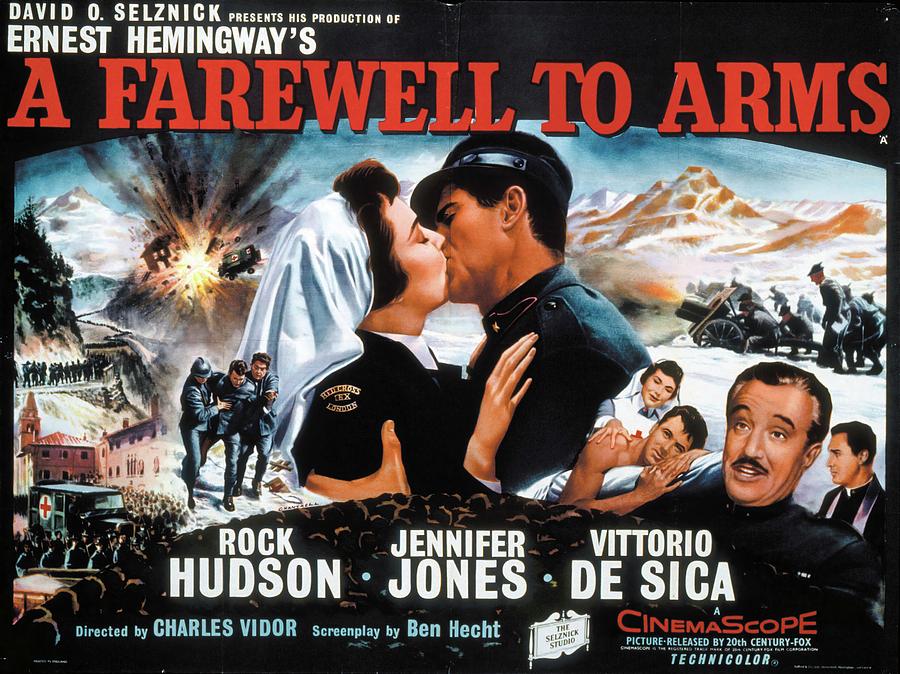
A Farewell to Arms is a 1957 American drama film directed by Charles Vidor.
The screenplay by Ben Hecht, based in part on a 1930 play by Laurence Stallings, was the second feature film adaptation of Ernest Hemingway’s 1929 semi-autobiographical novel of the same name. It was the last film produced by David O. Selznick.
Outline
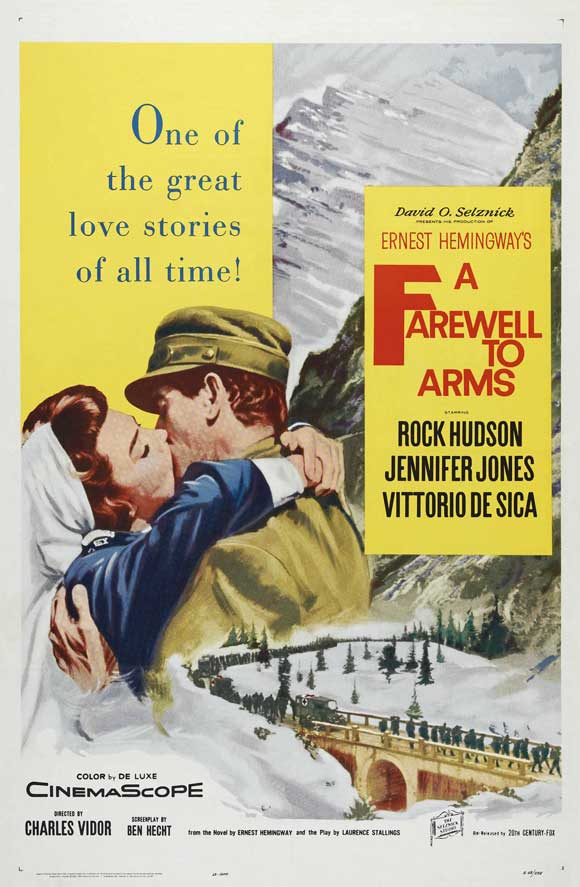
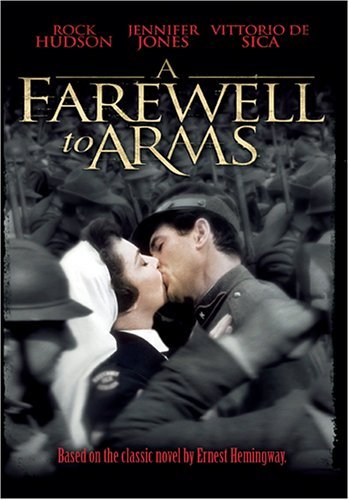
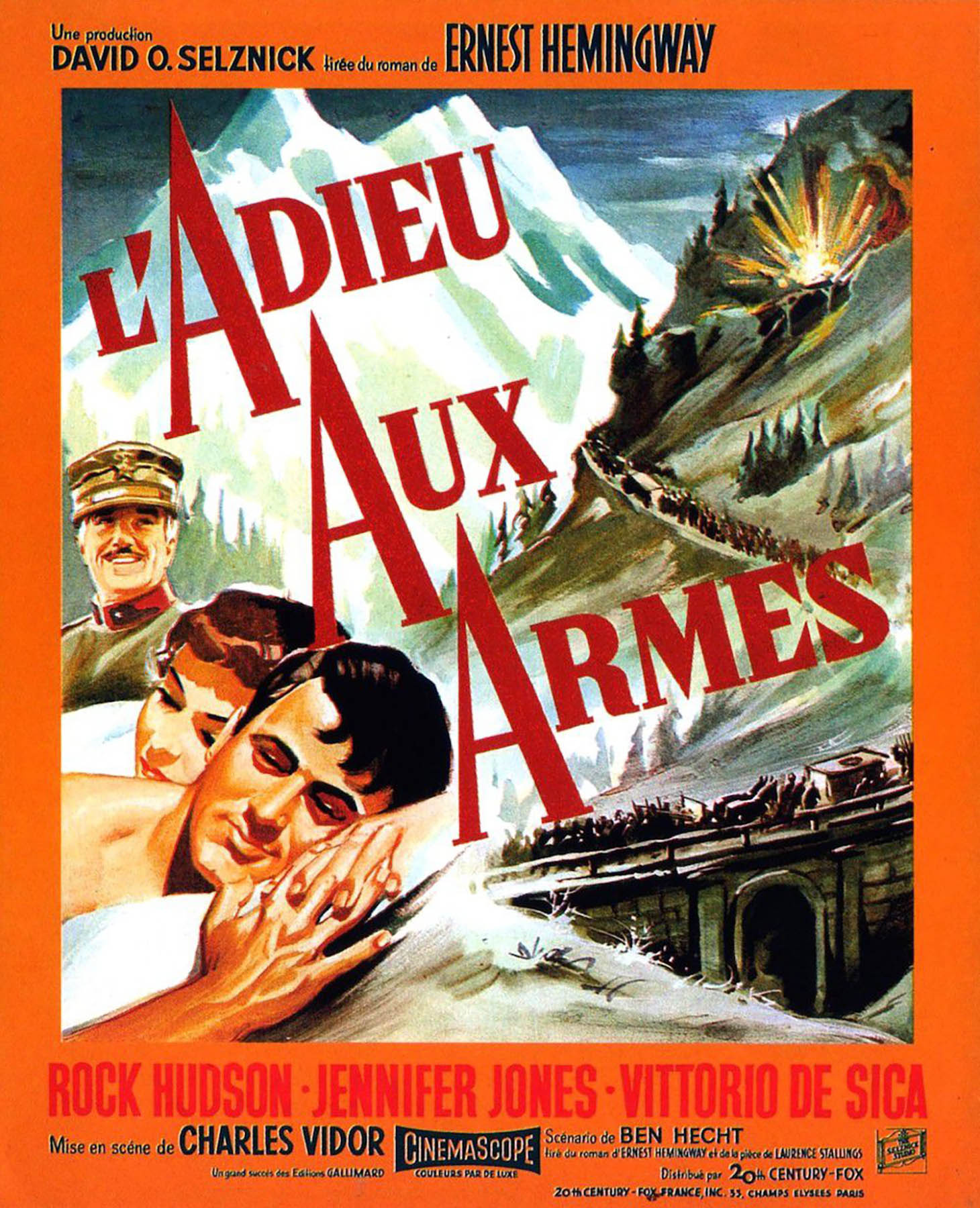
Frederick Henry (Rock Hudson) is an American officer serving in an ambulance unit for the Italian Army during World War I. While recovering from a wound in a British base hospital in northern Italy, he is cared for by Catherine Barkley (Jennifer Jones), a Queen Alexandra’s Royal Army Nursing Corps nurse he had met earlier, near the front, and they engage in an affair. Frederick’s friend, the doctor, convinces the army that Frederick’s knee is more severely wounded than it actually is and the two continue their romance but never get married.
Catherine discovers she is pregnant but after sneaking alcohol into the hospital for Frederick, the head nurse Miss Van Campen (Mercedes McCambridge) discovers the duplicity and separates them. She informs Frederick’s superiors that he has fully recovered from his wounds and is ready for active duty. During their separation, Catherine comes to believe Frederick has abandoned her.
Following the Battle of Caporetto, Frederick and his close friend Major Alessandro Rinaldi (Vittorio De Sica) are among the dispirited and retreating Italian army. Along the path or the retreat, several people die or are left behind due to exhaustion. Raving with illness, exhaustion and depression, Major Rinaldi professes defeatism with the pair arrested by the Carabinieri. A drumhead court-martial sentences Rinaldi to execution by firing squad that is immediately carried out. Enraged, Frederick knocks out the kerosene lamps and flees, jumping into the river.
Wanted by the Italian authorities, Frederick evades capture and meets up with Catherine. They flee Milan to hide out on a lake on the Italian-Swiss border (Lake Lugano or Lake Maggiore). Fearing arrest by the police, Catherine persuades Frederick to flee to Switzerland by rowboat; after some adventures, they land successfully in Switzerland. Claiming to be tourists trying to evade the war, the two are allowed to remain in neutral Switzerland. Catherine’s pregnancy progresses but due to the conditions around them, the pregnancy becomes complicated and Catherine is hospitalised. Their child is stillborn, and Catherine dies shortly afterward. Frederick leaves, shocked, and wanders the empty streets.
Cast
- Rock Hudson as Frederick Henry.
- Jennifer Jones as Catherine Barkley.
- Vittorio De Sica as Major Alessandro Rinaldi.
- Oskar Homolka as Dr. Emerich.
- Mercedes McCambridge as Miss Van Campen.
- Elaine Stritch as Helen Ferguson.
- Kurt Kasznar as Bonello.
- Victor Francen as Colonel Valentini.
- Franco Interlenghi as Aymo.
- Leopoldo Trieste as Passini.
- José Nieto as Major Stampi (as Jose Nieto).
- Georges Bréhat as Captain Bassi (as Georges Brehat).
- Johanna Hofer as Mrs. Zimmerman.
- Eduard Linkers as Lieutenant Zimmerman.
- Eva Kotthaus as Delivery Room Nurse.
- Alberto Sordi as Father Galli.
- Joan Shawlee as Blonde Nurse.
Production
For many years, David O. Selznick had wanted to film the Hemingway novel, but Warner Bros. owned the property and refused to sell it to him. He found himself in an advantageous bargaining position when Warner Bros. bought the remake rights to A Star is Born, to which he owned the foreign rights. Without them, the studio could not release their intended remake with Judy Garland overseas. Selznick offered to relinquish his rights to Star in exchange for the rights to Farewell, and Warner Bros. agreed. It was to be Selznick’s first film in four years.
On 25 October 1956, Selznick contacted director John Huston at the Blue Haven Hotel in Tobago and enthusiastically welcomed him to the project. He advised him his contract with 20th Century Fox called for severe financial penalties if the film went over schedule and/or budget, and urged him to concentrate wholly on the film until principal filming was completed. Selznick’s concerns increased as Huston began to tinker with the script and spend an inordinate amount of time on pre-production preparations, and on 19 March 1957, he sent the director a lengthy memo outlining the problems he foresaw arising from Huston’s lack of cooperation. Two days later, Huston announced he could not agree with Selznick on any of the issues he had raised and quit the project. Based on correspondence to Charles Vidor, it appears the producer’s relationship with Huston’s replacement was acrimonious as well. The producer later said the film was “not one of the jobs of which I am most proud.” During the course of production, Selznick sent over 10,000 memos.
The film was shot on location in the Italian Alps, Venzone in the Province of Udine in the region of Friuli-Venezia Giulia, Lazio, and Rome. It was budgeted at $4,100,000, $4.2 million or $4,353,000. Selznick’s wife Jennifer Jones was cast in the lead role.
According to Carlos Baker’s 1969 biography Ernest Hemingway: A Life Story, the Nobel Laureate was informed by Selznick that he would receive a $50,000 bonus from any profits the movie made. Unhappy at Selznick’s nepotistic decision to cast his nearly 40-year-old wife as a character intended to be in her early 20s, he wrote back “If, by some chance your movie, which features the 38-year-old Mrs. Selznick as 24-year-old Catherine Barkley, does succeed in earning $50,000, I suggest that you take all of that money down to the local bank, have it converted to nickels, and then shove them up your ass until they come out your mouth.”. A.E. Hotchner also refer this anecdote in his 2018 book Papa Hemingway: A Personal Memoir.
Release
The film had its premiere at Grauman’s Chinese Theatre in Los Angeles on 18 December 1957. It also opened at 7 other Los Angeles theatres and 44 theatres throughout California before expanding in 1958.
Box Office
The movie grossed $87,000 in its opening week in Los Angeles from 8 theatres. It earned an estimated $5 million in theatrical rentals in the United States and Canada and by the end of 1958 had made worldwide rentals of $6.9 million. Fox made some money on the movie but Selznick did not recover his costs.
Reception
Hemingway’s intuition proved correct as A Farewell To Arms opened to low box office receipts and harsh negative reviews after it premiered in 1957. The film would be forgotten by the moviegoing public as an epic in later years.
After this film, David O. Selznick left the movies completely, producing no other films.
Awards and Nominations
Vittorio De Sica was nominated for the Academy Award for Best Supporting Actor but lost to Red Buttons for Sayonara.
Trivia
- Rock Hudson turned down Sayonara (1957) and Ben-Hur (1959) in order to make this film.
- He later said this was the biggest mistake of his career.
- The film’s original director, John Huston, was fired after clashing with producer David O. Selznick.
- Cinematographer Oswald Morris quit after Selznick claimed Rock Hudson was being favoured over his wife, Jennifer Jones.
- Ernest Hemingway was not shy about expressing his dismay over producer David O. Selznick casting his 38-year old wife Jennifer Jones in the role of the 21-year-old nurse Catharine in the remake of his second novel, “A Farewell to Arms”.
- Selznick had earlier tried to generate publicity for the film by making a token payment to Hemingway for the novel, even though he was not required to do so as Hemingway had sold away the rights to his book a generation before.
- The gesture did not earn Hemingway’s goodwill.
- An amazing number of people left the film or were fired by Selznick: John Huston, the unit production manager, one cinematographer, three art directors, one visual effects supervisor and all of the staff working in the villa hired by David O. Selznick and Jennifer Jones in Rome.
A Farewell to Arms Series
- Films:
- A Farewell to Arms (1932).
- A Farewell to Arms (1957).
- In Love and War (1996) (storyline precedes the book/films).
- TV Series:
- A Farewell to Arms (1966).
- Part 01: That Summer There Were Many Victories.
- Part 02: We Knew the Summer Was Gone.
- Part 03: Like Saying Goodbye to a Statue.
- A Farewell to Arms (1966).
Production & Filming Details
- Director(s):
- Charles Vidor.
- John Huston … (uncredited).
- Producer(s):
- Arthur Fellows … associate producer (uncredited).
- David O. Selznick … executive producer (uncredited).
- Writer(s):
- Ben Hecht … (screenplay).
- Ernest Hemingway … (novel).
- Laurence Stallings … (play).
- Music:
- Mario Nascimbene.
- Cinematography:
- Oswald Morris … (photographed in cinemascope by).
- Piero Portalupi … (photographed in cinemascope by).
- James Wong Howe … (uncredited).
- Editor(s):
- John M. Foley.
- Gerard Wilson … (as Gerard J. Wilson).
- Production:
- Selznick International Pictures.
- Distributor(s):
- Twentieth Century Fox (1957) (USA) (theatrical).
- Twentieth Century Fox Film Company (1958) (UK) (theatrical).
- Twentieth Century Fox (1958) (France) (theatrical).
- Centfox (1958) (West Germany) (theatrical).
- Fox Film (1958) (Norway) (theatrical) (as Fox).
- Fox Film (1958) (Sweden) (theatrical).
- Fox Films (1958) (Finland) (theatrical).
- Fox Films (1958) (Argentina) (theatrical).
- American Broadcasting Company (ABC) (1965) (USA) (TV) (pan/scan).
- Magnetic Video (1977) (USA) (VHS).
- DomoVideo (1978) (Italy) (VHS) (for Magnetic Video).
- Nord Video (1981) (Norway) (VHS) (Beta) (Video 2000).
- CBS Electronics (1985) (Greece) (VHS).
- CBS/Fox (1985) (USA) (VHS).
- CBS/Fox (1987) (USA) (VHS).
- CBS/Fox (1990) (USA) (VHS).
- Fox Video (1991) (USA) (VHS).
- Fox Video (1994) (USA) (VHS).
- 20th Century Fox Home Entertainment (1995) (USA) (VHS).
- Fox Video (1995) (USA) (VHS).
- 20th Century Fox Home Entertainment (1998) (USA) (VHS).
- 20th Century Fox Home Entertainment (1999) (USA) (DVD).
- 20th Century Fox Home Entertainment (1999) (USA) (VHS).
- 20th Century Fox Home Entertainment (2004) (USA) (DVD).
- 20th Century Fox Home Entertainment (2005) (Germany) (DVD).
- 20th Century Fox Home Entertainment (2005) (Italy) (DVD).
- 20th Century Fox Home Entertainment (2005) (USA) (DVD).
- France Video Distribution (Fravidis) (2005) (France) (DVD).
- 20th Century Fox Home Entertainment (2006) (Germany) (DVD).
- SF Norge A/S (2006) (Norway) (DVD).
- 20th Century Fox Home Entertainment (2007) (USA) (DVD).
- 20th Century Fox Home Entertainment (2010) (Canada) (DVD) (4 film collection).
- 20th Century Fox Home Entertainment (2010) (USA) (DVD) (4 film collection).
- 20th Century Fox Home Entertainment (2012) (USA) (Blu-ray) (DVD).
- Ascot Elite Home Entertainment (2013) (Germany) (DVD).
- Ascot Elite Home Entertainment (2013) (Germany) (Blu-ray) (DVD).
- Kino Lorber (2017) (USA) (Blu-ray) (DVD).
- CBS/Fox Home Video (1984) (Australia) (video).
- FS Film (Finland) (DVD).
- Lineafilm (Italy) (video).
- Release Date: 14 December 1957 (Romania & US).
- Running Time: 152 minutes.
- Rating: A.
- Country: US.
- Language: English.


 Military Gogglebox
Leave a comment