
Introduction
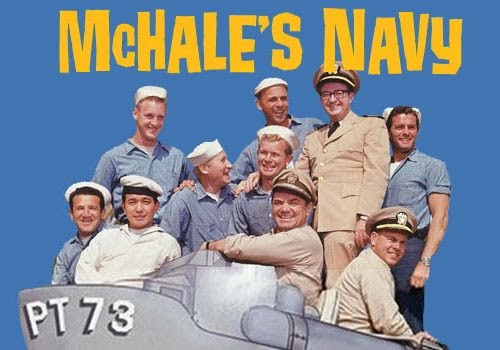
McHale’s Navy is an American sitcom starring Ernest Borgnine that aired 138 half-hour episodes over four seasons, from 11 October 1962 to 12 April 1966 on the ABC television network.
The series was filmed in black and white and originated from a one-hour drama titled “Seven Against the Sea”, broadcast on 03 April 1962. The ABC series spawned three feature films: McHale’s Navy (1964); a sequel, McHale’s Navy Joins the Air Force (1965); and a 1997 sequel-remake of the original series. A documentary, McHale’s Navy: The Crew Remembers, was aired in 2007.
Producer Edward Montagne set up a female version of McHale’s Navy entitled Broadside, which ran for 32 episodes in the 1964-1965 ABC season.

Background
Seven Against the Sea (1962)
Academy Award-winning dramatic actor Ernest Borgnine first appeared as Quinton McHale in an hour-long one-shot drama called “Seven Against the Sea“, which aired as an episode of Alcoa Premiere on 03 April 1962, an ABC dramatic anthology also known as Fred Astaire’s Premiere Theatre and hosted by Fred Astaire, who introduced television audiences to the Quinton McHale character. It is considered the pilot show for the series although it is an hour-long drama instead of a half-hour situation comedy and is starkly different in tone.
TV Show (1962-1965)
This military service comedy series was set in the Pacific theatre of World War II – for the last season, the setting changed to the European theatre in Italy – and focused on antics of the misfit crew of PT-73 led by Lieutenant Commander Quinton McHale, played by Borgnine. The producer, Edward Montagne, had enjoyed success with The Phil Silvers Show (1955-1959), a military comedy about an opportunistic non-commissioned officer (NCO) and his loyal platoon putting loony things over on the camp commander. While the pilot had been dramatic, with overtones of Henry Fonda’s introspective Mister Roberts, Montagne turned the “McHale” project into “Bilko in the Navy” and recruited Sergeant Bilko actors and writers. However, unlike The Phil Silvers Show, which was set in peacetime, McHale’s Navy was set during World War II, although much of what takes place is, in some ways, as if it were peacetime with the crew permanently stationed in one location and concerns about peacetime duties rather than fighting a war. At the time of the series, then-President John F. Kennedy was known as the wartime commander of PT-109. A popular book, PT 109: John F. Kennedy in WWII by Robert J. Donovan came out the previous year and PT-109 was referenced in the episode “Jolly Wally.”
The Real Life PT-73
The real-life PT-73 was finished on 12 August 1942 by Higgins Industries, Iinc., New Orleans. It was 78 feet (24 m) long, weighed 56 tons and had a top speed of 40 knots. It was assigned to Motor Torpedo Boat Squadron 13 under the command of Commander James B. Denny, USN. The squadron participated in the Aleutian Islands Campaign from March 1943 to May 1944. The squadron was then transferred to the Southwest Pacific, where the squadron saw action at Mios Woendi, Dutch New Guinea; Mindoro, Philippine Islands; and Brunei Bay, Borneo. The squadron was also based for a time at Dreger Harbour, New Guinea and San Pedro Bay, Philippine Islands, but saw no action from these bases. Overall, the real PT-73 did not have the kind of illustrious combat record depicted in the series. On 15 January 1945, it ran aground off Lubang Island in the Philippine Islands after delivering supplies to Filipino guerrillas and was destroyed by the crew to prevent it from falling into enemy hands.
Outline
The basic plot is that McHale’s crew schemes to make money, get girls and enjoy themselves, and the efforts of Captain Binghamton (McHale’s superior) to rid himself of the PT-73 crew for good, either by transfer or court martial. Although they often get into trouble, they typically manage to get out of it. Despite their scheming, conniving, and often lazy and unmilitary ways, McHale’s crew is always successful in combat in the end. This bears close resemblance to the British radio programme The Navy Lark, broadcast around the same period. The entire show is based on only two locations, one in the South Pacific at a fictional base called Taratupa – the inferred location (first episode) is islands north of New Zealand – and an equally fictional town in Italy called Voltafiore. The first few episodes merely indicate it is “somewhere in the South Pacific 1943.” While in the South Pacific, McHale’s crew lives on “McHale’s Island,” across the bay from Taratupa. It keeps them away from the main base, where they are free to carry out their antics and even fight the war. In the final season, Binghamton and the entire PT-73 crew move to the liberated Italian theatre to the town of Voltafiore “in Southern Italy” “in late 1944.”
Cast
- Ernest Borgnine as Lieutenant Commander Quinton McHale.
- Tim Conway as Ensign Charles Parker.
- Joe Flynn as Captain Wallace Burton Binghamton (“Old Leadbottom”).
- Bob Hastings as Lieutenant Elroy Carpenter.
- Gary Vinson as George “Christy” Christopher, quartermaster.
- Bobby Wright as Willy Moss, radioman.
- Carl Ballantine as Lester Gruber, torpedoman’s mate.
- Billy Sands as Harrison “Tinker” Bell, engineman and motor machinist mate.
- Edson Stroll as Virgil Edwards, gunner’s mate.
- Gavin MacLeod as Joseph “Happy” Haines, seaman (1962-1964).
- Yoshio Yoda as Fuji Kobiaji, cook, seaman 3rd class, Japanese POW; in season 2, episode 13 (“A Letter for Fuji”), he is given the name Fujiwara Takeo.
Production
The Pacific Ocean naval base stood on the back lot of Universal Studios. For years after the show went off the air, the sets were an attraction on the studio tour. The portion of the Universal Studios tour involving Bruce the Shark attacking the tourist tram takes place on McHale’s Lagoon, according to the tour guides. Three PT-73 boats were used in the show. One was for shots at sea and two were converted 63-ft World War II Army Air Force Sea Rescue boats based at Universal Studios, which were reconfigured above-deck to resemble the vessel used in filming the PT-73 underway; a 71-foot type II Vosper MTB (motor torpedo boat), a British design built in the U.S. for export to the Soviet Union. The war ended in August 1945 before the boat, hull number PT-694, was sent to the Soviet Union. The boat was purchased by Howard Hughes for a chase boat for the only flight of his Spruce Goose aircraft. The boat was sold to the studio – as there were few PT boats in existence, almost all having been sold, stripped, or destroyed after the war by various governments – where significant liberties were taken reconfiguring the Vosper 694 and the two Sea Rescue boats to resemble a World War II-era PT boat.
- The Vosper’s charthouse and bridge configuration were kept.
- Gun turrets were added to both sides of the charthouse about where they would have been on a stock Vosper 71-ft, but this was not the configuration of the Elco 80s, but mimicked the Higgins 78′ PT-71 Class boats.
- On McHale’s boat, each gun turret mounted a single .50 cal M2 heavy machine gun on an external, tubular steel spindle fed from a 100-round ammunition box, whereas the real boats used two aircraft M2 heavy machine guns in Mk-17 gun mount / Mk-9 gun carriage combinations that rotated within the body of the turret and had integral ammunition magazines and feed systems holding 250 rounds in disintegrating belts for each gun.
- The turrets in the show also did away with the wrap-around safety cages that kept the .50 cal gunners from accidentally firing into the boat during the heat of combat.
- A single M2, .50 cal mounted on a M4-style pipe stand tended to appear, disappear, and move around from scene to scene on the forward deck. Normally, the forward gun would have been an either an M2 .50 cal. heavy machine gun or Oerlikon 20-mm antiaircraft cannon on a pedestal to the right of centreline, back nearer the charthouse and possibly a 37-mm Browning aircraft cannon or a 37-mm M3 Army antitank gun strapped or bolted to the deck forward (as had been thought the case for the PT-109).
- A pseudo-“radar” unit and mast was added aft of midhull, where normally an Mk-4 Oerlikon 20-mm single antiaircraft cannon was mounted. The mast on the -73’s command-bridge was also incorrect.
- The 40-mm Bofors cannon or pedestal-mounted Oerlikon 20-mm antiaircraft cannon usually found on the aft deck was done away with completely, as was one of the engine compartment ventilator housings and the M2 smoke screen generator.
- Two mock-ups of US Navy 21″ MK-18, swing-out, torpedo tubes (as carried on the early war 80-ft Elco boats like the PT-109) replacing the MK-7/8 tubes normally carried by the Vosper 71-ft.
- The gunwale side cut-outs normally seen on the Vosper, were built-up forward of the cabin, creating a flush forward deck. Normally, the Vosper required forward clearance in front of the Mk 7/8 tubes when torpedoes were fired over the gunwale.
Shots of the crew aboard the PT-73 were usually staged on a full-scale mock-up of the bridge and gun tubs in front of a front projection screen at Universal. PT-73’s final appearance (one of the two converted 63-ft boats) was in the 1970s show Emergency! (“Quicker Than the Eye”, season 4, episode 8, aired: 11/9 1974). Station 51 was dispatched to a movie studio to rescue a man trapped beneath a boat. The boat in question was being moved from one end of the studio to another by truck, and wooden supports holding it had broken and trapped a man underneath. “PT-73” is visible on the bow, appearing as if the numbers had been removed, but an image of them remained. The boat was missing the pilot house, masts, and depth charges. No record of the final fate of this boat, or the other converted 63-ft boat has been found. The sea-going (ex-Howard Hughes PT-694 boat) PT-73 was sold to the mayor of Hawthorne, California, Hal Crozer, and converted to a sport-fishing boat. In 1992, the boat was destroyed when it broke from its mooring near Santa Barbara and washed up on the beach during a storm.
Release
Films
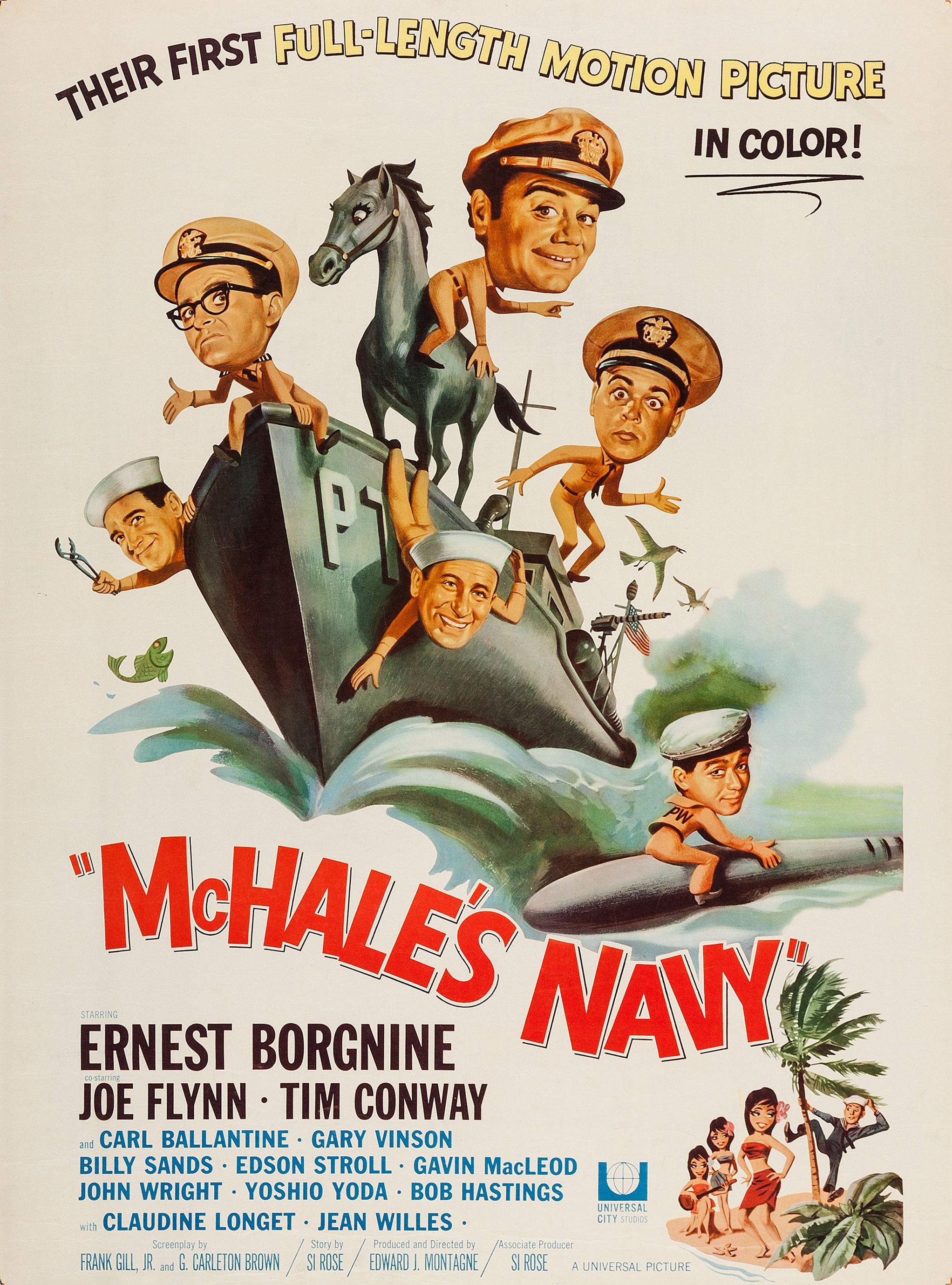
Two feature film spin-offs were based on the series: McHale’s Navy (1964) and McHale’s Navy Joins the Air Force (1965).
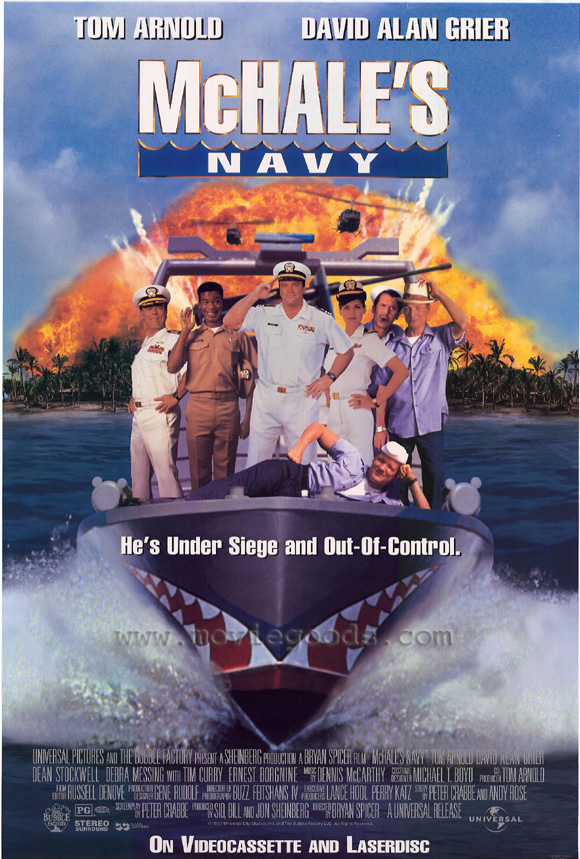
The cast appeared in both films, with the exception of Borgnine and Ballantine in the latter film; Borgnine was not available due to schedule conflicts with the filming of The Flight of the Phoenix; why Ballantine was absent is not known. To beef up the crew, MacLeod, who left the series, returned for this appearance. In a Cinema Retro interview, Borgnine said Montagne wanted to make the film cheaply, without him and would not show him the script. Both films were produced without laugh tracks. The sea-going PT-73 was extensively filmed running between San Pedro and Catalina Island’s Avalon harbour, which stood in for the fictional town where the show was set. While both did well at the box office, the latter film was not as successful and was derided by critics as being too excessive in its use of slapstick comedy, though others praised it for satirising of military incompetence (after a typical screw-up, the Japanese POW Fuji sighs, “Beats me how they beating us.”). William Lederer, who co-authored the second film with John Fenton Murray, used scenes lifted directly from his comic novel, All the Ships at Sea. Unlike the television series, both movies were filmed in Technicolor. McHale’s Navy (1964) earned an estimated $2,250,000 in North American rentals. McHale’s Navy Joins the Air Force took in $1,500,000. In 1997, a sequel was released, starring Tom Arnold as McHale’s US Naval Academy graduate son, which showed the PT-73 and its crew operating in a modern, post-World War II setting in the Caribbean. Borgnine has a cameo appearance as the senior McHale, commanding rear admiral of what appears to be the United States Naval Special Warfare Command and going by the code name “Cobra.”
Documentary
A documentary, McHale’s Navy: The Crew Remembers, was aired in 2007.
The crew of PT 73 reunited after forty years and shared their memories of making the ABC television series “McHale’s Navy” from 1962 to 1966.
Home Media
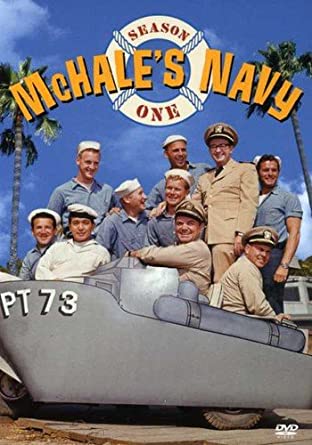
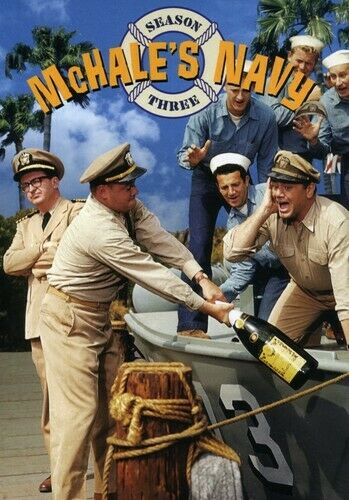
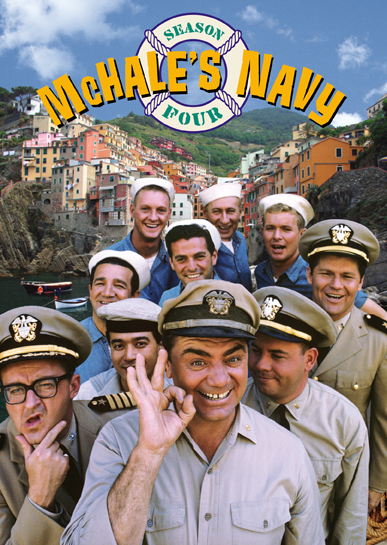
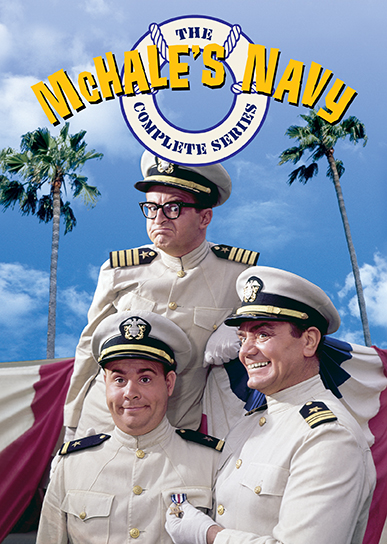
Shout! Factory has released all four seasons of McHale’s Navy on DVD in Region 1. On 17 November 2015, Shout! released McHale’s Navy- The Complete Series on DVD in Region 1. The 21-disc set contained all 138 episodes and both theatrical films in special collectible packaging. In Australia, Madman Entertainment has released all four seasons on DVD. Madman had released the first three seasons in Australia on 03 August 2009, in Slimline packaging, replacing the original releases, which were box sets. In June 2011, a Slimline-packaged set of season 4 was seen in Big W stores in Australia in Region 4, however, no details indicate the item being available elsewhere. All full episodes are now available on YouTube.
Spinoff
Producer Edward Montagne set up a female version of McHale’s Navy entitled Broadside, which ran for 32 episodes in the 1964-1965 ABC season. In place of the PT crew were a group of WAVES led by Anne Morgan (Kathleen Nolan) consisting of Joan Staley, Sheila James, Lois Roberts and Jimmy Boyd (as a male with a female name), up against Binghamton-type Captain Edward Andrews and his Lieutenant Carpenter clone George Furth, who guest-starred in an episode of McHale’s Navy entitled “Dart Gun Wedding.” Dick Sargent provided a love interest for Nolan. Although not an actual spinoff, Conway and Flynn teamed up playing characters with similar personalities in The Tim Conway Show, which lasted only 12 episodes in 1970.
McHale’s Navy Series
- Pilot (1962):
- Series 01 (1962-1963):
- Episode 01: An Ensign for McHale.
- Episode 02: A Purple Heart for Gruber.
- Episode 03: McHale and His Seven Cupids.
- Episode 04: PT 73, Where Are You?.
- Episode 05: Movies Are Your Best Diversion.
- Episode 06: Operation Wedding Party.
- Episode 07: Who Do the Voodoo?.
- Episode 08: Three Girls on an Island.
- Episode 09: McHale’s Paradise Motel.
- Episode 10: The Battle of McHale’s Island.
- Episode 11: The Day They Captured Santa Claus.
- Episode 12: Beauty and the Beast.
- Episode 13: The Captain’s Mission.
- Episode 14: Send Us a Hero.
- Episode 15: The Captain Steals a Cook.
- Episode 16: The Ensign Gets a Zero.
- Episode 17: The Big Raffle.
- Episode 18: One of Our Engines Is Missing.
- Episode 19: The Natives Get Restless.
- Episode 20: The Confidence Game.
- Episode 21: Six Pounds from Paradise.
- Episode 22: Washing Machine Charlie.
- Episode 23: Nippon Nancy Calling.
- Episode 24: One Enchanted Weekend.
- Episode 25: The Mothers of PT 73.
- Episode 26: HMS 73.
- Episode 27: A Wreath for McHale.
- Episode 28: Portrait of a Peerless Leader.
- Episode 29: Instant Democracy.
- Episode 30: Camera, Action, Panic.
- Episode 31: Alias Captain Binghamton.
- Episode 32: Parents Anonymous.
- Episode 33: McHale’s Millions.
- Episode 34: The Hillbillies of PT 73.
- Episode 35: The Monster of McHale’s Island.
- Episode 36: Uncle Admiral.
- Series 02 (1963-1964):
- Episode 01: The Day the War Stood Still.
- Episode 02: The Binghamton Murder Plot.
- Episode 03: McHale and His Schwienhunds.
- Episode 04: Is There a Doctor in the Hut?.
- Episode 05: To Binghamton with Love.
- Episode 06: Have Kimono, Will Travel.
- Episode 07: Today I Am a Man!.
- Episode 08: Jolly Wally.
- Episode 09: Scuttlebutt.
- Episode 10: The August Teahouse of Quint McHale.
- Episode 11: French Leave for McHale.
- Episode 12: The Happy Sleepwalker.
- Episode 13: A Letter for Fuji.
- Episode 14: My Ensign, the Lawyer.
- Episode 15: Orange Blossoms for McHale.
- Episode 16: The Creature from McHale’s Lagoon.
- Episode 17: A Medal for Parker.
- Episode 18: The Balloon Goes Up.
- Episode 19: Who’ll Buy My Sarongs?.
- Episode 20: Evil-Eye Parker.
- Episode 21: The Great Impersonation.
- Episode 22: Urulu’s Paradise West.
- Episode 23: Dear Diary.
- Episode 24: Babette Go Home.
- Episode 25: The Novocain Mutiny.
- Episode 26: Stars Over Taratupa.
- Episode 27: Comrades of PT 73.
- Episode 28: The Return of Big Frenchy.
- Episode 29: Alias PT 73.
- Episode 30: The Rage of Taratupa.
- Episode 31: Ensign Parker, E.S.P..
- Episode 32: The McHale Mob.
- Episode 33: Carpenter in Command.
- Episode 34: Marryin’ Chuck.
- Episode 35: The Dart Gun Wedding.
- Episode 36: A Da-Da for Christy.
- Series 03 (1964-1965):
- Episode 01: The Ghosts of 73.
- Episode 02: Lester, the Skipper.
- Episode 03: It’s a Mad, Mad, Mad War.
- Episode 04: McHale, the Desk Commando.
- Episode 05: McHale’s Floating Harem.
- Episode 06: Laugh, Captain, Laugh.
- Episode 07: Will the Alligator Take the Stand?.
- Episode 08: The British Also Have Ensigns.
- Episode 09: Senator Parker, Suh!.
- Episode 10: Fountain of Youth.
- Episode 11: The Great Eclipse.
- Episode 12: McHale and His Jet Set.
- Episode 13: Christy Goes Travelling.
- Episode 14: The Missing Link.
- Episode 15: Fuji’s Big Romance.
- Episode 16: The Stool Parrot.
- Episode 17: The PT 73 Follies.
- Episode 18: The Truth Hurts.
- Episode 19: The Late Captain Binghamton.
- Episode 20: McHale’s Floating Laundromat.
- Episode 21: All Chiefs and No Indians.
- Episode 22: Pumpkin Takes Over.
- Episode 23: The Seven Faces of Ensign Parker.
- Episode 24: The Return of Maggie.
- Episode 25: Send This Ensign to Camp.
- Episode 26: By the Numbers, Paint.
- Episode 27: Chuckie Cottontail.
- Episode 28: The Great Necklace Caper.
- Episode 29: Will the Real Admiral Please Stand Up?.
- Episode 30: Hello, McHale? Colonna!.
- Episode 31: Rumble on Taratupa.
- Episode 32: All Ahead, Empty.
- Episode 33: The Vampire of Taratupa.
- Episode 34: Birth of a Salesman.
- Episode 35: A Star Falls on Taratupa.
- Episode 36: Make Room for Orvie.
- Series 04 (1965-1966):
- Episode 01: War, Italian Style.
- Episode 02: The Bathtub Thief.
- Episode 03: Marriage, McHale Style.
- Episode 04: Giuseppe McHale.
- Episode 05: A Nip in Time.
- Episode 06: Piazza Binghamtoni.
- Episode 07: The Bald-Headed Contessa.
- Episode 08: Voltafiore Fish-Fry.
- Episode 09: A Wine Cellar Is Not a Home.
- Episode 10: Vino, Vino, Who’s Got the Vino?.
- Episode 11: The McHale Opera Company.
- Episode 12: The Good Luck Fountain.
- Episode 13: Blitzkrieg at McHale’s Beach.
- Episode 14: Reunion for PT 73.
- Episode 15: The Return of Giuseppe.
- Episode 16: The Boy Scouts of 73.
- Episode 17: Fire in the Liquor Locker.
- Episode 18: The Fugitive Ensign.
- Episode 19: The Wacky WAC.
- Episode 20: La Dolce 73.
- Episode 21: McHale’s Country Club Caper.
- Episode 22: Secret Chimp 007.
- Episode 23: 36-24-73.
- Episode 24: My Son, the Skipper.
- Episode 25: Little Red Riding Doctor.
- Episode 26: Who Was That German I Saw You With?.
- Episode 27: The McHale Grand Prix.
- Episode 28: An Ensign’s Best Friend.
- Episode 29: Binghamton, at 20 Paces.
- Episode 30: Wally for Congress.
- Films:
- McHale’s Navy (1964), a sequel.
- McHale’s Navy Joins the Air Force (1965).
- McHale’s Navy (1997), sequel-remake of the original series.
- Documentary:
Production & Filming Details
- Director(s):
- Sidney Lanfield … (54 episodes, 1962-1964).
- Hollingsworth Morse … (46 episodes, 1964-1966).
- Charles Barton … (9 episodes, 1964-1965).
- Edward Montagne … (8 episodes, 1962-1963).
- Earl Bellamy … (6 episodes, 1964-1965).
- Oscar Rudolph … (5 episodes, 1963).
- Sidney Miller … (3 episodes, 1965).
- Jean Yarbrough … (3 episodes, 1965).
- Norman Abbott … (2 episodes, 1963-1964).
- Frank McDonald … (2 episodes, 1964).
- Producer(s):
- Edward Montagne … producer / executive producer (138 episodes, 1962-1966).
- Si Rose … producer / associate producer (102 episodes, 1963-1966).
- Writer(s):
- Danny Arnold … (written by) (2 episodes, 1962-1963).
- Barry E. Blitzer … (written by) (8 episodes, 1964-1965).
- Ray Brenner … (written by) (6 episodes, 1964-1965).
- George Carleton Brown … (written by) (11 episodes, 1963-1965).
- Tim Conway … (story) (1 episode, 1963).
- Gene L. Coon … (written by) (2 episodes, 1962).
- Jerry Davis … (written by) (1 episode, 1963).
- Sam Denoff … (written by) (1 episode, 1963).
- Stan Dreben … (written by) (12 episodes, 1963-1965).
- Fred F. Finklehoffe … (written by) (1 episode, 1962).
- Bob Fisher … (written by) (3 episodes, 1963-1964).
- Mickey Freeman … (written by) (1 episode, 1966).
- Henry Garson … (written by) (2 episodes, 1965).
- Frank Gill Jr. … (written by) (11 episodes, 1963-1965).
- Ralph Goodman … (written by) (18 episodes, 1963-1966).
- Ralph Goodman … (teleplay) (18 episodes, 1963-1966).
- Joseph Heller … (written by) (1 episode, 1962).
- Robert Hilliard … (written by) (1 episode, 1966).
- Arnold Horwitt … (written by) (3 episodes, 1963-1964).
- Bruce Howard … (written by) (6 episodes, 1965-1966).
- Scott Hunt … (story) (1 episode, 1965).
- William C. Jackson … (story) (1 episode, 1965).
- Robert Kaufman … (story) (1 episode, 1963).
- Beth Keele … (story) (1 episode, 1965).
- Walter Kempley … (teleplay) (2 episodes, 1962-1963).
- Walter Kempley … (written by) (2 episodes, 1962-1963).
- Howard Leeds … (written by) (1 episode, 1963).
- Albert E. Lewin … (written by) (1 episode, 1964).
- Sam Locke … (written by) (14 episodes, 1964-1966).
- Sam Locke … (teleplay) (14 episodes, 1964-1966).
- Allan Manings … (written by) (4 episodes, 1965).
- Allan Manings … (teleplay) (4 episodes, 1965).
- Bob Marcus … (written by) (1 episode, 1963).
- Larry Markes … (written by) (5 episodes, 1962-1963).
- Arthur Marx … (written by) (3 episodes, 1963-1964).
- Jerry Mayer … (story) (1 episode, 1966).
- Michael Morris … (written by) (5 episodes, 1962-1963).
- John Fenton Murray … (written by) (8 episodes, 1964-1966).
- Bill Persky … (written by) (1 episode, 1963).
- Brad Radnitz … (written by) (2 episodes, 1966).
- Joel Rapp … (written by) (14 episodes, 1964-1966).
- Joel Rapp … (teleplay) (14 episodes, 1964-1966).
- William Raynor … (written by) (28 episodes, 1963-1966).
- William Raynor … (story) (28 episodes, 1963-1966).
- William Raynor … (teleplay) (28 episodes, 1963-1966).
- Si Rose … (story) (5 episodes, 1962-1964).
- Si Rose … (written by) (5 episodes, 1962-1964).
- Martin Roth … (written by) (11 episodes, 1962-1964).
- Martin Roth … (story) (11 episodes, 1962-1964).
- Martin Roth … (teleplay) (11 episodes, 1962-1964).
- Elroy Schwartz … (written by) (3 episodes, 1965-1966).
- Henry Sharp … (story) (1 episode, 1964).
- Danny Simon … (written by) (2 episodes, 1963).
- Bill Stowell … (story) (1 episode, 1965).
- Burt Styler … (written by) (1 episode, 1964).
- Gary Vinson … (story) (1 episode, 1963).
- Frank Waldman … (written by) (3 episodes, 1963-1965).
- Tom Waldman … (written by) (3 episodes, 1963-1965).
- Hugh Wedlock Jr. … (written by) (2 episodes, 1965).
- Andy White … (written by) (1 episode, 1964).
- Myles Wilder … (written by) (28 episodes, 1963-1966).
- Myles Wilder … (story) (28 episodes, 1963-1966).
- Myles Wilder … (teleplay) (28 episodes, 1963-1966).
- John Wright … (story) (1 episode, 1965).
- Music:
- Axel Stordahl … (42 episodes, 1962-1963).
- Frank Comstock … (35 episodes, 1964-1965).
- Jack Elliott … (29 episodes, 1965-1966).
- Cyril J. Mockridge … (5 episodes, 1963).
- Herbert W. Spencer … (1 episode, 1965).
- Cinematography:
- Ray Flin … (26 episodes, 1962-1965).
- Lionel Lindon … (14 episodes, 1963-1965).
- Bud Thackery … (12 episodes, 1962-1966).
- William Margulies … (11 episodes, 1962-1966).
- John L. Russell … (11 episodes, 1962-1965).
- Benjamin H. Kline … (9 episodes, 1962-1965).
- John F. Warren … (9 episodes, 1963).
- Jacques R. Marquette … (8 episodes, 1963-1964).
- Walter Strenge … (8 episodes, 1965-1966).
- Ray Rennahan … (6 episodes, 1963-1965).
- Richard L. Rawlings … (4 episodes, 1962-1964).
- Robert Tobey … (3 episodes, 1963-1964).
- Ray Fernstrom … (3 episodes, 1964-1965).
- Nicholas Musuraca … (3 episodes, 1965-1966).
- Fred Mandl … (2 episodes, 1962).
- Irving Lippman … (2 episodes, 1963-1966).
- Vaughn Wilkins … (2 episodes, 1966).
- Neal Beckner … (1 episode, 1963).
- Robert G. Hager … (1 episode, 1963).
- Robert Wyckoff … (1 episode, 1964).
- Monroe P. Askins … (1 episode, 1965).
- Richard A. Kelley … (1 episode, 1966).
- Editor(s):
- Sam E. Waxman … (123 episodes, 1962-1966).
- Edwin H. Bryant … (5 episodes, 1965).
- Richard G. Wray … (4 episodes, 1965).
- Danford B. Greene … (2 episodes, 1964).
- Robert Seiter … (2 episodes, 1964).
- Bud S. Isaacs … (1 episode, 1964).
- Milton Shifman … (1 episode, 1964).
- Production:
- Sto-Rev-Co Productions.
- Distributor(s):
- American Broadcasting Company (ABC) (1962) (USA) (TV).
- MCA/Universal Pictures (1962) (USA) (TV).
- MCA Television (1989) (USA) (TV).
- Qintex Entertainment (1989) (USA) (TV) (syndication).
- MCA TV (1996) (USA) (TV) (syndication).
- Studios USA Television (2000) (USA) (TV) (syndication).
- Universal Television (2000) (USA) (TV) (syndication).
- Universal Domestic Television (2002) (USA) (TV) (syndication).
- NBC Universal Television Distribution (2004) (USA) (TV) (syndication).
- Shout! Factory (2015) (USA) (DVD) (complete series).
- BBC TV (1963) (UK) (TV).
- Release Date:
- Pilot: 03 April 1962.
- Series 01: 11 October 1962 to 27 June 1963.
- Series 02: 17 September 1963 to 19 May 1964.
- Series 03: 15 September 1964 to 01 June 1965.
- Series 04: 14 September 1965 to 12 April 1966.
- Rating: TV-PG/TV-G.
- Running Time: 30 minutes (per episode).
- Country: US.
- Language: English.

 Military Gogglebox
Leave a comment