
Introduction
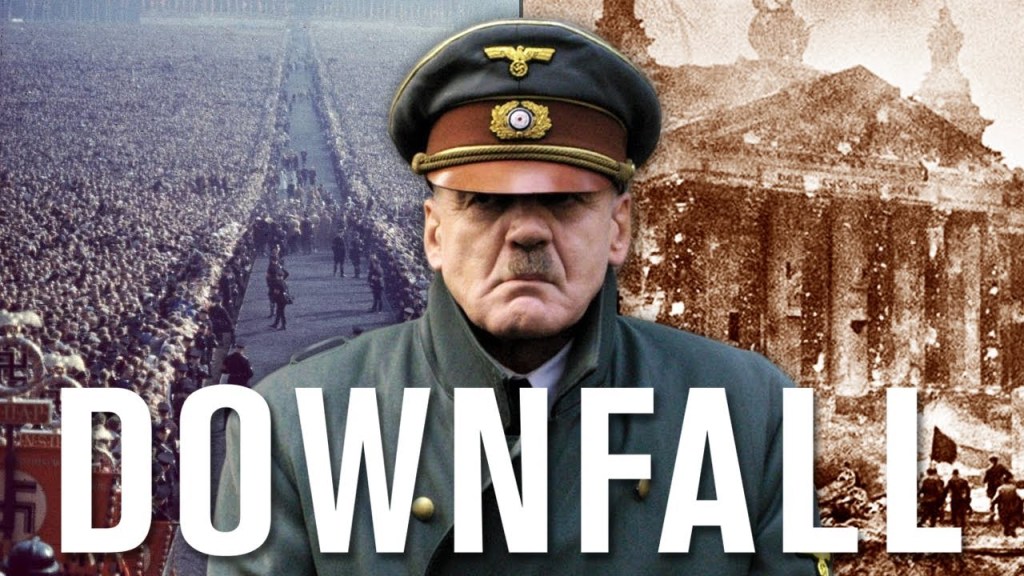
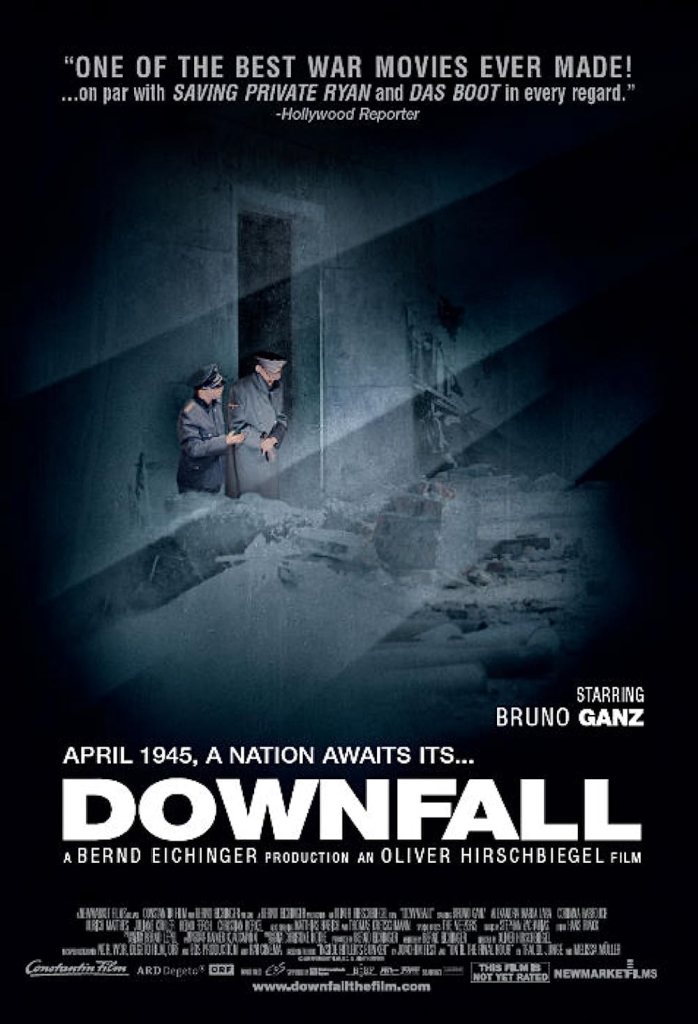
Downfall (German: Der Untergang) is a 2004 German-language historical war drama film directed by Oliver Hirschbiegel from a screenplay by its producer, Bernd Eichinger.
It is set during the Battle of Berlin in World War II, when Nazi Germany is on the verge of defeat, and depicts the final days of Adolf Hitler (portrayed by Bruno Ganz). The cast includes Alexandra Maria Lara, Corinna Harfouch, Ulrich Matthes, Juliane Köhler, Heino Ferch, Christian Berkel, Alexander Held, Matthias Habich, and Thomas Kretschmann. The film is a German-Austrian-Italian co-production.

Outline
In November 1942 Adolf Hitler invites a number of women to interview for the position of personal secretary. Traudl Junge is overjoyed when he chooses her. Two and a half years later, the Red Army has pushed Germany’s forces back and surrounded Berlin. On Hitler’s 56th birthday, shelling of Berlin’s city centre starts. Reichsführer-SS Heinrich Himmler tries to persuade Hitler to start negotiations with the Western Allies, but Hitler refuses. Himmler leaves to negotiate in secret. Later, Gruppenführer Hermann Fegelein, Himmler’s liaison officer at Hitler’s headquarters, attempts to persuade Hitler to flee, but Hitler insists that he will win or die in Berlin. SS doctor Obersturmbannführer Ernst-Günther Schenck is ordered to leave Berlin in Operation Clausewitz, but persuades an SS general to let him stay in Berlin. In the streets, Hitler Youth Peter Kranz’s father approaches his son’s unit and tries to persuade him to leave. Peter, who destroyed two enemy tanks, calls his father a coward.
At a meeting in the Führerbunker, Hitler forbids the overwhelmed 9th Army to retreat, instead ordering Obergruppenführer Felix Steiner’s units to mount a counter-attack. The generals find the orders impossible and irrational. Above ground, Hitler awards Peter the Iron Cross, hailing him as braver than his generals. In his office, Hitler talks to armaments minister Albert Speer about his scorched earth policy. Speer is concerned about the destruction of Germany’s infrastructure, but Hitler believes the German people are weak and deserve death. Hitler’s companion Eva Braun holds a party in the Reich Chancellery. Her brother-in-law Fegelein tries to persuade Eva to leave Berlin with Hitler, but she refuses.
On the battlefield, General Helmuth Weidling is informed he will be executed for allegedly ordering a retreat. Weidling comes to the Führerbunker to clear himself. His action impresses Hitler, who promotes him to oversee all of Berlin’s defences. At another meeting, Hitler learns that Steiner did not attack because his unit lacked sufficient force. Hitler becomes enraged at this, and launches into a furious tirade, shouting that everyone has failed him, and denouncing his generals as cowards and traitors. He acknowledges that the war is lost, but says that he would rather commit suicide than leave Berlin.
Schenck witnesses old men being executed by German Feldgendarmerie for refusing to take part in the fighting. Hitler receives a message from Reichsmarschall Hermann Göring, requesting state leadership for himself. Hitler declares Göring a traitor, ordering his dismissal and arrest. Speer makes a final visit to the Führerbunker, and admits that he has defied orders to destroy Germany’s infrastructure. Hitler, however, does not punish Speer, who decides to leave Berlin. Peter returns to find his unit dead and runs back home. Hitler continues to imagine ways for Germany to turn the tide. At dinner, Hitler learns of Himmler’s secret negotiations. This sends him into another rage, and he orders Himmler’s execution. He discovers that Fegelein has deserted his post, and has him executed despite Eva’s pleas. SS physician Obergruppenführer Ernst-Robert Grawitz asks Hitler’s permission to evacuate for fear of Allied reprisal. Hitler refuses, leading Grawitz to kill himself and his family.
The Red Army continues its advance as Berlin’s supplies run low and German morale plummets. Hitler hopes that the 12th Army, led by Lieutenant General Walther Wenck, will save Berlin. After midnight, Hitler dictates his last will and testament to Junge, before marrying Eva. The following morning, Hitler learns that the 12th Army is unable to relieve Berlin. Refusing surrender, Hitler plans his death. He administers poison to his dog Blondi, bids farewell to the bunker staff, and commits suicide with Eva. They are cremated with petrol in a ditch in the Chancellery garden.
Propaganda Minister Joseph Goebbels assumes the Chancellorship. General Hans Krebs fails to negotiate a conditional surrender with Soviet Marshal Georgy Zhukov. Goebbels declares that Germany will not surrender. Goebbels’ wife Magda poisons their six children with cyanide, before committing suicide with Goebbels; Weidling announces unconditional surrender of German forces in Berlin. Many officials and soldiers including Krebs commit suicide after learning of Germany’s defeat. Peter discovers that his parents were executed. Junge tries to flee the city; Peter joins her and they slip through Soviet soldiers before finding a bicycle and leaving Berlin.
Cast
- NSDAP, HJ, NSFK, NSKK and SA
- Bruno Ganz as Adolf Hitler
- Alexandra Maria Lara as Traudl Junge
- Ulrich Matthes as Reichsleiter Joseph Goebbels
- Corinna Harfouch as Magda Goebbels
- Juliane Köhler as Eva Braun
- Birgit Minichmayr as Gerda Christian
- Donevan Gunia as Peter Kranz
- Karl Kranzkowski as Wilhelm Kranz
- Ulrike Krumbiegel as Dorothee Kranz
- Michael Brandner as Hans Fritzsche
- Anna Thalbach as Hanna Reitsch
- Bettina Redlich as Constanze Manziarly
- Elizaveta Boyarskaya as Erna Flegel
- Oliver Stritzel as Johannes Hentschel
- Heino Ferch as Oberbefehlsleiter Albert Speer
- Wehrmacht
- Christian Redl as Generaloberst Alfred Jodl
- Rolf Kanies as General der Infanterie Hans Krebs, Chief of the Army General Staff
- Michael Mendl as General der Artillerie Helmuth Weidling
- Dietrich Hollinderbäumer as Generalfeldmarschall Robert Ritter von Greim
- Dieter Mann as Generalfeldmarschall Wilhelm Keitel
- Justus von Dohnányi as General der Infanterie Wilhelm Burgdorf
- Hans H. Steinberg as General der Flieger Karl Koller
- Klaus B. Wolf as Kriegsmarine Korvettenkapitän Alwin-Broder Albrecht
- Devid Striesow as Feldwebel Fritz Tornow
- Mathias Gnädinger as Reichsmarschall Hermann Göring, Luftwaffe commander-in-chief
- Schutzstaffel
- Ulrich Noethen as Reichsleiter and Reichsführer-SS Heinrich Himmler, Gestapo and Allgemeine-SS
- Thomas Thieme as Reichsleiter and SS-Obergruppenführer Martin Bormann
- Christian Hoening as SS-Obergruppenführer Ernst-Robert Grawitz
- Thomas Kretschmann as SS-Gruppenführer and Generalleutnant Waffen-SS Hermann Fegelein
- Alexander Held as SS-Brigadeführer Walther Hewel
- André Hennicke as SS-Brigadeführer Wilhelm Mohnke
- Matthias Habich as SS-Obersturmbannführer Prof. Dr. Werner Haase
- Thomas Limpinsel as SS-Obersturmbannführer Heinz Linge
- Thorsten Krohn as SS-Obersturmbannführer Dr. Ludwig Stumpfegger
- Jürgen Tonkel as SS-Obersturmbannführer Erich Kempka
- Igor Romanov as SS-Obersturmbannführer Peter Högl
- Igor Bubenchikov as SS-Obersturmbannführer Franz Schädle
- Christian Berkel as SS-Obersturmbannführer Dr. Ernst-Günther Schenck
- Fabian Busch as SS-Obersturmbannführer Stehr
- Götz Otto as SS-Sturmbannführer Otto Günsche
- Heinrich Schmieder as SS-Oberscharführer Rochus Misch
Additional cast members in smaller roles include Alexander Slastin as Soviet Marshal Vasily Chuikov, Elena Dreyden as Inge Dombrowski, Norbert Heckner as Walter Wagner, Silke Nikowski as Frau Grawitz, Leopold von Buttlar as Sohn Grawitz, Veit Stübner as Tellermann, Boris Schwarzmann as Matvey Blanter, Vsevolod Tsurilo as Russian Adjutant, Vasily Reutov as Weidling’s chief of staff Theodor von Dufving. The Goebbels children are portrayed by Alina Sokar (Helga), Charlotte Stoiber (Hilda), Gregory Borlein (Helmut), Julia Bauer (Hedda), Laura Borlein (Holde), and Amelie Menges (Heide).
Production
Development
Producer and screenwriter Bernd Eichinger wanted to make a film about Adolf Hitler and the Nazi Party for twenty years but was, at first, discouraged after its enormity prevented him from doing so. Eichinger was inspired to begin the filmmaking process after reading Inside Hitler’s Bunker: The Last Days of the Third Reich (2002) by historian Joachim Fest. Eichinger also based the film on the memoirs of Traudl Junge, one of Hitler’s secretaries, called Until the Final Hour: Hitler’s Last Secretary (2002). When writing the screenplay, he used the books Inside the Third Reich (1969), by Albert Speer, one of the highest-ranking Nazi officials to survive both the war and the Nuremberg trials; Hitler’s Last Days: An Eye-Witness Account (1973), by Gerhard Boldt; Das Notlazarett unter der Reichskanzlei: Ein Arzt erlebt Hitlers Ende in Berlin (1995) by Ernst-Günther Schenck; and Soldat: Reflections of a German Soldier, 1936–1949 (1992) by Siegfried Knappe as references.
After completing the script for the film, Eichinger presented it to director Oliver Hirschbiegel. Though he was interested in exploring how the people of Germany “could have plumbed such depths”, as a German, Hirschbiegel hesitated to take it as he “reacted to the idea of Nazism as a taboo”. Hirschbiegel eventually agreed to helm the project.
Casting
When Bruno Ganz was offered the role of Hitler, he was reluctant to accept the part, and many of his friends advised against it, but he believed that the subject had “a fascinating side”, and ultimately agreed to take the role. Ganz conducted four months of research and studied a recording of Hitler in private conversation with Finnish Field Marshal Carl Gustaf Emil Mannerheim in order to properly mimic Hitler’s conversational voice and Austrian dialect. Ganz came to the conclusion that Hitler had Parkinson’s disease, noting his observation of Hitler’s shaky body movements present in the newsreel Die Deutsche Wochenschau, and decided to visit a hospital to study patients with the disease. Ganz auditioned in the casting studio with makeup for half an hour and tested his voice for Hirschbiegel who was convinced by his performance.
Alexandra Maria Lara was cast as Traudl Junge; she was given Junge’s book Until the Final Hour (2002), which she called her “personal treasure”, to read during filming. Before she was cast, she had seen André Heller’s documentary film Im toten Winkel which impressed her and influenced her perspective on Junge.
Filming and Design
Principal photography lasted twelve weeks from September to November 2003, under the working title Sunset. The film is set mostly in and around the Führerbunker; Hirschbiegel made an effort to accurately reconstruct the look and atmosphere of World War II through eyewitness accounts, survivors’ memoirs, and other historical sources. Hirschbiegel filmed in the cities of Berlin, Munich, and Saint Petersburg, Russia, with a run-down industrial district along the Obvodny Canal used to portray the historical setting in Berlin. Hirschbiegel noted the depressing atmosphere surrounding the shoot, finding relief through listening to Johann Sebastian Bach’s music. Alexandra Maria Lara also mentioned the depressing and intense atmosphere during filming. To lighten the mood, Lara’s colleagues engaged in activities such as football, while Ganz tried to keep a happy mood by retiring during shooting breaks.
The film was produced on a €13.5 million budget. The bunker and Hitler’s Wolf’s Lair were constructed at Bavaria Studios in Munich by production designer Bernd Lepel. The damaged Reich Chancellery was depicted through the use of CGI. Hirschbiegel decided to limit the use of CGI, props and sets so as not to make the set design look like that of a theatre production, explaining:
The only CGI shot that’s been used in the film was the one with the [Reich Chancellery] because of course we could not reconstruct that – that’s the only thing. I’m very proud of that, because if you do a war movie, you cannot do that and build sets. You feel the cardboard. You feel that it’s all made to entertain, and it takes away from that horror that war basically means.
Release
Downfall premiered at the Toronto Film Festival on 14 September 2004. After first failing to find a distributor, the film was eventually released on 16 September in Germany by Constantin Film. It premiered in the US in Manhattan on 18 February 2005, under Newmarket Films. On its broadcast in the UK, Channel 4 marketed it with the strapline: “It’s a happy ending. He dies.”
Box Office
Downfall sold nearly half a million tickets in Germany for its opening weekend and attracted 4.5 million viewers in the first three months. The final North American gross was $5,509,040, while $86,671,870 was made with its foreign gross. The film made $93.6 million altogether.
Awards
Downfall was nominated for Best Foreign Language Film at the 77th Academy Awards. It won the 2005 BBC Four World Cinema competition. The film was also ranked number 48 in Empire magazine’s “The 100 Best Films Of World Cinema” in 2010.
Home Media
The film was released on DVD in 2005 by Columbia-TriStar Home Entertainment (now Sony Pictures Home Entertainment). Shout! Factory released a collector’s edition Blu-ray in March 2018, with a “making-of” featurette, cast and crew interviews, and audio commentary from director Oliver Hirschbiegel.
Controversy
Downfall was the subject of dispute by critics and audiences in Germany before and after its release, with many concerned regarding Hitler’s portrayal in the film as a human being with emotions in spite of his actions and ideologies. The portrayal sparked debate in Germany due to publicity from commentators, film magazines, and newspapers, leading the German tabloid Bild to ask the question, “Are we allowed to show the monster as a human being?”
It was criticized for its scenes involving the members of the Nazi party, with author Giles MacDonogh criticising the portrayals as being sympathetic towards SS officers Wilhelm Mohnke and Ernst-Günther Schenck, the former of whom was accused of murdering a group of British prisoners of war in the Wormhoudt massacre. At a discussion in London, Hirschbiegel said that the allegations that Schenck had performed unethical medical experiments were unproven. Russian press visited the set, making the producers uneasy and occasionally defensive. Yana Bezhanskay, director of Globus Film, Constantin’s Russian partner, raised her voice to Russian journalists and said: “This is an antifascist film and nowhere in it do you see Hitler praised.”
Cristina Nord from Die Tageszeitung criticised the portrayal, and said that though it was important to make films about perpetrators, “seeing Hitler cry” had not informed her on the last days of the Third Reich. Some have supported the film: Hans-Jürgen Syberberg, director of Hitler: A Film from Germany, felt the time was right to “paint a realistic portrait” of Hitler. Eichinger replied to the response from the film by stating that the “terrifying thing” about Hitler was that he was human and “not an elephant or a monster from Mars”. Ganz said that he was proud of the film; though he said people had accused him of “humanizing” Hitler.
Internet Parodies
Downfall is well known for its rise in popularity due to many “Hitler Rants” internet parody videos which use several scenes in the film: when Hitler phones General der Flieger Karl Koller about Berlin’s April 20 bombings; when Hitler discusses a counterattack against advancing Soviet forces with his generals; where Hitler becomes angry after hearing that Steiner’s attack never happened, due to a lack of forces; when Hitler hears Luftwaffe commander Hermann Göring’s telegram; when Hitler is having dinner and discovers Reichsführer-SS Heinrich Himmler secretly made a surrender offer to the Western Allies; and where Hitler orders Otto Günsche to find SS-Gruppenführer Hermann Fegelein. In the videos the original German audio is retained, but new subtitles are added so that Hitler and his subordinates seem to be reacting to an issue or setback in present-day politics, sports, entertainment, popular culture, or everyday life. In addition, some users combine footage from the film with other sources, dub the German dialogue over video games and/or footage from other films and TV series, or edit images of the characters onto pre-existing or animated footage, often for greater comic effect.
Hirschbiegel spoke positively about these parodies in a 2010 interview with New York magazine, saying that many of them were funny and a fitting extension of the film’s purpose. Nevertheless, Constantin Film asked video sites to remove them. The producers initiated a removal of parody videos from YouTube in 2010. This prompted more posting of parody videos of Hitler complaining that the parodies were being taken down, and a resurgence of the videos on the site.
One particular parody was the subject of BP Refinery v Tracey, where a BP employee named Scott Tracey was terminated from his job for a video satirising collective bargaining negotiations at the company he was working in. Tracey managed to successfully appeal his unfair dismissal to the Full Federal Court who decided that the video in question was not offensive, and had his job reinstated and received $200,000 in compensation.
Trivia
- Bruno Ganz studied Parkinson’s disease patients in a Swiss hospital to prepare for his role as Adolf Hitler.
- Also helping Bruno Ganz in preparing for the role was the unique, only known recording of Adolf Hitler when he held a private conversation with Field Marshal Gustaf Mannerheim of Finland; at that time, he was a World War II ally of Germany against the Soviet Union.
- Hitler unexpectedly showed up to congratulate Mannerheim on his 75th birthday on 04 June 1942.
- Finnish intelligence agents secretly made the recording in a train wagon, as Hitler did not allow recordings nor photographs to be taken in private.
- Some eleven minutes of the recording feature relaxed, normal-tone talk in which Hitler generally describe his views about the war.
- One of two copies of the tape was discovered in 1992 and has since been studied by scientists and historians.
- Most of the outdoor city scenes for the movie were filmed in Saint Petersburg, Russia.
- This was for two reasons: one, the architecture of the city has many Germanic aspects, and two, there are plenty of streets with little or no modern advertisements and other commercial aspects.
- Many of Adolf Hitler’s lines are historically accurate, based on accounts from Albert Speer and Traudl Junge.
- Most of them, however, are from earlier dates.
- Of the 37 real-life people featured in the film, only Rochus Misch was still alive when the film was released.
- He died on 05 September 2013 at the age of 96.
Production & Filming Details
- Director(s):
- Oliver Hirschbiegel
- Producer(s):
- Wolf-Dietrich Brücker … co-producer: WDR
- Bernd Eichinger … producer (produced by)
- Doris J. Heinze … co-producer: NDR
- Jörn Klamroth … co-producer: Degeto Film
- Christine Rothe … executive producer
- Silvia Tollmann … line producer
- Writer(s):
- Bernd Eichinger … (written by)
- Joachim Fest … (based on the book “Der Untergang: Hitler und das Ende des Dritten Reiches” by)
- Traudl Junge … (based on the book “Bis zur letzten Stunde” by)
- Melissa Müller … (based on the book “Bis zur letzten Stunde” by)
- Music:
- Stephan Zacharias
- Cinematography:
- Rainer Klausmann … director of photography
- Editing:
- Hans Funck
- Production:
- Constantin Film
- Norddeutscher Rundfunk (NDR) (NDR, co-production)
- Westdeutscher Rundfunk (WDR) (WDR, co-production)
- ARD Degeto Film (co-production)
- Österreichischer Rundfunk (ORF) (ORF, co-production)
- EOS Entertainment (EOS Production GmbH & Co. KG, co-production)
- Rai Cinema (co-production)
- Distributor(s):
- Constantin Film Verleih (Germany, 2004)(theatrical)
- Release Date: 08 September 2004 (Munich, Germany; premiere).
- Running time: 156 minutes.
- Rating: 15.
- Country: Germany.
- Language: German.


 Military Gogglebox
Leave a comment