
Introduction
Napoleon is a 2002 historical miniseries which explored the life of Napoleon Bonaparte.
It was the most expensive television miniseries in Europe up to that time, costing an equivalent of (USD) $46,330,000 to produce. The miniseries covered Napoleon’s military successes and failures, including the battles of Austerlitz, Eylau, and Waterloo and the retreat from Russia. It also delved into Napoleon’s personal life: his marriage to and divorce from Josephine de Beauharnais, his marriage to Marie Louise, the Duchess of Parma and daughter of Francis II, and his affairs with Eleanore Denuelle and Marie Walewska.
The series draws from Max Gallo’s biography. Also known as Le tricorne de Napoleon (working title, France).
Outline
The series begins with Napoleon imprisoned on Saint Helena. The episode then goes back to show Napoleon’s first meeting the widow Josephine de Beauharnais. The story then follows his career breakthrough, the suppression of Royalist rioters on 13 Vendémiaire (1795). Later, Napoleon is shown at the Battle of Arcole (1796). It continues with the couple inspecting their future house, Château de Malmaison, and shows Napoleon allying with Talleyrand and Fouché. It moves to the French campaign in Egypt and Syria (1798-1801), the Coup of 18 Brumaire (1799), and ends with the Plot of the rue Saint-Nicaise (1800).
The second episode begins in 1804 with the controversial arrest and execution of the duc d’Enghien, followed by the elevation of members of the House of Bonaparte, and Napoleon’s imperial coronation. There is an extended sequence showing the Battle of Austerlitz (1805), followed by a brief scene of the Battle of Jena-Auerstedt (1806). Napoleon’s affair with Maria Walewska is also shown, as are the troubles with his wife. It ends with the Battle of Eylau (1807), with Napoleon waiting desperately for the reinforcements led by Marshal Michel Ney.
The third episode begins with the timely arrival of Ney at Eylau. Napoleon then concludes a short-lived peace treaty with Alexander at Tilsit as the costly Peninsular War starts and troubles with his family and imperial succession begin to dominate. Next is the defeat at the Battle of Aspern-Essling (1809) and his marriage to the Duchess of Parma in 1810 and the birth of a son in 1811. Napoleon, feeling provoked by the Russians, invades in 1812 and watches from the Kremlin as Moscow ignites.
The final episode begins with the bitter retreat from Russia. Sensing France’s weakness, the War of the Sixth Coalition erupts in 1813, and, outnumbered, Napoleon’s forces are reduced and Paris is taken in 1814. After attempting suicide, and being forced to abdicate, he becomes the sovereign of Elba. Later, there is the Hundred Days, culminating with the Battle of Waterloo (1815) and the defeat of the imperial forces. It ends with Napoleon dying in exile on the island of Saint Helena in 1821.
Cast
- Christian Clavier as Napoléon Bonaparte
- Isabella Rossellini as Joséphine de Beauharnais
- Gérard Depardieu as Joseph Fouché
- John Malkovich as Charles Talleyrand
- Anouk Aimée as Letizia Bonaparte
- Heino Ferch as Armand Augustin Louis de Caulaincourt
- Sebastian Koch as Marshal Jean Lannes
- Ennio Fantastichini as Joseph Bonaparte
- Yves Jacques as Lucien Bonaparte
- Alexandra Maria Lara as Countess Marie Walewska
- Toby Stephens as Alexander I of Russia
- Mavie Hörbiger as Marie Louise of Austria
- Marie Bäumer as Caroline Bonaparte
- Claudio Amendola as Marshal Joachim Murat
- Julian Sands as Klemens von Metternich
- Ludivine Sagnier as Hortense de Beauharnais
- John Wood as Pope Pius VII
- Natacha Amal as Madame Bertrand
- Charlotte Valandrey as Madame Coigny
- Florence Pernel as Thérésa Tallien
- Jessica Paré as Eléanore Denuelle
- Tamsin Egerton-Dick as Lucia Elizabeth “Miss Betsy” Balcombe
- David La Haye as Louis-Antoine-Henri de Bourbon-Condé, duc d’Enghien
- David Francis as Sir Hudson Lowe
- Jacky Nercessian as Roustam Raza
- Guillaume Depardieu as Jean-Baptiste Muiron
- Alain Doutey as Marshal Michel Ney
- Serge Dupire as Pierre Cambronne
- Philippe Volter as Paul Barras
- Vincent Grass as Charles IV of Spain
- Jean Dell as Malmaison’s player
Production
Filming took place in Austria, Canada, the Czech Republic, France, Hungary, Morocco and Switzerland. The filmmakers found that many locations in Hungary resembled 19th century France. However, matte paintings and various digital effects were also employed in post-production in order to recreate the historical setting. In many of the battle sequences, computer-generated soldiers created by Hybride Technologies were added into the footage. The fact that Napoleon left behind many historical records helped in the production, and other records were supplied by the modern-day French Army.
Historical Accuracy
- In the first episode, during the Plot of the Rue Saint-Nicaise, Napoleon is seen travelling alongside his wife, but in reality Joséphine was riding in a separate carriage.
- In the third episode, Napoleon and Tsar Alexander are shown in 1808 at the Congress of Erfurt listening to a performance of Nicolo Paganini’s Caprice No. 24. In reality the piece was composed in 1817.
- As shown in episode three, the dressing down of Talleyrand during which Napoleon claimed that he was “shit in a silk stocking” occurred in front of Napoleon’s marshals rather than in private chambers. By this time, Talleyrand had also already resigned his office, rather than being fired.
- In the fourth episode, Talleyrand warns King Louis XVIII that Napoleon and his army are advancing on Paris. In reality, Talleyrand was at the Congress of Vienna at the time.
- In another scene, Murat is seen offering his services to Napoleon once more for the upcoming Waterloo campaign, but in real life, Murat had actually done so through a dispatch and not in person, as the last time the two actually saw each other was in Germany in 1813 following Napoleon’s defeat at the Battle of Leipzig.
- Cambronne is seen saying the infamous word of Cambronne and later a variation of his famous response about the Guard during the Battle of Waterloo. The accuracy of these words is disputed, though they are popularly attributed to him.
Release
The series premiered at a time when many other books and films about Napoleon had recently come out or were in production, including a stage production called C’était Bonaparte, which opened days before the miniseries premiered. Upon its release, it was the first television series to be broadcast simultaneously in all the participating European countries. However, when originally broadcast in the United States, it was edited down to a running time of three hours, as opposed to the original six hours.
When it first aired in France it drew in on average more than seven million nightly viewers, which represented a share over 30% of all the TV viewers on those nights.
Controversy
The series was praised in France, but received negative reviews in Italy. Italian politician, Umberto Bossi, was angered by the series, stating that it glamorized Napoleon despite the fact that his occupation of Italy resulted in the deaths of hundreds of thousands and the looting of many of the country’s artistic treasures. He also criticized Italy’s RAI television network for co-funding the series. Producer and cast member Gérard Depardieu defended the series, stating that it keeps to the truth and that “perhaps Bossi would have preferred an idiot Napoleon.” Two other members of the cast, Clavier and Rossellini, vouched for the integrity of their respective portrayals of the French emperor and empress. Lichfield, on the other hand, says that the series omits most of the unsavoury elements of Napoleon’s Italian campaign.
Awards
In 2003, the series won a Bavarian TV award. In France, it won a 7 d’Or award for Best Director. In the United States, it was nominated for nine Emmy awards, and it won the Emmy for Outstanding Costumes for a Miniseries, Movie or a Special.
DVD Release
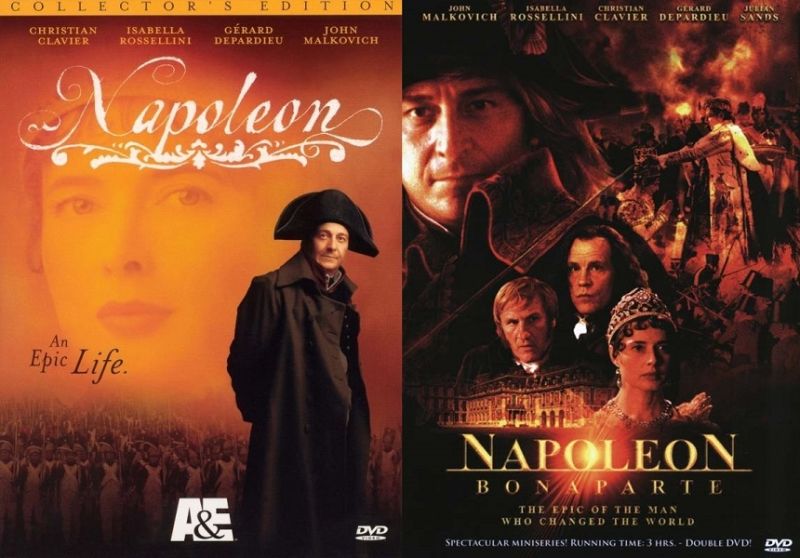
A three-disc DVD (full screen) recording, under the A&E label and with A&E extra features, is sold in the United States. In Canada, there is a four-disc DVD (fullscreen) recording, under the REMSTAR label and without the A&E extra features, in both English and French editions. French edition is in 1.78:1 (16:9) widescreen.
Video Game
A Risk-style video game based on the miniseries, titled Napoleon, was released on 14 November 2002 by Atari and Infogrames for Mac and Windows. The game allows players to recreate some of Napoleon’s historical battles. Richard Grégoire, the composer of the soundtrack of the miniseries, also contributed a part of the game’s music.
Trivia
- The series was shot simultaneously in French and English, thus two versions exist, with the exact same actors and near-identical edits, but a different original language.
- When Napoleon is with Eleanore Denuelle and his son to say goodbye, his hair is parted on his left side.
- When he leaves and turns around at the door, Napoleon’s hair is parted on his right side.
- During the Battle of Waterloo, soldiers on the British side can be seen firing beyond the effective range of their muskets.
- Tsar Alexander and Napoleon are listening to Paganini’s Caprice No. 24.
- However, that piece was only composed in 1817, when Napoleon was already in St. Helena.
Napoleon: An Epic Life Series
Production & Filming Details
- Director(s):
- Yves Simoneau … (4 episodes, 2002)
- Producer(s):
- Adam Betteridge … associate producer (4 episodes, 2002)
- Michael Cowan … co-producer (4 episodes, 2002)
- David Craig … supervising producer: A&E (4 episodes, 2002)
- Gérard Depardieu … producer (4 episodes, 2002)
- Sarim Fassi … executive producer (4 episodes, 2002)
- Delia Fine … executive producer: A&E Network (4 episodes, 2002)
- Jean-Marc Félio … producer: New Brunswick (4 episodes, 2002)
- Max Gusberti … co-producer (4 episodes, 2002)
- Jean-Pierre Guérin … producer (4 episodes, 2002)
- Marc Jenny … executive producer (4 episodes, 2002)
- Claude Léger … co-producer (4 episodes, 2002)
- Véronique Marchat … associate producer (4 episodes, 2002)
- Alex Marshall … associate producer (4 episodes, 2002)
- Jan Matjo … co-producer (4 episodes, 2002)
- Jan Mojto … co-producer (4 episodes, 2002)
- Jason Piette … co-producer (4 episodes, 2002)
- David Rogers … co-producer (4 episodes, 2002)
- Yves Simoneau … associate producer (4 episodes, 2002)
- Kornél Sipos … co-producer (4 episodes, 2002)
- Marc Vadé … executive producer (4 episodes, 2002)
- Jonathan Vanger … co-producer (4 episodes, 2002)
- Wolfgang Ramml … producer austria (1 episode, 2002)
- Milos Twilight … Executive Producer for ASP Productions (1 episode, 2002)
- Writer(s):
- Didier Decoin … (4 episodes, 2002)
- Max Gallo … (book) (4 episodes, 2002)
- Milos Twilight … (historical consultant) (3 episodes, 2002)
- Milos Twilight … (historical scenes) (3 episodes, 2002)
- Music:
- Michel Cusson … (4 episodes, 2002)
- Richard Grégoire … (4 episodes, 2002)
- Marc Ouellette … (2 episodes, 2002)
- Cinematography:
- Guy Dufaux … (4 episodes, 2002)
- Editor(s):
- Yves Langlois … (4 episodes, 2002)
- Isabelle Malenfant … (4 episodes, 2002)
- Production:
- A+E Networks
- ASP Productions
- GMT Productions
- Kekchi Films Productions
- KirchMedia
- MA Films
- Okko Productions
- Spice Factory
- Transfilm
- Zweites Deutsches Fernsehen (ZDF)
- Distributor(s):
- France 2
- A+E Networks (United States)(TV)
- Beta Film (international)
- Fernsehjuwelen (Germany, 2017)(Blu-ray)
- Fernsehjuwelen (Germany, 2017)(DVD)
- Kinowelt Home Entertainment (Germany, 2010)(DVD)
- RTL Klub Televízió (Hungary, 2003)(TV)
- StudioCanal (Germany, 2014)(DVD)
- Teleview International (Lebanon, 2002)(Middle East, TV)
- Umbrella Entertainment (Australia, 2010)(DVD)
- Universal Pictures (Germany, 2003)(DVD)
- Versátil Home Vídeo (Brazil, 2009)(DVD)
- Release Date: 07 October 2002 to 28 October 2002 (France).
- Running Time: 360 minutes (total running time).
- Rating: Unknown.
- Country: France.
- Language: French and English.


 Military Gogglebox
Leave a comment