
Introduction
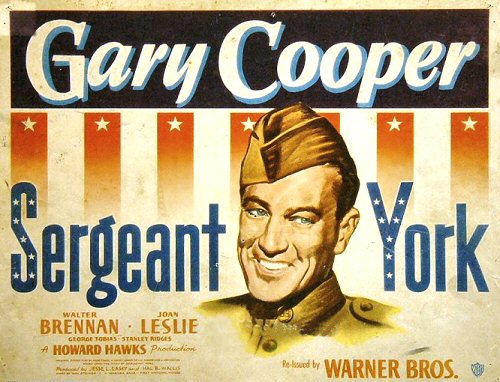
Sergeant York is a 1941 American biographical film about the life of Alvin C. York, one of the most decorated American soldiers of World War I.
Directed by Howard Hawks and starring Gary Cooper in the title role, the film was a critical and commercial success, and became the highest-grossing film of 1941. In 2008, Sergeant York was selected for preservation in the United States National Film Registry by the Library of Congress as being “culturally, historically, or aesthetically significant”.
Outline
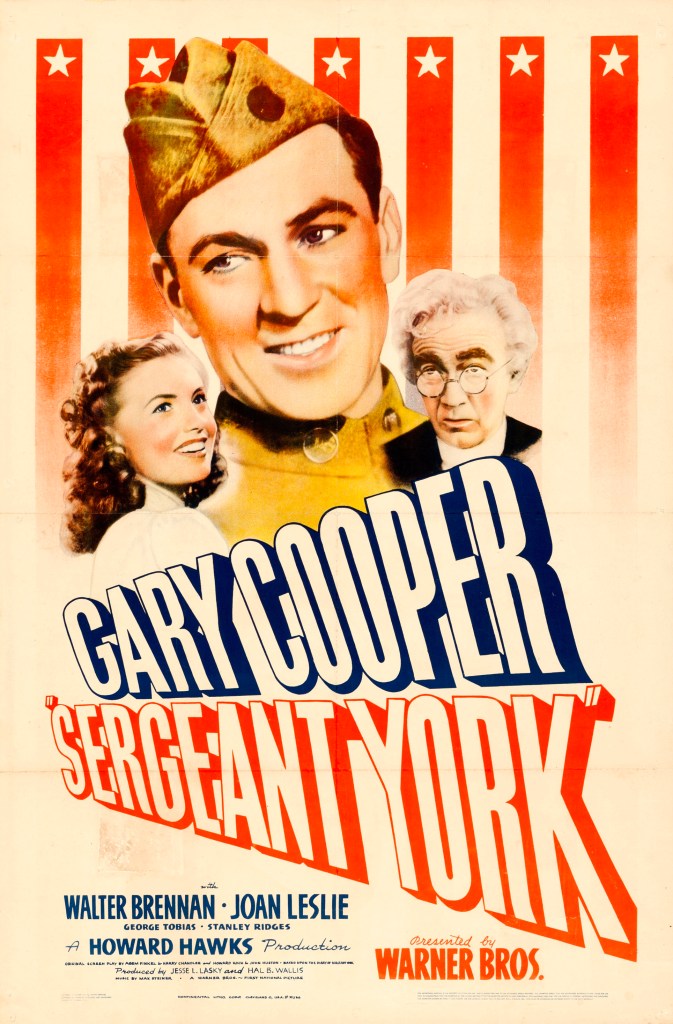
Before America’s entry into World War I, Alvin York is a poor, young farmer in rural Tennessee, living with his widowed mother, sister, and younger brother. Alvin’s leisure time is spent fighting and getting drunk with friends. Alvin’s goal is to purchase a piece of farmland, fertile “bottomland”. Alvin works hard to acquire the price for the land, and is given an extension by the owner. Alvin’s sharpshooting skills enable him to raise the money needed, but the owner reneges, making Alvin angry and bitter. En route to seek revenge, Alvin and his mule are struck by lightning. The incident prompts Alvin to rejoin his church.
When the US enters World War I, Alvin seeks exemption as a conscientious objector, which is denied. Alvin is torn between fighting for his country and the biblical prohibition against killing. His sympathetic commanding officer gives him leave to go home and come to a decision. Alvin reconciles his moral conflict after reading the biblical injunction to “render unto Caesar the things that are Caesar’s, and unto God the things that are God’s.”
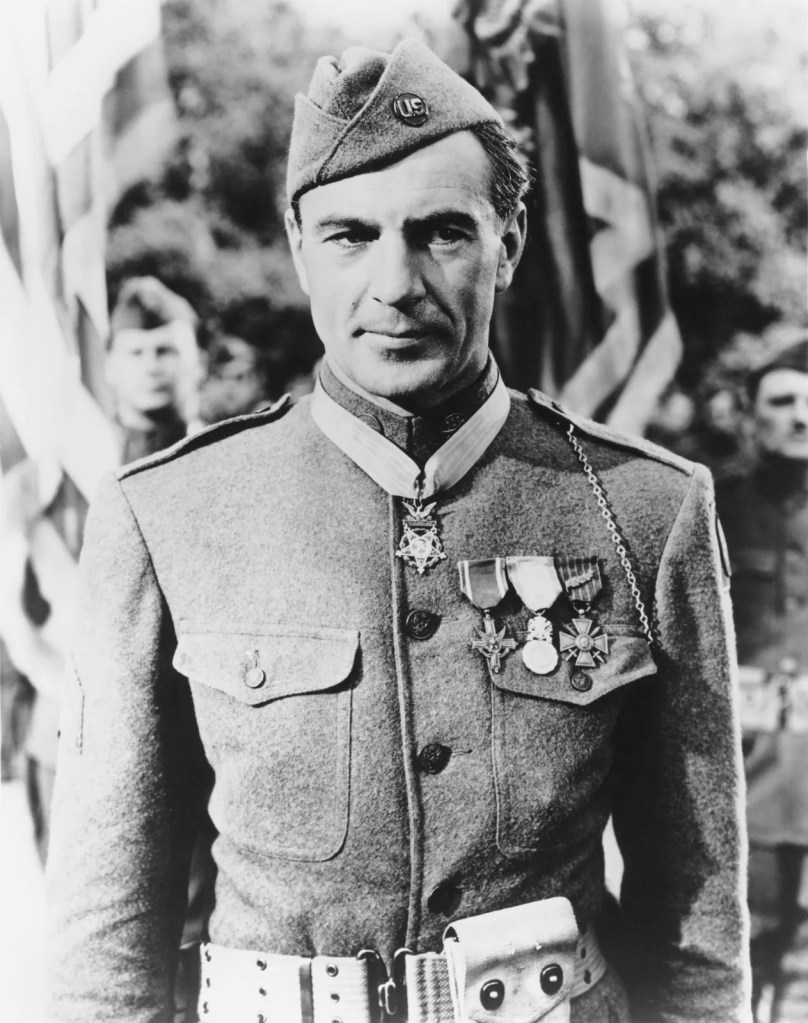
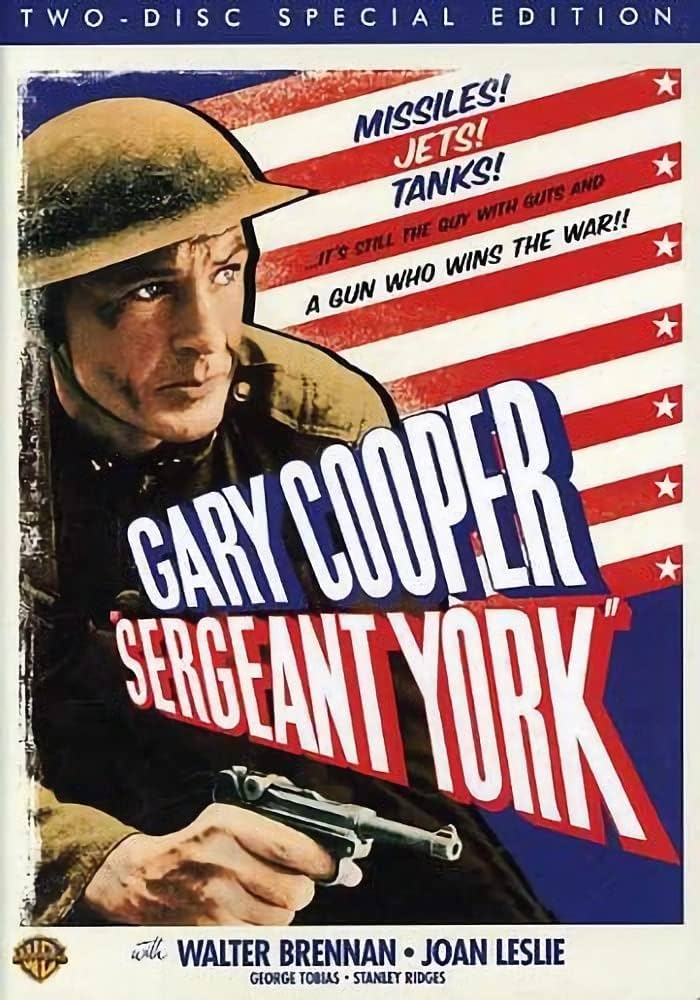
During the Meuse-Argonne offensive, York’s qualms vanish when he sees his friends and comrades being killed as they assault a strong German position. With his superiors dead or incapacitated, he takes charge. He infiltrates the German lines by himself and finds a position that lets him enfilade the main German defensive trench. He kills so many German soldiers that they eventually surrender to him en masse. One of the prisoners of war treacherously grenades Alvin’s good friend, “Pusher” Ross, and is gunned down by York. He and the handful of survivors from his unit lead their many captives behind their lines, but have a hard time finding anyone to take the Germans off their hands. The officer who finally does is astonished to learn that so few men captured so many of the enemy.
York is decorated and hailed as a national hero, feted in Europe, New York, and Washington DC, but he desires to return home. He rejects commercial offers that would make him wealthy, explaining that he could not take money for doing his duty. York returns home to marry his fiancée, Gracie. To his surprise, the state has purchased the bottomland farm and built a house for Gracie and him.
Cast
- Gary Cooper as Alvin C. York
- Walter Brennan as Pastor Rosier Pile
- Joan Leslie as Gracie Williams
- George Tobias as “Pusher” Ross, a soldier from New York City and one of Alvin’s friends
- Stanley Ridges as Major Buxton
- Margaret Wycherly as Mother York
- Ward Bond as Ike Botkin
- Noah Beery Jr. as Buck Lipscomb
- June Lockhart as Rosie York, Alvin’s sister
- Dickie Moore as George York, Alvin’s brother
- Clem Bevans as Zeke
- Howard Da Silva as Lem
- Charles Trowbridge as Cordell Hull
- Harvey Stephens as Captain Danforth
- David Bruce as Bert Thomas, another of Alvin’s soldier friends
- Charles Esmond as German Major
- Joseph Sawyer as Sergeant Early
- Pat Flaherty as Sergeant Harry Parsons
- Robert Porterfield as Zeb Andrews
- Erville Alderson as Nate Tomkins
Release
Sergeant York was a success at the box office and became the highest-grossing film of 1941. This was influenced by the attack on Pearl Harbour, which occurred while the film was still playing in theatres. The film’s patriotic theme helped recruit soldiers; young men sometimes went directly from the movie theatre to military enlistment offices. After its initial release, the film was frequently reshown at theatres all over America during the war as a quick replacement for box-office flops and as a theme programme for bond sales and scrap drives.
According to Warner Bros. records, the film earned $6,075,000 domestically and $2,184,000 internationally.
Trivia
- Alvin C. York himself was on the set for a few days during filming.
- When one of the crew members tactlessly asked him how many “Jerries” he had killed, York started sobbing so vehemently he threw up.
- The crew member was nearly fired, but the next day, York demanded that he keep his job.
- Alvin C. York had been approached by producer Jesse L. Lasky several times, beginning in 1919, to allow a movie to be made of his life, but had refused, believing that “this uniform ain’t for sale.”
- Lasky convinced York that, with war threatening in Europe, it was his patriotic duty to allow the film to proceed.
- York finally agreed, but only on three conditions. First, York’s share of the profits would be contributed to a Bible school York wanted to be built. Second, no cigarette-smoking actress could be chosen to play his wife. Third, only Gary Cooper could recreate his life on screen.
- Cooper at first turned down the role, but when York himself contacted the star with a personal plea, Cooper agreed to do the picture. Strangely, York did not mind the fact that Cooper was a chain smoker.
- The highest-grossing film of 1941.
- Adjusted for inflation, it still remains one of the highest-grossing films of all time.
- Gary Cooper, unable to participate in WWII due to his age and an old injury to his hip, felt strongly that this film was his way of contributing to the cause.
Production & Filming Details
- Director(s):
- Howard Hawks
- Producer(s):
- Howard Hawks … producer (uncredited)
- Jesse L. Lasky … producer
- Hal B. Wallis … producer
- Writer(s):
- Abem Finkel … (original screen play)
- Harry Chandlee … (original screen play)
- Howard Koch … (original screen play)
- John Huston … (original screen play)
- Alvin C. York … (based upon: the diary of) (as Sergeant York)
- Tom Skeyhill … (diary editor)
- Sam Cowan … (uncredited)
- Music:
- Max Steiner
- Cinematography:
- Sol Polito … director of photography
- Editor(s):
- William Holmes
- Production:
- Warner Bros.
- Distributor(s):
- Warner Bros.
- Release Date: 02 July 1941 (US).
- Running Time: 134 minutes.
- Rating: A.
- Country: US.
- Language: English.


 Military Gogglebox
Leave a comment