
Introduction
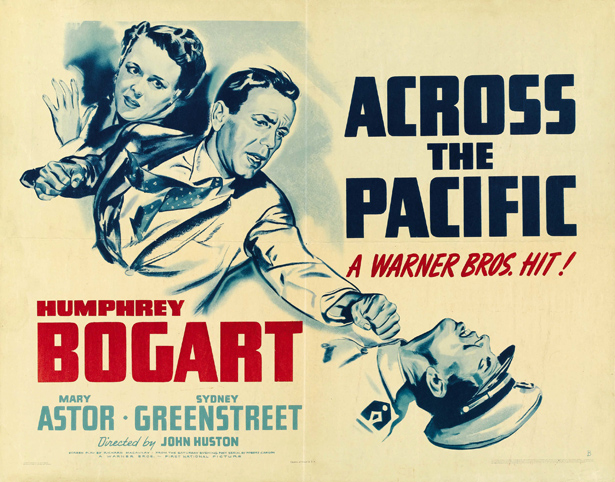
In December 1941, ex-army captain Rick Leland boards a Japanese ship heading to Asia via the Panama Canal where his Japanese hosts show interest in the American defence plans for the canal zone.
Outline
In late 1941, Captain Rick Leland (Humphrey Bogart) is court-martialed and discharged from the US Coast Artillery after he is caught stealing. He tries to join the Canadian Army but is coldly rebuffed. He boards a Japanese ship, the Genoa Maru, in Halifax, apparently to make his way to China via the Panama Canal to fight for Chiang Kai-shek.
On board, he meets Canadian Alberta Marlow (Mary Astor) and Dr. Lorenz (Sydney Greenstreet), a professor of sociology who makes no secret of his admiration of the Japanese and so is not popular in the Philippines, where he resides. Leland, in his turn, makes it clear to Lorenz that he has no loyalty toward his country and would fight for anyone willing to pay him.
During a stop in New York, Leland, revealed as a secret agent trailing Lorenz, reports to Colonel Hart (Paul Stanton), an undercover Army Intelligence officer. Lorenz is a known enemy spy, but Hart and Leland are uncertain about Marlow. Upon returning to the ship, Leland surprises a Filipino man (Rudy Robles) who is about to shoot Lorenz, thus gaining Lorenz’s confidence. Second-generation Japanese-American Joe Totsuiko (Victor Sen Yung) embarks as a passenger. Lorenz attempts to gather details from Leland concerning the military installations guarding the Panama Canal. Meanwhile, Marlow and Leland engage in a light-hearted romance.
As they arrive in Panama, the captain announces that the ship has been denied passage through the strategically vital canal and will be forced to take a long detour around Cape Horn. Leland, Marlow, and Lorenz disembark to wait for another ship. Several crates are unloaded addressed to a Dan Morton at the Bountiful Plantation. Lorenz asks Leland, who was once stationed in the area, to procure up-to-date schedules for the American planes that patrol the canal. Leland meets with his local contact, A. V. Smith (Charles Halton), and convinces him to provide the real schedules since Lorenz could easily find out if he were given fake ones. The date is December 6, 1941, the eve of the attack on Pearl Harbour.
Having delivered the schedules after haggling with Lorenz over their price, Leland is knocked out. He wakes up several hours later and finds out that both Lorenz and Marlow have left the hotel. He immediately calls Smith and warns him to change the patrol schedule. Then, on a tip from an informer (Philip Ahn) inside a movie theatre, he heads out to the Bountiful Plantation, where he sees a torpedo bomber being prepared. He is captured, however, and brought inside to Lorenz, Marlow, and Totsuiko. Marlow turns out to be the daughter of the plantation’s owner, Dan Morton (Monte Blue), a drunk whose weakness was exploited to provide a base for espionage activities. To Leland’s relief, Marlow’s only stake in the affair is concern for her father.
Lorenz reveals that they killed Smith before he could have the schedule changed and that they are planning to torpedo the Panama Canal Locks. After Lorenz leaves for the landing field, Leland overpowers Totsuiko after the latter shoots Morton. Leland makes his way to the field where he takes over a machine gun and shoots down the bomber aircraft, piloted by no less than an Imperial Japanese prince, as it is about to take off. Leland dispatches Lorenz’s men in the ensuing firefight. Returning to the house, he finds a defeated Lorenz attempting to commit seppuku, but his nerve fails him and he begs Leland to shoot him in the head. Leland refuses, saying his prisoner has “a date with Army intelligence.”
Versions
Trivia & Goofs
- The opening scene shows 198th Coast Artillery Command at Governors Island, New York City. In fact the 198th Coast Artillery Regiment was stationed at Wilmington, Delaware.
- This version of Across the Pacific was also adapted as a radio play on The Screen Guild Theatre’s 25 January 1943, broadcast with Bogart, Astor, and Greenstreet reprising their film roles.
- This version of Across the Pacific was based on ‘Aloha Means Good-bye’, a 1942 ‘The Saturday Evening Post, story by Robert Carson.
- The title had been used before by Warner Brothers for a 1926 silent adventure film by the same name starring Monte Blue, who also has a small role in this film. However, the plots of the two films bear no resemblance to each other. Indeed, the plot of the talkie is more like a remake of the silent film-era spy thriller “The Silent Command!”
- Initially, it was planned that the film would portray an attempt to avert a Japanese plan to bomb Pearl Harbour. When the real-life Pearl Harbour bombing occurred, the script was quickly rewritten to change the location of the planned attack to Panama.
- Director John Huston was called up to military service during filming; he claimed he left at the point near the end of the film in which Bogart is trapped in a house at gun-point. Vincent Sherman finished directing the film, minus the script which Huston took with him, explaining “Bogie will know how to get out”. An implausible escape and plot wrap-up was shot, which Huston declared “lacked credibility”.
- Despite the title, the action of the film never progresses across the Pacific, concluding in Panama.
Production & Filming Details
- Directors: John Huston and Vincent Sherman.
- Producers: Jack Saper and Jerry Wald.
- Writer: Richard Macauley (screenplay).
- Music: Adolph Deutsch.
- Cinematography: Arthur Edeson.
- Editor: Frank Magee.
- Distribution: Warner Brothers.
- Release Date: 04 September 1942 (US).
- Running time: 97 minutes.
- Country: US.
- Language: English (silent).
YouTube Link



Leave a Reply