
Introduction
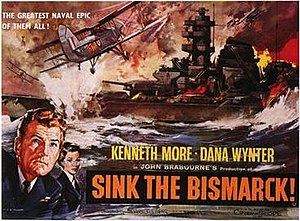
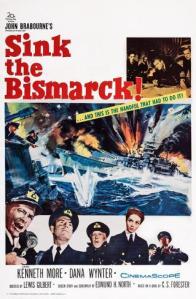
The World War II story of the British Navy’s effort to defeat Nazi Germany’s most powerful warship.
Outline
The story begins with a clip of actual German newsreel footage from 14 February 1939, when Nazi Germany’s largest and most powerful battleship, Bismarck, is launched in a ceremony at Hamburg with Adolf Hitler in attendance. The launching of the hull is the beginning of a new era of German sea power.
Two years later, in 1941, British convoys are being ravaged by U-boats and surface raider attacks that cut off all supplies essential for Britain’s ability to continue the war. In May, British intelligence discovers Bismarck and the heavy cruiser Prinz Eugen are about to break out of the Baltic and into the North Atlantic to attack convoys.
Meanwhile, a spy in Norway, while perched on a ledge, spots Bismarck and its escort Prinz Eugen at anchor in Grimstadfjord; he attempts to alert the British Admiralty by radio, but he is discovered by German guards and is shot. The spy, still alive, attempts to message the Admiralty but is only able to transmit that one of the ships is Prinz Eugen; he is killed before he can complete the identity of the second ship, which was Bismarck.
The man assigned to coordinate the hunt is the Admiralty’s chief of operations, Captain Jonathan Shepard (Kenneth More), who has been distraught over the death of his wife in an air raid and the sinking of his warship by the German battleships Scharnhorst and Gneisenau, commanded by Fleet Admiral Günther Lütjens (Karel Štěpánek). Upon receiving his new post, Shepard discovers Lütjens is the fleet commander on Bismarck. Shepard’s experience of conflict with Nazi Germany’s Kriegsmarine and his understanding of Lütjens allow him to predict Bismarck’s movements. Shepard acts coldly to his staff but comes increasingly to rely on the coolness and skill of his assistant, WRNS Second Officer Anne Davis (Dana Wynter).
Lütjens is also bitter. After the First World War, he considered that he had received no recognition for his efforts in the war. Lütjens promises the captain of Bismarck, Ernst Lindemann (Carl Möhner), that this time, he and Germany will be remembered as the victors.
Next morning, in the Denmark Strait Bismarck and Prinz Eugen encounter HMS Hood and HMS Prince of Wales. The four warships engage in a heavy battle, and a shell from Bismarck hits Hood, slightly damaging her. Bismarck fires another salvo from her main battery and both sides watch as three shells hit the water near Hood, but the fourth hits the vessel just below its main mast, penetrating through the thin deck armour; suddenly the ship’s deck simultaneously disintegrates and explodes in a massive fireball, even blowing one of the turrets off into the ocean. Both sides are shocked and horrified at the devastation, as Hood’s sinking remains are enveloped by smoke. The captain of Prince of Wales, John Leach asks the yeoman to send a message to Admiralty saying that Hood has blown up. Now Prince of Wales is alone and is fired at by the two German ships. The battleship fires back and manages to hit Bismarck on the bow. Bismarck fires back and hits Prince of Wales on the bridge, destroying it, and leaving only two men alive. Prince of Wales is hit multiple times before it makes smoke and retreats.
Bismarck and Prinz Eugen’s escape is shadowed by smaller British ships. Later, Prinz Eugen breaks away and heads toward Brest, France, while Bismarck turns around and fires at the British cruisers to provide cover as it escapes. The attack forces the cruisers to retreat. Meanwhile, Shepard, obsessed with the German battleship, acknowledges that his son, an air-gunner on a Fairey Swordfish torpedo bomber from HMS Ark Royal, one of the British ships deployed to the hunt, may die when the British aircraft attack Bismarck. Shepard gambles that Lütjens is returning to friendly waters where U-boats and air cover will make it impossible to attack, so he plans to intercept and attack Bismarck before it reaches safety.
Shepard commits large forces stripped from convoy escort and uses Catalina flying boats to search for the German battleship. His hunch proves correct, and Bismarck is located, apparently steaming towards the German-occupied French coast. British forces have a narrow window to destroy or slow their prey before German support and their own diminishing fuel supplies prevent further attack. Swordfish aircraft from HMS Ark Royal have two chances. The first fails: they misidentify HMS Sheffield as Bismarck, and their new magnetic torpedo detonators are faulty, with most exploding as soon as they hit the sea. Switching to conventional contact detonators, the second attack is successful, with one torpedo hitting Bismarck amidships, causing minor damage, while a catastrophic second hit detonates near the stern, causing extensive damage jamming the German battleship’s rudder and slowing her speed.
Unable to repair its rudder, Bismarck steams in circles. During the night the German battleship is attacked by two British destroyers. They fire torpedoes, and one torpedo hits, but Bismarck returns fire, sinking the destroyer HMS Solent. The main force of British ships (including battleships HMS Rodney and HMS King George V) find Bismarck the next day and rain shells upon her. Lütjens in his final moments insists to Lindemann that German forces will arrive to save them, but he dies when a shell destroys Bismarck’s bridge. After that, the remaining officers abandon ship. In King George V Admiral Tovey orders the newly joined cruiser HMS Dorsetshire to finish off Bismarck. The cruiser fires a salvo of six torpedoes at the already sinking and severely damaged German battleship. Four torpedoes strike its hull, causing the vessel to sink faster than the crew can escape. The captain in King George V lowers his head as Bismarck rolls over and disappears beneath the waves. The admiral orders Dorsetshire to pick up any remaining survivors, finally saying tersely: “Well, gentlemen, let’s go home”.
After the sinking of Bismarck, and having been told that his son has been rescued, Shepard asks Davis out for dinner, believing it to be nine o’clock at night, only to realise it is nine in the morning after stepping outside and seeing the sky. Davis instead suggests breakfast, as they walk off together.
Ships Involved
Sink the Bismarck! was made in 1960, as the last major Second World War fleet units were being retired. Producer John Brabourne was able to use his influence as son-in-law of Lord Mountbatten, then Chief of the Defence Staff, to obtain the full co-operation of the Admiralty. The soon-to-be-scrapped battleship HMS Vanguard provided some footage of a capital ship’s 15-inch gun turrets in action, and was used for scenes set on board HMS Hood, Prince of Wales, King George V and Bismarck herself. The cruiser HMS Belfast, now preserved in London, was used to depict the cruisers involved in Bismarck’s pursuit, including HMS Norfolk, Suffolk, Sheffield and Dorsetshire. A Dido-class cruiser in reserve was used as the set for Bismarck’s destruction, and one of her tall raked funnels is glimpsed in the final scenes.
The aircraft carrier HMS Victorious is briefly shown as herself, despite the postwar addition of a large angled flight deck and a massive Type 984 “searchlight” radar; the same ship is also used to depict HMS Ark Royal sailing from Gibraltar. All flying from both carriers was filmed aboard HMS Centaur – clearly marked with her postwar pennant number R06 – and three surviving Fairey Swordfish aircraft were restored, of which two were flown from her flight deck. These three aircraft now form the core of the Royal Navy Historic Flight. A 2010 article in Aeroplane identifies the Swordfish flown in the production: LS326, carrying its true serial, was marked as “5A” of 825 Naval Air Squadron, while NF389 was marked as LS423 / “5B”. The same actor plays the leader of the Swordfish attack from HMS Victorious (in reality, Lieutenant Commander Eugene Esmonde VC, DSO), and also the pilot from HMS Ark Royal who later fired the torpedo which crippled Bismarck’s steering gear, (in reality Lieutenant John Moffat RNR).
The destroyers used to depict the torpedo night attacks were the C-class HMS Cavalier, representing the flagship of “Captain (D), of the 4th Destroyer Flotilla”, (in reality, Captain Vian in HMS Cossack) and the Battle-class destroyer HMS Hogue, representing the fictitious HMS Solent which Bismarck destroys in the film. Their pennant numbers can be made out quite clearly, although they are reversed because of the film’s convention that British ships should move from left to right of the screen and German ships vice versa. These were the last classes of destroyer built during the war, and the last to have the classic War Emergency Programme destroyers’ outline. HMS Cavalier remained in service until 1972, the last RN destroyer to have served in the Second World War, and is now preserved at Chatham Dockyard to commemorate all these vessels, but the newer and larger HMS Hogue was broken up shortly after the film was completed, following a collision off Ceylon with the Indian cruiser INS Mysore (formerly HMS Nigeria).
The large models of the major warships: Bismarck, HMS Hood, HMS Prince of Wales, HMS King George V, HMS Rodney and the County-class cruisers, are generally accurate, although HMS Hood is depicted in a slightly earlier configuration than that which actually blew up. The use of models in a studio tank was intercut with wartime footage and staged sequences using available full-size warships. Bismarck’s anti-aircraft guns, however, are represented by stock footage of British QF 2-pounder naval guns.
Portrayal of Günther Lütjens
The film has been criticised for its portrayal of German Admiral Günther Lütjens, who is portrayed as a stereotypical Nazi, committed to Nazism and crazed in his undaunted belief that Bismarck is unsinkable.
In reality, Lütjens did not agree with Nazi policies; along with two other navy commanders, he had publicly protested against the brutality of antisemitic crimes during Kristallnacht.
He was one of the few officers who refused to give the Hitler salute when Hitler visited Bismarck before its first and final mission, deliberately using instead the traditional naval salute.
He was pessimistic of the chances of success of Bismarck’s mission and realised that it would be a daunting task.
The film shows Lütjens ordering Captain Ernst Lindemann to open fire on HMS Hood and HMS Prince of Wales. In reality, Lütjens ordered Lindemann to avoid engaging HMS Hood; Lindemann refused and ordered the ship’s guns to open fire.
Film Inspiration
The film is based on the 1958 novel ‘The Last Nine Days of the Bismarck’ by C.S. Forster.
Trivia & Goofs
- In the aerial view of London in one of the opening shots, a Zebra Crossing can seen quite plainly. These types of road safety aids did not appear in the UK until 1951. And the skies over wartime London should have included Barrage Balloons.
- About half way into the film the HMS Ark Royal and HMS Victorious are mentioned. Close ups of flight deck operations included a shot that showed the hull number R06. “R” is a NATO designation that was not utilized until after WWII. R06 is the hull number for HMS Centaur which was not launched until 1947.
- Prior to the German Admiral’s rousing speech, the crew are brought to attention. The officer shouts “Achtung”. “Achtung” means attention as in a warning, NOT as a drill instruction. The correct order should be “Stillgestanden”.
Production & Filming Details
- Director: Lewis Gilbert.
- Producer: John Brabourne.
- Writer: Edmund H. North (screenplay).
- Music: Clifton Parker.
- Cinematography: Christopher Challis.
- Editor: Peter R. Hunt.
- Production: 20th Century Fox.
- Distribution: 20th Century Fox.
- Release Date: 11 February 1960 (US).
- Running time: 97 minutes.
- Country: US.
- Language: English.
YouTube Link



Leave a Reply