
Introduction
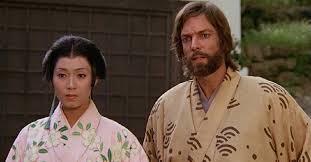
Shōgun is an American television miniseries based on the 1975 novel of the same name by James Clavell, who also was the executive producer of the miniseries.
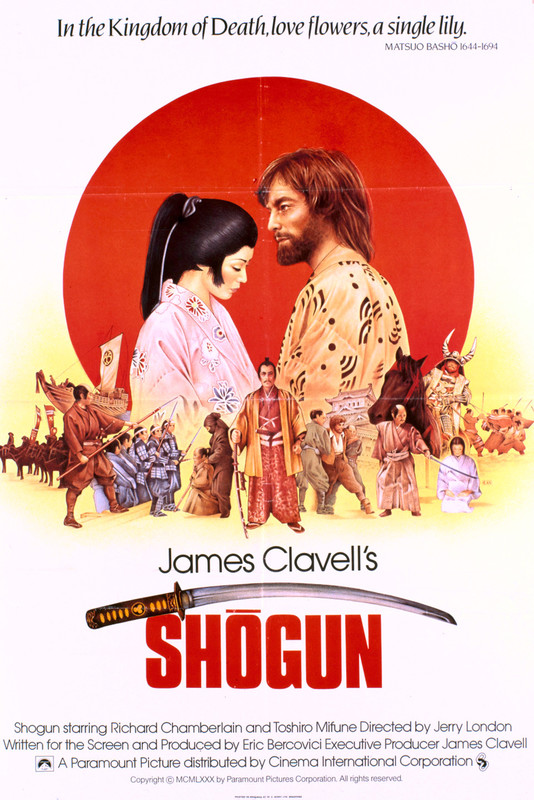
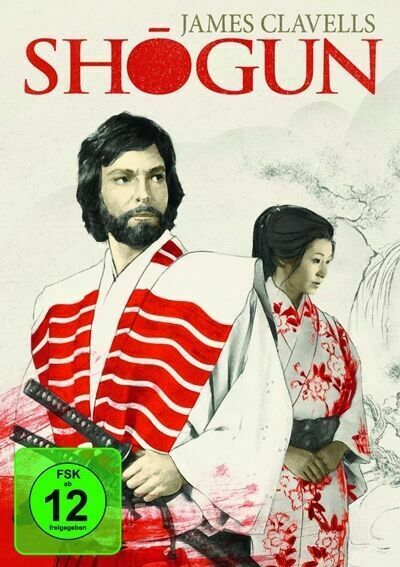
It was first broadcast in the United States on NBC over five nights between 15 and 19 September 1980.
The miniseries is loosely based on the adventures of English navigator William Adams, who journeyed to Japan in 1600 and rose to high rank in the service of the shōgun. The miniseries follows fictional Englishman John Blackthorne’s transforming experiences and political intrigues in feudal Japan in the early 17th century.
A second series adapting the book was released by FX in 2024.
Outline
After his Dutch trading ship Erasmus and its surviving crew is blown ashore by a violent storm at Anjiro on the east coast of Japan, Pilot-Major John Blackthorne, the ship’s English navigator, is taken prisoner by samurai warriors. When he is later temporarily released, he must juggle his self-identity as an Englishman associated with other Europeans in Japan, namely Portuguese traders and Jesuit priests, with the alien Japanese culture into which he has been thrust and now must adapt to in order to survive. Being an Englishman, Blackthorne is at both religious and political odds with his enemy, the Portuguese, and the Catholic Church’s Jesuit order. The Catholic foothold in Japan puts Blackthorne, a Protestant and therefore a heretic, at a political disadvantage. But this same situation also brings him to the attention of the influential Lord Toranaga, who mistrusts this foreign religion now spreading in Japan. He is competing with other samurai warlords of similar high-born rank, among them Catholic converts, for the very powerful position of Shōgun, the military governor of Japan.
Through an interpreter, Blackthorne later reveals certain surprising details about the Portuguese traders and their Jesuit overlords which forces Toranaga to trust him; they forge a tenuous alliance, much to the chagrin of the Jesuits. To help the Englishman learn their language and to assimilate to Japanese culture, Toranaga assigns a teacher and interpreter to him, the beautiful Lady Mariko, a Catholic convert, and one of Toranaga’s most trusted retainers. Blackthorne soon becomes infatuated with her, but Mariko is already married, and their budding romance is ultimately doomed by future circumstances. Blackthorn also ends up saving the life of a Portuguese counterpart, Pilot Vasco Rodrigues, who becomes his friend despite being on opposite sides.
Blackthorne saves Toranaga’s life by audaciously helping him escape from Osaka Castle and the clutches of his longtime enemy, Lord Ishido. To reward the Englishman for saving his life, and to forever bind him to the warlord, Toranaga makes Blackthorne hatamoto, a personal retainer, and gifts him with a European flintlock pistol. Later, Blackthorne again saves Toranaga’s life during an earthquake by pulling him from a fissure that opened and swallowed the warlord, nearly killing him. Having proved his worth and loyalty to the warlord, during a night ceremony held before a host of his assembled vassals and samurai, Lord Toranaga makes Blackthorne a samurai; he awards him the two swords, 20 kimonos, 200 of his own samurai, and an income-producing fief, the fishing village Anjiro where Blackthorne was first blown ashore with his ship and crew. Blackthorne’s repaired ship Erasmus, under guard by Toranaga’s samurai and anchored near Kyoto, is lost to fire, which quickly spread when the ships’ night lamps are knocked over by a storm tidal surge. During a later attack on Osaka Castle by the secretive Amida Tong (Ninja assassins), secretly paid for by Lord Ishido, Mariko is killed while saving Blackthorne’s life, who is temporarily blinded by the black powder explosion that kills his lover. Lord Yabu is forced to commit seppuku for his involvement with the ninja attack and personally murdering Captain Yoshinaka. Right before he dies, Yabu gives Blackthorne his katana, and Yabu’s nephew, Omi, becomes the daimyō of Izu.
Blackthorne supervises the construction of a new ship, The Lady, with funds Mariko left to him in her will for this very purpose. Blackthorne is observed at a distance by Lord Toranaga; a voice-over reveals the warlord’s inner thoughts: It was he who ordered the Erasmus destroyed by fire, in order to keep Blackthorne safe from his Portuguese enemies who feared his actions with the ship (since Blackthorne still has much to teach Toranaga); and, if need be, the warlord will destroy the ship Blackthorne is currently building. He also discloses Mariko’s secret but vital role in the grand deception of his enemies, and, as a result, how she was destined to die, helping to assure his coming final victory. The warlord knows that Blackthorne’s karma brought him to Japan and that the Englishman, now his trusted retainer and samurai, is destined never to leave. Toranaga also knows it is his karma to become Shōgun.
In an epilogue it is revealed that Toranaga and his army are triumphant at the Battle of Sekigahara; he captures and then disgraces his old rival, Lord Ishido (by burying him up to his neck), and takes 40,000 enemy heads, after which he then fulfils his destiny by becoming Shōgun. A different voice-over narrates that when the Emperor of Japan offered Toranaga the title of Shogun, he ‘reluctantly agreed’.
Cast
- Richard Chamberlain.
- Toshiro Mifune.
- Yoko Shimada.
- Damien Thomas.
- John Rhys-Davies.
Trivia
- To date, it is the only American television production to be filmed on location entirely in Japan, with additional sound stage filming also taking place in Japan at the Toho studio.
- Clavell and NBC wanted Sean Connery to play Blackthorne, but Connery reportedly laughed at the idea of working for months in Japan, as he had disliked filming You Only Live Twice there.
- According to the documentary The Making of Shōgun, other actors considered for the role included Roger Moore and Albert Finney.
- Only three of the Japanese actors spoke English in the entire production: Shimada, Obayashi, and Okada.
- At the time of filming, Shimada knew very little English, and heavily relied on her dialogue coach to deliver her lines phonetically.
- The English words that she could not pronounce were substituted or overdubbed in post-production.
- Theatrical release:
- In Japan, Shōgun was cut to a 159-minute version and released theatrically on 09 November 1980.
- Stuart Galbraith IV described this version of the film as “fatally cut to ribbons”.
- It was later restored to its full length for a home video release in Japan.
- A heavily truncated 125-minute edit of the miniseries was released in 1980 to European theatrical film markets.
- This was also the first version of Shōgun to be released to the North American home video market (a release of the full miniseries did not occur until later).
- The theatrical version contains additional violence and nudity that had been removed from the NBC broadcast version.
- DVD release:
- Released on 30 September 2003, the DVD release has no episode breaks and is divided over 4 discs, with bonus features on disc 5.
- Feature length: 547 minutes
- Extras: 13-segment documentary on the making of Shōgun (79:24); Historical Featurettes – The Samurai (5:34), Tea Ceremony (4:35), and Geisha (4:56); audio commentary by Director Jerry London on 7 selected scenes.
Shogun 1980 Series
Production & Filming Details
- Director(s): Jerry London.
- Producer(s): Eric Bercovici, Ben Chapman, James Clavell, and Kerry Feltham.
- Writer(s): Eric Bercovici.
- Music: Maurice Jarre and Richard Bowden (composer).
- Cinematography: Andrew Laszlo.
- Editor(s):
- Production: Asahi National Broadcasting Company, Jardine Matheson Co. Ltd., National Broadcasting Company (NBC), Paramount Television, and Toho Company.
- Distributor(s): NBC (US) and BBC (UK).
- Release Date: 15 September 1980 to 19 September 1980.
- Running time: 9 hours 7 minutes (total running time).
- Country: US.
- Language: English.


 Military Gogglebox
Leave a comment