
Introduction
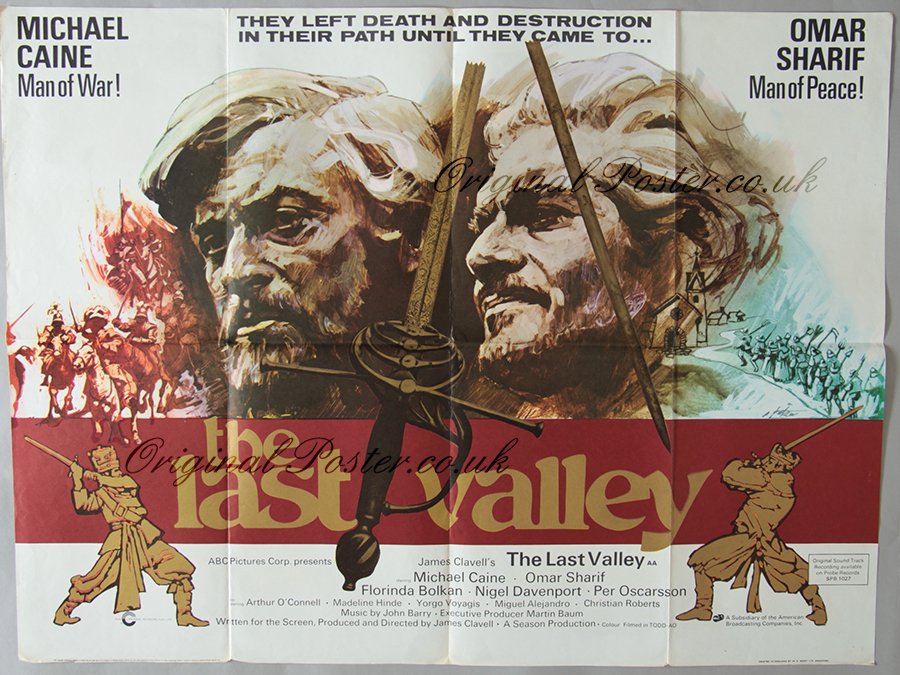
The Last Valley is a 1971 film directed by James Clavell, a historical drama set during the Thirty Years’ War (1618–1648). While war ravages southern Germany, a mercenary leader (Michael Caine) and a teacher (Omar Sharif) stumble upon a valley untouched by the war.
Based upon the novel The Last Valley (1959), by J.B. Pick, the cinematic version of The Last Valley, directed by James Clavell, was the final feature film photographed with the Todd-AO 70 mm widescreen process until it was revived to make the film Baraka in 1991.
Outline
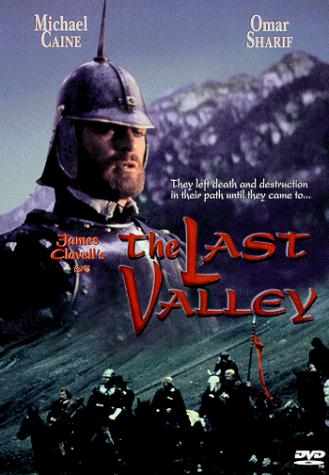
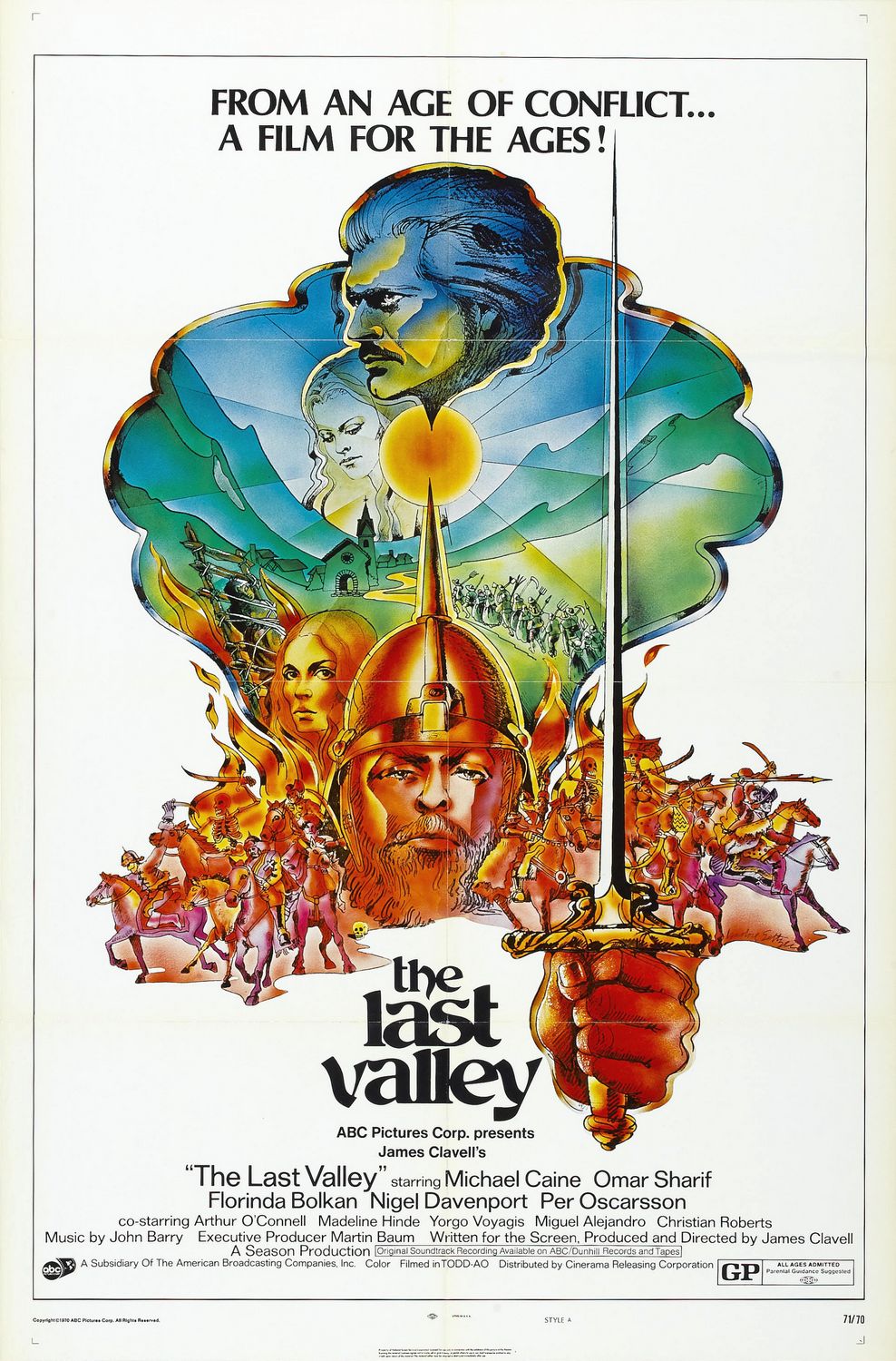
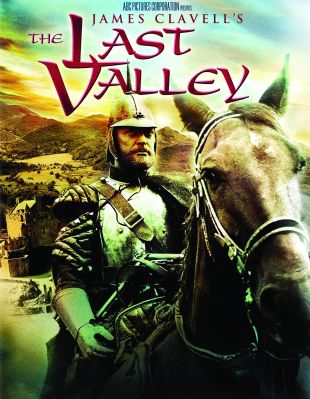
“The Captain” leads a band of mercenaries who fight for whoever will pay them, regardless of religion. His soldiers pillage the countryside, raping and looting when not fighting. Vogel is a former teacher trying to survive the fighting and resulting chaos in south-central Germany. Vogel runs from the Captain’s force, and eventually stumbles upon an idyllic mountain valley, untouched by war.
The Captain and his small band are not far behind. Caught, Vogel convinces the Captain to preserve the village so it can shelter the band through the coming winter, as the outside world faces famine, plague and the devastation of war. “Live,” Vogel tells the Captain, “while the army dies.” The Captain thinks the idea is good. He kills Korski, one of his own men, without warning when Korski objects to the idea of desertion. The local headman, Gruber, submits, after obtaining the best terms he can. The local Catholic priest is livid that the mercenaries include a number of Protestants (and nihilistic atheists for that matter), but there is nothing he can do to sway the Captain. The Captain kills several dissenting members of his band to uphold their pledge to set aside religious divisions.
The locals accept their fate. Vogel is appointed judge by the Captain to settle disputes between villagers and soldiers. As long as food, shelter, and a small number of women are provided, the mercenaries leave the locals alone. The Captain takes Gruber’s wife, Erica, for himself. Hansen attempts to rape a girl. When Vogel stops him, he and two others try but fail to kill the Captain. They flee, but return with a larger mercenary band before the winter closes the valley to outsiders. However, the Captain has anticipated this, and Hansen and his band are destroyed.
From the first peddler to enter the valley in the spring, the Captain learns of a major military campaign in the Upper Rhineland and decides to seek employment with Bernard of Saxe-Weimar. Vogel wants to accompany him, fearing Gruber will have him killed once the Captain leaves. However, the Captain orders Vogel to stay as the condition of not sacking the village, leaving Geddes and Pirelli behind as guards.
After the Captain departs, the priest catches Erica praying to Satan to keep the Captain safe. The priest has her tortured and condemned to be burned at the stake. To spare her further suffering, Vogel kills her before her body is consigned to the flames. Enraged, Geddes pushes the priest into the fire and holds him there. Both are killed.
Meanwhile, the Captain and his men fight in a night assault on a fortified city. He returns to the valley with the only other survivor of his band. Vogel tries to warn him, but the Captain rides into an ambush set by Gruber. The Captain, however, is dying of his battle wounds, so there is no fighting. He tells Vogel, “You were right. I was wrong.” Inge, a young woman who has fallen in love with Vogel, wants to leave with him, but he tells her to stay, and walks off alone.
Cast
- Michael Caine as The Captain.
- Omar Sharif as Vogel.
- Florinda Bolkan as Erica.
- Nigel Davenport as Gruber.
- Per Oscarsson as Father Sebastian.
- Arthur O’Connell as Hoffman.
- Madeleine Hinde as Inge.
- Yorgo Voyagis as Pirelli.
- Vladek Sheybal as Matthias.
- Miguel Alejandro as Julio.
- Christian Roberts as Andreas.
- Brian Blessed as Korski.
- Ian Hogg as Graf.
- Michael Gothard as Hansen.
- George Innes as Vornez.
- John Hallam as Geddes.
Production
The novel was published in 1960. The New York Times called it “oddly compelling”. The Chicago Tribune called it “a strange and memorable book.”
In July 1967 it was announced that James Clavell, then enjoying success with the release of the film To Sir With Love and the book Tai-Pan, would adapt the book into a screenplay and direct a film adaptation for the Mirisch Corporation.
In November 1968 it was announced Clavell would make the film for ABC Pictures. The head of ABC was Martin Baum who was Clavell’s agent and who had helped put together To Sir, with Love.
Clavell was going to make the film after The Great Siege, a story of the Siege of Malta, which he was going to do after Where’s Jack? (1967). He ended up not making Great Siege. After he made The Last Valley he said he would write another book “to see if I’ve still got it.” (This would become Shogun.)
Omar Sharif was the first star to sign. By June 1969 Michael Caine had also signed on. At one stage the film was going to be called Somewhere in the Mountains There is a Last Valley. It was the biggest budgeted pictures made to date by ABC Pictures.
Clavell cast much of the supporting cast from British rep companies.
Shooting
Filming started 25 August 1969 in Austria.
The film was mostly shot in Tyrol, Austria (Trins and Gschnitz and the Gschnitztal Valley). Actor Martin Miller collapsed and died on the set before shooting of the first scene commenced.
Release
Box Office
The film was one of the most popular movies at the British box office in 1971. However, it was an expensive failure overall. It earned rentals of $380,000 in North America and $900,000 in other countries, recording an overall loss of $7,185,000.
DVD
The Last Valley was released on DVD by MGM Home Video 25 May 2004. It was again released on Blu-Ray by Kino Lorber on 23 June 2020.
Trivia
- Perhaps the most praised element of the production was the score by John Barry, then most famous for his “James Bond” scores.
- In the new millennium, it was still regarded as one of his best scores.
- In a project to prepare a special CD release of the soundtrack, it was discovered that the complete original session recordings were either lost or destroyed.
- The Captain changes sides at least once during the war.
- To have participated in the sack of Magdeburg, he must’ve fought with the Imperialists.
- At the end of this movie, he joins the army fighting against the Imperialists.
- Such fickle behaviour was far from uncommon amongst mercenaries of the period.
- The Captainrefers to the sack of Magdeburg having occurred twelve years previously.
- The sack took place in 1631, so the events of this movie occur in 1643 to 1644.
Production & Filming Details
- Director(s):
- James Clavell.
- Producer(s):
- Martin Baum … executive producer.
- James Clavell … producer.
- Robert Porter … associate producer.
- Writer(s):
- James Clavell.
- J.B. Pick … novel.
- Music:
- John Barry.
- Cinematography:
- Norman Warwick.
- John Wilcox.
- Editor(s):
- John Bloom.
- Production:
- ABC Pictures.
- Seamaster Films.
- Season.
- Distributor(s):
- Cinerama Releasing UK (1971) (UK) (theatrical).
- Cinerama Releasing Corporation (1971) (USA) (theatrical).
- 20th Century Fox Argentina (1971) (Argentina) (theatrical).
- Fox Films (1971) (Finland) (theatrical).
- Fox Norena Film A/S (1971) (Norway) (theatrical).
- Twentieth Century Fox (1971) (Belgium) (theatrical).
- Twentieth Century Fox (1971) (France) (theatrical).
- Filmes Castello Lopes (1981) (Portugal) (theatrical) (re-release).
- Nord Video (1981) (Norway) (VHS) (Beta) (Video 2000).
- Star Video (1982) (Australia) (video).
- Thorn-Emi Video (West Germany) (VHS).
- Video Elit (1986) (Greece) (VHS).
- Buena Vista Pictures (1995) (World-wide) (all media).
- Pearson Television International (2001) (UK) (DVD).
- Topanga Canyon Films (2018) (Spain) (all media).
- Pidax Film (2019) (Germany) (DVD).
- Kino Lorber Studio Classics (2020) (USA) (Blu-ray).
- MGM Home Entertainment (USA) (DVD).
- Release Date: 28 January 1971 (US).
- Rating: AA.
- Running Time: 125 minutes.
- Country: US.
- Language: English.


 Military Gogglebox
Leave a comment